



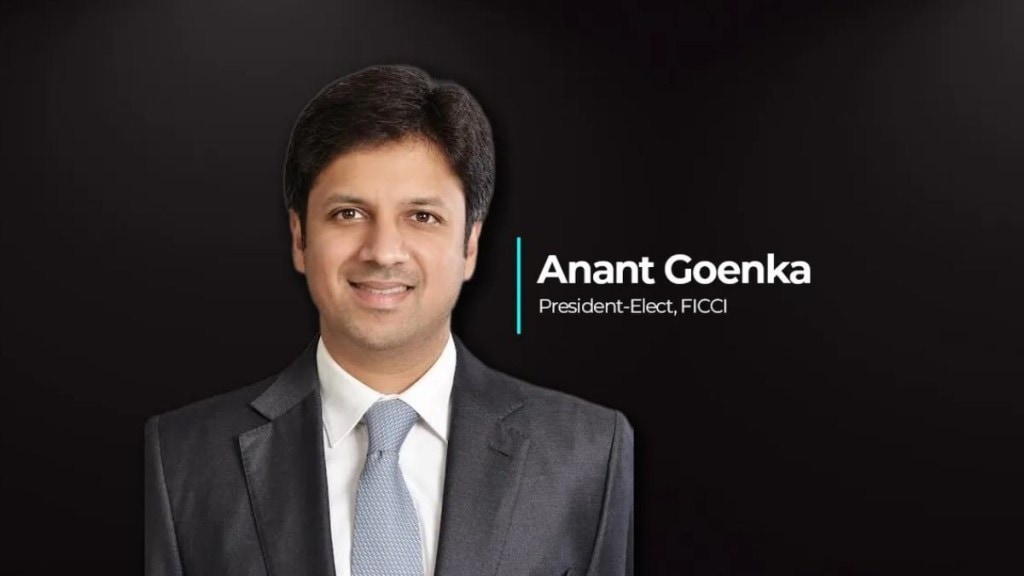
Industry body FICCI’s key focus areas will be helping lift manufacturing’s GDP share to 25%, boosting R&D and innovation, maximising new-age FTAs, driving sustainability, skilling and global competitiveness through industry-led initiatives, its new president Anant Goenka said. Economy will likely grow by around 7% in FY26, Goenka told Prasanta Sahu and Nitin Kumar. Edited excerpts.
The economy grew by 8% in H1. Where do you see growth for FY26?
We expect GDP growth to be close to 7% this year. Several measures have boosted consumption, including tax relief for incomes up to ₹12 lakh and the recent GST cuts. These steps are clearly reflected in improving demand, which had earlier been somewhat tepid. With demand strengthening, capacity utilisation across companies is rising as well. This creates a more favourable environment for private capex, which has been a key expectation from the government. As utilisation improves and confidence builds, we believe private investment should begin picking up, further supporting growth momentum through the year.
How long will GST cuts sustain the demand in the economy?
The overall deflation impact should be largely positive. We have already seen a 50% jump in two-wheelers and over 20% growth in passenger cars, though such high rates may not persist. Still, with lower costs and more money in people’s pockets, a virtuous cycle can emerge—supporting demand, private capex, jobs, and wages. For FICCI, the core priority is to lift manufacturing’s GDP share from 15% to 25% through R&D (leveraging the ₹1.5 lakh crore fund), deeper industry-academia ties, higher FTA utilisation, supply-chain resilience, women-led growth, sustainability, MSME mentoring and joint ease-of-doing-business reforms with the government.
Goenka on tax and labour reforms
After tax and labour reforms, what key structural changes should the government undertake to push growth?
While labour and logistics have seen progress, power and land remain areas needing deeper reforms—reducing cross-subsidisation in electricity, strengthening renewable energy rules and improving land acquisition processes. Other priorities include improving ease of doing business at the state level. Expanding self-certification, which worked well during COVID, should further strengthen the shift to a trust-based system—while retaining checks only for sensitive or national-security areas. During COVID times, there were certain areas where self-certification was allowed because physical visits were not happening.
How do you participate in the projects for skilling, technology adoption, and sustainability?
We are prioritising sustainability, Industry 4.0 adoption, women-led development and quality excellence, and much of this work is industry-led. Rather than seeking extensive government intervention, we partner with them on specific initiatives such as integrating AI and expanding digital capabilities. We have also identified 30–40 leading companies that excel in digitalisation, quality and women empowerment. MSMEs are encouraged to visit these firms, learn from their practices and receive mentorship on what works and what doesn’t.
Goenka on maximising capex
How do you think private capex can be catalysed?
Improving ease of doing business, lowering production costs and enhancing global competitiveness remain essential, but a major responsibility lies with entrepreneurs themselves. Indian firms must design products for American and European consumers, invest consistently in branding, packaging, design, and allocate at least 2–3% of revenue to R&D. While some of this happens for the domestic market, it is not enough to build world-class manufacturing, quality and brands.
Why are Indian exporters underutilisation free trade agreements (FTAs)?
This is a very important area for us. Across industry chambers, our role is to ensure awareness and encourage higher utilisation of FTAs, which is why we are actively spreading information among members. Unlike a decade ago with Japan and Korea—when utilisation was low due to non-tariff barriers—we are now seeing a clear shift. Australia’s FTA utilisation is around 77%, and trade with the UAE has risen 15–17% year-on-year. The new FTAs are more comprehensive, going beyond tariff cuts to include mutual recognition of certifications, stronger IP protection, smoother people movement, and broader market access, leading to better real-world outcomes.