


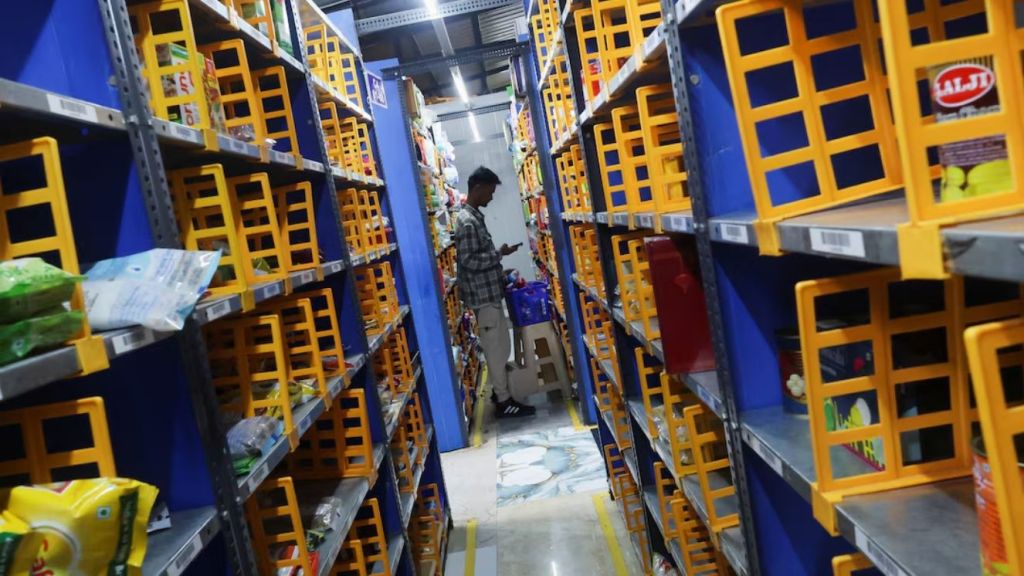

India’s quick commerce sector is projected to require around 75 million square feet (sq ft) of urban logistics space by 2030, as operators expand their dark-store networks and invest in larger warehouses to support fulfillment, according to a report by real estate consultancy CBRE.
Of the projected requirement, around 42 million sq ft will be needed for in-city dark stores, while 33 million sq ft will be required for mother hubs, larger warehouses on city outskirts that replenish multiple dark stores.
India had around 7,800 dark stores in 2026, occupying nearly 27 million sq ft across more than 100 cities. The network is projected to exceed 12,000 stores by 2030, with expansion extending beyond major metros into tier-II and tier-III markets, the report said.
Quick-commerce-related warehousing demand grew at a compound annual growth rate (CAGR) of 81% between 2021 and 2025, accounting for 4-5% of India’s total logistics leasing during the period. Annual space take-up increased from 3.1 million sq ft in 2024 to 4.3 million sq ft in 2025.
But the demand remains concentrated in major urban centres. Delhi-NCR accounted for 21% of quick-commerce leasing between 2021 and the first half of 2026, followed by Mumbai at 20% and Bengaluru at 17%. Hyderabad and Chennai accounted for 16% and 11%, respectively.
While 65-70% of dark stores are concentrated in the top eight cities, operators are also expanding into markets such as Jaipur, Lucknow, Surat, Coimbatore and Nagpur, where relatively lower real estate costs could support expansion, said the report.
The expansion of dark-store networks is also driving demand for larger mother hubs. Typically measuring 100,000-125,000 sq ft, these facilities serve 30-50 dark stores each, depending on store density, and accommodate additional stock that cannot be stored in smaller urban facilities.
The report also points to franchise-led dark stores, third-party logistics providers and partnerships with neighbourhood kirana stores as potential routes for expansion. Such models could help operators enter smaller cities and use shared fulfilment infrastructure, influencing leasing demand through 2030, the report said.
“Quick commerce is creating a distinct urban logistics requirement that sits between retail and conventional warehousing. As networks expand, operators will increasingly assess sites on their ability to support high-throughput fulfilment, rather than on floor area alone,” said Ram Chandnani, managing director, leasing services, India, CBRE.
He said factors such as ground-floor access, loading arrangements, rider movement, power availability for cold-chain infrastructure and proximity to consumer catchments would become important in determining the suitability of locations.