


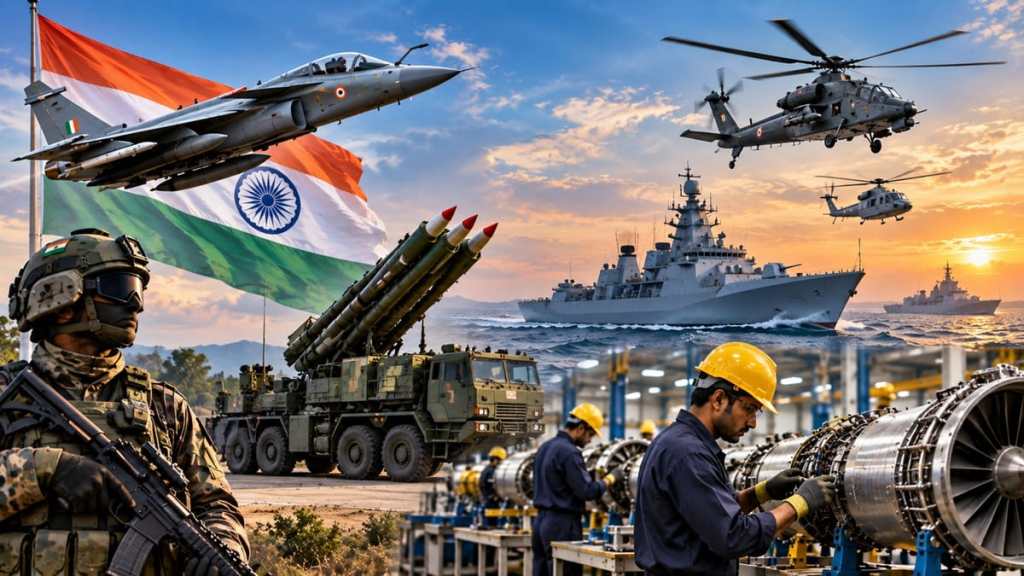

India’s private defence companies have about Rs 34,700 crore earmarked for them in FY27, according to a report by Emkay Global Financial Services. That is roughly 25% of the domestic capital acquisition budget.
The money is part of a larger rise in government spending. Defence capital outlay for FY27 is about Rs 1.9 lakh crore, up 24% from last year, as per the report. Spending is also being reset in Europe, and that gives Indian firms a chance to sell abroad, the report noted.
India’s defence production hits record
Much of this rests on a growing domestic base. Defence production reached a record Rs 1.8 lakh crore in FY26, up 15.6% from the year before, according to the report. That takes the annual growth rate since FY21 to about 18%.
The government now wants production to reach Rs 3 lakh crore by FY29, as per the report. Exports are expected to help get it there. They rose 63% to around Rs 38,000 crore in FY26, and the target for FY29 is Rs 50,000 crore, the report noted.
India already sells to more than 80 countries. The US, France and Armenia are among the major buyers, according to the report.
Private defence firms gain market share
Private companies are getting a bigger slice of this output. Their share rose to 24% in FY26 from 22% in FY25, which works out to about Rs 42,000 crore, as per the report.
Policy is pushing in the same direction. Of the Rs 1.4 lakh crore modernisation budget for FY27, 75% is set aside for domestic industry, the report noted.
With more work coming their way, private firms are also taking on harder tasks. Until now, many built products to a drawing given by the buyer, a model known as Build-to-Print. They are now moving to Build-to-Specification, Build-to-Design and Build-to-Requirements work, according to the report.
According to the report, some are going a step further. They are building Lead System Integrator skills, which would let them handle the design, integration and delivery of complex platforms, as per the report.
Defence orders hit record levels
These firms have a healthy order flow to work with. In FY26, the Defence Acquisition Council cleared 55 proposals worth about Rs 6.8 lakh crore, according to the report. Contracts for 503 proposals worth around Rs 2.3 lakh crore were also signed, and both figures are the highest annual levels cited in it.
As per the report, the demand comes from all three services. The Air Force is progressing the Multi-Role Fighter Aircraft, LCA Tejas Mk-II and the Advanced Medium Combat Aircraft. The Army is looking at Future Infantry Combat Vehicles, QRSAM and loitering munitions. The Navy is pursuing Project 75I, more Scorpène submarines and next-generation frigates.
Defence indigenisation boosts local suppliers
Programmes of this size will need many local suppliers, and the indigenisation drive is meant to build that base. Five positive indigenisation lists covering 5,012 critical items have been notified, and 3,025 of them have already been made in India, according to the report.
The Srijan portal extends the effort to smaller parts. It has identified more than 38,000 items for indigenisation, and over 13,900 have been indigenised so far, the report said.
New technology is getting support as well. Allocations under iDEX and ADITI stand at about Rs 450 crore, which is nearly triple the level of two years ago. The money is going to start-ups working on artificial intelligence, unmanned systems, electronic warfare and sensors, as per the report.
Manufacturing capacity is spreading too. The Uttar Pradesh and Tamil Nadu defence corridors have drawn more than Rs 9,100 crore in investment, the report noted. Another 289 MoUs point to potential investments of around Rs 66,400 crore across 11 nodes.
Europe opens new defence export opportunities
Beyond India, the biggest new demand is coming from Europe. The European Union’s SAFE mechanism offers up to €150 billion in long-maturity loans, according to the report. The money is meant for ammunition, missiles, drones, counter-drone systems and air and missile defence.
India has already taken a step towards that market. It signed the EU-India Security and Defence Partnership in January 2026, which opens room for co-production and technology cooperation, the report said.
HAL, BEL and BDL order books
Among listed companies, Hindustan Aeronautics has the largest order book at about Rs 2.5 lakh crore. It is backed by the Tejas Mk1A programme, and the company plans capital expenditure of around Rs 12,000 crore through FY30, as per the report.
Bharat Electronics has been shifting towards a systems integrator role. Its order inflows were about Rs 29,700 crore in FY26, up 53%, and its backlog is around Rs 72,300 crore, the report noted.
Bharat Dynamics has an order book above Rs 26,000 crore, with Akash-NG, Astra Mk-II, QRSAM and MRSAM in its pipeline. The report stated BEML’s order book stands at about Rs 21,700 crore.
Taken together, these trends are changing the shape of the industry. The sector is moving from a market driven by government procurement to a wider manufacturing and technology base.