


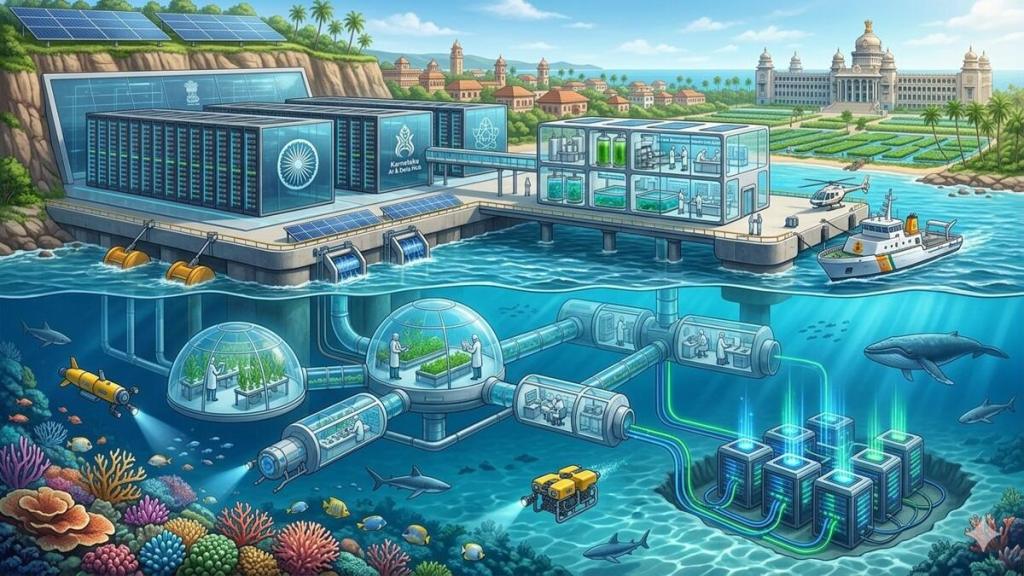

Karnataka has put money at the centre of its next growth push, approving two five-year policies that together aim to attract investment and expand economic activity. The Marine Biotechnology Policy 2026–2031 targets lifting the state’s “Blue Bioeconomy” from an estimated $2 billion today to $6–8 billion by 2031, with a proposed outlay of Rs 120 crore.
On the digital side, the Sustainable Data Centre Policy 2026–2031 carries a much larger proposed outlay of Rs 1,300.45 crore and sets a 1 gigawatt (GW) cumulative IT load target by 2031, aiming for 10–12% of India’s AI-ready data centre capacity.
Karnataka is taking a major step towards building a high-value Blue Bioeconomy with India's first comprehensive Karnataka Marine Biotechnology Policy 2026-31, targeting growth to $8 billion by 2031.
At the centre of the policy will be the Karnataka Institute of Marine… pic.twitter.com/KynQAbGiYm
— Priyank Kharge / ಪ್ರಿಯಾಂಕ್ ಖರ್ಗೆ (@PriyankKharge) September 19, 2026
Marine biotechnology policy: Turning coastline into cash flow
The marine policy is built around a simple idea- convert Karnataka’s 343.3-km coastline, marine biodiversity and existing biotech strengths into high-value products, companies and intellectual property (IP) rather than just raw materials.
The state government officials say the focus is on moving “from recognising potential to creating products, technologies, companies and IP” around marine resources.
“To do this, the policy backs marine biomanufacturing, seaweed-based products, marine biomaterials, bioprocessing and sustainable marine enterprises, while keeping ecosystem sustainability as a core condition. The goal is not only higher export earnings but also better incomes for coastal communities through new enterprises and jobs,” they added.
Karnataka Home Minister Priyank Kharge said, “Karnataka is looking to turn its marine resources into new products, technologies, companies and intellectual property, while building the digital infrastructure needed to drive its next phase of tech-led growth.”
What will the Rs 120 crore policy support?
The proposed Rs 120 crore five-year budget covers infrastructure and incentive mechanisms.
Key components include:
- Karnataka Institute of Marine Biotechnology and Blue Economy (KIMBE): A new institutional anchor for research, innovation and commercialisation, to be set up at the Government Fisheries College.
- Marine Biotechnology Zones: Dedicated zones developed with the fisheries department, offering common infrastructure, logistics, testing facilities and plug-and-play setups for companies.
- Seaweed Value Addition PLI (SVA-PLI): A production-linked incentive for higher-value seaweed derivatives such as nutraceuticals, biofertilisers, bioplastics, bio-based chemicals and biofuels.
- Pilot Blue Carbon Certification Programme: A scheme to scientifically assess and certify carbon sequestration from seaweed cultivation and other eligible coastal blue-carbon ecosystems, opening up potential carbon credit revenues.
- Research and incubation infrastructure: Labs, a biobank and incubation centres, particularly in Udupi, to link marine science with startups and industry.
The government expects this ecosystem to create around 2,500 high-value technical jobs and about 7,500 coastal enterprise and livelihood opportunities over the policy period.
Data centre policy: Karnataka’s Rs 1,300-crore AI infrastructure bet
Alongside the blue economy push, Karnataka has cleared the Sustainable Data Centre Policy 2026–2031 to meet surging demand from artificial intelligence (AI), cloud computing, the Internet of Things (IoT), 5G, global capability centres (GCCs) and fintech.
The policy’s headline numbers are stark:
- Proposed outlay: Rs 1,300.45 crore over five years.
- Capacity target: 1 GW of cumulative data centre IT load by 2031.
- AI share ambition: Capture 10–12% of India’s AI-ready data centre capacity.
IT load here refers to the power needed to run computing equipment—servers, storage and networking gear—inside data centres, a key measure of capacity for AI workloads.
Karnataka’s Marine Biotechnology Policy 2026–31, approved at the Coastal Cabinet Meeting, targets an $8B Blue Bioeconomy by 2031.
With KIMBE, Marine Biotechnology Zones, Seaweed PLI & Blue Carbon Certification, it aims to drive innovation, startups and coastal livelihoods. pic.twitter.com/LeV2RlrDZi
— ITBT Karnataka (@ITBTGoK) September 19, 2026
Beyond Bengaluru: Spreading data centre investment across the state
A major objective of the data centre policy is to expand infrastructure beyond Bengaluru and strengthen emerging regional digital corridors, in line with the state’s “Beyond Bengaluru” vision.
The framework ties together:
- Investment facilitation for domestic and global players across the data centre value chain.
- Digital infrastructure planning, including identification of Data Centre Zones and Parks.
- Sustainability-linked incentives and ecosystem development, covering research and development (R&D), skilling and green power integration.
Implementation will follow a phased five-year roadmap, starting with policy operationalisation and investor facilitation, then moving to zone identification, ecosystem expansion, R&D, skilling and finally consolidation of Karnataka’s position as a sustainable data centre hub.
What the policies aim to achieve
Karnataka’s two new policies aim to support a more connected growth strategy. The state wants to use its coastline and marine resources to build a strong blue bioeconomy, while at the same time expanding digital infrastructure like data centres and AI-ready facilities.
The goal for the blue bioeconomy is clear: to grow its value from about $2 billion to $6–8 billion in five years and create thousands of jobs along the coast. For data centres, the state hopes that building large, green, AI-friendly capacity will attract big investments, bring global tech companies in, and create high-skilled jobs outside Bengaluru.