


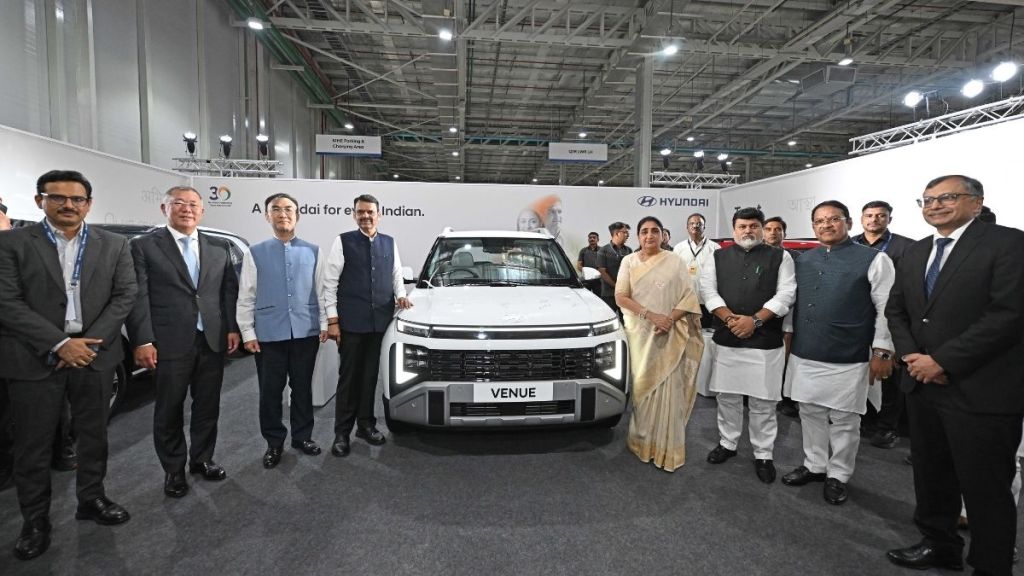

Hyundai Motor Company President and CEO José Muñoz expects Hyundai Motor India to regain its position as the country’s second-largest passenger vehicle manufacturer by 2028-29, with the newly inaugurated Pune plant playing a key role in expanding production capacity and supporting growth.
Speaking on the sidelines of the plant inauguration, Muñoz said the recovery in market share would depend largely on increasing production to meet demand. “This factory is going to help us (in getting more cars). Once the factory increases production up to 3,20,000 units, we’re going to get there. At the latest, maybe 2028 or 2029,” he said. The Pune plant currently produces Hyundai Venue SUVs for domestic and export markets and has a yearly capacity of 1,70,000 units
Hyundai has slipped to fourth place in the passenger vehicle market amid intensifying competition from Tata Motors and Mahindra & Mahindra. However, Muñoz said the company was not fixated on its ranking. “We are not obsessed with that. The most important thing is to have a good product, good quality and then everything else is going to come,” he said, adding that India remained Hyundai’s second-largest market after the US this year. Munoz also indicated that a CNG-powered Venue could arrive soon.
Hyundai Motor India Limited (HMIL) inaugurated a new manufacturing plant in Talegaon, Pune, on October 14, 2026, expanding its production network beyond its original Chennai facility, which has been operational since the company entered India in 1996.
Maharashtra Chief Minister Devendra Fadnavis presided over the inauguration, joined by Hyundai Motor Group Executive Chair Euisun Chung, HMG President and CEO José Muñoz, and HMIL Managing Director and CEO Tarun Garg, along with South Korea’s Ambassador to India, Lee Seong-ho.
Hyundai plans to increase the Pune plants annual capacity from 1,70,000 units to 3,20,000 units by 2030, taking combined capacity at its Pune and Chennai plants to 11,40,000 units. The company has committed up to ₹11,000 crore to the Maharashtra facility.
Tarun Garg, managing director and CEO of Hyundai Motor India, said Pune would also provide a manufacturing base for planned hybrid vehicles. The company aims to ensure sustainable powertrains account for 50% of its portfolio by 2030.
Hyundai plans to introduce 26 new models and expand its electric vehicle portfolio to four models by 2029. It is also strengthening its domestic EV supply chain, having localised battery packs and power electronics, while evaluating cell localisation.
The automaker aims to raise localisation levels from 83% currently to 92%, with Maharashtra-based suppliers expected to play a significant role. “We are looking at Pune to really, really provide a great fillip to our plants in India,” Garg said.
Hyundai currently exports around 24% of its production, compared with 20% five years ago, and aims to raise the share to 30%. It has crossed four million cumulative vehicle exports from India, becoming the first automaker in the country to achieve the milestone.
“We want to increase more. So, I think that is the second thing which we are going to do, not only in the domestic market, but also in the exports market,” Garg said.
Hyundai has invested ₹7,000 crore directly in Maharashtra, with another ₹4,000 crore planned by 2030. Its vendors have invested an additional ₹4,600 crore in the state, with Tier 1 and Tier 2 suppliers generating more than 18,000 jobs.