


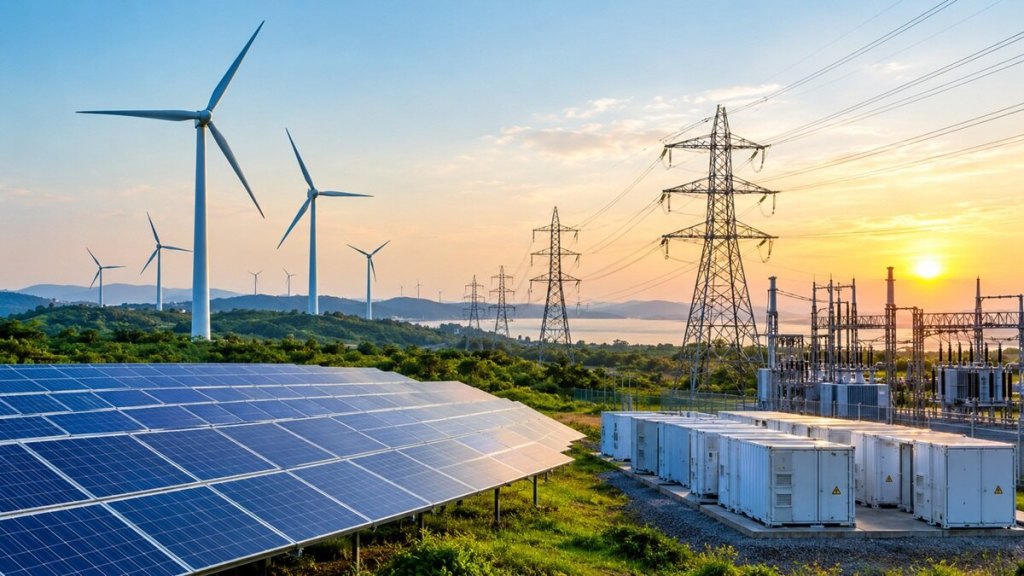

Renewables are no longer a side project in India’s power system; they are becoming the backbone of the country’s energy security. Union Minister for New and Renewable Energy, Pralhad Joshi, earlier said that India ranks third globally in renewable energy installed capacity.
With the world’s third-largest installed renewable capacity, India is moving from simply adding solar and wind projects to building the transmission lines, storage systems and policy frameworks needed to make clean power reliable, affordable and available when it is needed most.
Installed solar capacity has risen from about 3 GW in 2014 to over 168 GW by August 2026, while wind capacity stands at around 58 GW. As the share of renewables in the generation mix grows, the grid needs stronger transmission networks and large-scale storage to handle variability in solar and wind output.
As per the government data, the policies for rooftop solar, floating solar, small hydro, geothermal and green hydrogen are also diversifying the energy mix which reduces dependence on imported fossil fuels, cushions the economy from volatile global fuel prices and strengthens long-term energy security while supporting India’s climate commitments.
Grid first: Transmission and storage take centre stage
To strengthen India’s renewable energy push, the Union Cabinet has approved the Rs 1.86 lakh crore Green Energy Corridor Phase-III (GEC-III) scheme. The programme aims to evacuate up to 135 GW of renewable power and deploy 50 GWh of battery storage by 2032–33, as the grid prepares for a sharp rise in non-fossil capacity.
For years, India’s renewable story focused mainly on adding generation capacity. Now, the emphasis is shifting to evacuation, integration and reliability. Union Minister Ashwini Vaishnaw said adequate transmission capacity would be important as renewable generation rises, with the government seeking to ensure that grid infrastructure comes up ahead of new renewable projects. A presentation during the briefing warned that without adequate transmission, renewable power could face curtailment, and stressed that transmission capacity needed to precede renewable-energy capacity addition.
GEC-III has a total outlay of Rs 1,86,405 crore. Of this, Rs 1,36,378 crore is for strengthening intra-state transmission systems and Rs 50,000 crore is for 50 GWh of Battery Energy Storage Systems (BESS). The Centre will provide financial assistance of Rs 54,082 crore to help offset intra-state transmission charges and limit their impact on consumer tariffs.
The Union Cabinet has approved the Green Energy Corridor Phase-III (GEC-III) Scheme for Development of Intra-State Transmission Systems with Battery Energy Storage Systems, with a total outlay of ₹1,86,405 crore. The scheme will strengthen transmission infrastructure, enable up… pic.twitter.com/Nl9sTlhLC7
— Ministry of New and Renewable Energy (MNRE) (@mnreindia) September 30, 2026
All new intra-state transmission projects will be awarded through tariff-based competitive bidding, with Transmission Service Providers building, owning, operating and maintaining the assets. State Transmission Utilities will act as implementing agencies. Upgradation of existing networks will be done on a cost-plus basis. The battery systems can be installed at renewable generation sites or other strategic locations to address intermittency, transmission congestion, peak-hour curtailment and demand during non-solar hours.
Why storage matters for solar-heavy grids?
According to the Ministry of New and Renewable Energy, India’s solar capacity has grown and this rapid expansion is increasing the need for supporting grid infrastructure and storage.
Speaking with The Financial Express Digital, Vineet Mittal, Chairman and Founder of Avaada Group, said the Cabinet’s approval of GEC-III was an important step towards ensuring affordable and dependable delivery of clean power.
“By bringing transmission and battery storage into one programme, it recognises that generation, delivery and availability must advance together,” Mittal told.
He also cautioned that battery capacity alone does not determine how much new solar must be built.
“Some batteries will initially absorb surplus electricity from existing plants. As demand and storage utilisation increase, additional renewable generation may be needed to charge them. However, this requires careful planning. Battery capacity alone does not tell us how much new solar must be built. That depends on charging sources, operating cycles, efficiency, local demand and the availability of existing surplus power,” he said.
Mittal added that every district should assess the role that local renewable generation and storage can play in meeting its electricity needs.
“The right solution will vary by location. Some districts will benefit from solar and batteries close to demand centres. Others will require stronger connections to larger renewable projects. Planning should reflect local resources, land availability, network conditions and consumption patterns,” he said.
Speaking with The Financial Express Digital, Kishor Nair, CEO and Director of Avaada Energy said that renewable energy is changing the very meaning of energy security for India. “For decades, our growth has remained exposed to imported fossil fuels and global price volatility. The opportunity now is to progressively move from imported molecules to domestically produced electrons. The progress we have achieved in renewable energy capacity addition give us confidence. India’s solar capacity has increased from around 2.8 GW in 2014 to over 168 GW by August 2026,” Nair told
“Yet India continues to import close to 90% of its crude-oil requirement. The next phase of our energy transition should therefore not be measured only by renewable capacity added, but by how much imported energy we can structurally replace. Our ambition should be to electrify every economically and technically feasible use of energy—mobility, buildings, agriculture and progressively industrial processes. For hard-to-abate sectors where direct electrification is difficult, renewable electricity can be converted into green hydrogen and derivatives such as green ammonia and green methanol. This can simultaneously strengthen energy security, save precious foreign exchange and create a new domestic industrial ecosystem,” he added.
Nair said, “Countries such as Iceland and Uruguay demonstrate what sustained policy and investment can achieve. Iceland built around its hydro and geothermal strengths, while Uruguay generated 98% of its electricity from renewable sources in 2025, combining hydro, wind, biomass and solar. India need not replicate either model; we must build around our own advantages—abundant solar, complementary wind, hydro and pumped storage, batteries and an increasingly interconnected national grid. The next frontier is therefore dependable renewable electricity for every hour, not renewable capacity alone. This requires generation, storage, transmission, forecasting and flexible demand to be planned as one system.”
“India can take this ambition further through a 100% Renewable Electricity States Mission, beginning with a few willing States and progressively demonstrating reliable, affordable, increasingly renewable electricity at scale. Ultimately, India’s energy transition should be about energy sovereignty. We should aim for maximum electrification, green molecules where direct electrification is difficult, and deep domestic manufacturing so that we do not replace dependence on imported oil with dependence on imported clean-energy technologies. That is the pathway towards making India an Electrostate—an economy increasingly powered by energy that we produce, store and control ourselves,” he further stated.
Manufacturing opportunity in a more electrified economy
GEC-III also opens up a manufacturing opportunity across the renewable value chain. “This programme can also support a broader manufacturing opportunity. Solar modules and cells, batteries, transformers, cables, inverters and control systems all form part of the infrastructure required for a more electrified economy,” Mittal said.
“For India, the opportunity is to develop the capability to design, manufacture, install and maintain these systems at scale. That means investing in quality, engineering, skilled people and sustained innovation. The government has set out the direction. Industry, utilities and implementing agencies must now turn that direction into dependable infrastructure,” he added.
Wind Power: Record additions and growing domestic manufacturing
Wind energy remains a main pillar of India’s renewable expansion. India ranks fourth globally in installed wind power capacity which stood at 58.14 GW as of July 31, 2026. The country added 6.05 GW in 2025–26, its highest-ever annual wind capacity addition and 46% higher than in 2024–25. Around 28 GW of additional wind capacity is under implementation.
Domestic manufacturing has also scaled up. Wind turbine manufacturing capacity reached about 24 GW by March 2026, up from 10 GW in 2014, with 70–80% indigenisation across key components. The Union Cabinet has also approved a Rs 7,453 crore viability gap funding (VGF) scheme for 1 GW of offshore wind projects, signalling a push into deeper-water, higher-capacity wind resources.
Solar Power: From utility-scale to rooftops and floating PV
Solar is now the largest component of India’s renewable energy capacity. In 2025, India became the world’s second-largest solar growth market, adding more than 37 GW of solar capacity, compared with 34 GW added by the United States.
The PM-Surya Ghar: Muft Bijli Yojana, launched in February 2024 with an outlay of Rs 75,021 crore for 1 crore households, has so far benefited 51.58 lakh households with rooftop solar installations. Approximately Rs 28,024 crore in subsidy has been transferred, and nearly 19 lakh households are now receiving zero electricity bills. Cumulatively, 14.8 GW of rooftop solar capacity has been commissioned under the scheme.
A newer initiative, the Pradhan Mantri Surya Sarovar Yojana (PM-SSY), was approved on July 31, 2026 with an outlay of Rs 5,070 crore. It focuses on floating solar photovoltaic projects with energy storage.
The target is 5,000 MW of floating solar PV projects, co-located with storage of at least two-hour duration, equivalent to 10,000 MWh. Projects will be sanctioned from 2026–27 to 2030–31.
Hydropower: Flexible, firm renewable capacity
Hydropower continues to provide firm, flexible renewable electricity and supports grid stability as variable solar and wind capacity expands. Cumulative hydro capacity, including large and small hydro, was 57.24 GW as of July 31, 2026.
In March 2026, the government approved the Small Hydro Power (SHP) Development Scheme for 2026–27 to 2030–31, with an outlay of Rs 2,584.60 crore. The scheme aims to add about 1,500 MW of small hydro capacity through projects of 1–25 MW, with a focus on hilly and North-Eastern regions.
Geothermal: Tapping earth’s heat for baseload power
Geothermal energy offers a reliable renewable source that can complement variable solar and wind. It uses heat stored within the Earth to generate electricity or provide direct heat. The National Policy on Geothermal Energy, notified on September 15, 2025, provides a framework for exploration, development and utilisation of geothermal resources. The Geological Survey of India has estimated India’s geothermal potential at around 10,600 MW, based on exploration across 381 hot springs, with 42 geothermal manifestations identified as promising areas.
The policy promotes technology partnerships, knowledge transfer and joint R&D. India has cooperation mechanisms with Australia, Iceland, Saudi Arabia and the United States for geothermal energy. Five projects were sanctioned during July–August 2025, including a pilot production plant, resource assessment projects and a solar–geothermal hybrid plant to establish techno-economic viability.
Green Hydrogen: From pilots to early commercial use
Green hydrogen has emerged as a clean fuel option for hard-to-abate sectors such as refining, fertilisers, steel and heavy transport. The National Green Hydrogen Mission, launched in 2023 with an outlay of Rs 19,744 crore, targets 5 million metric tonnes (MMT) of green hydrogen production by 2030. Around 8,000 tonnes per annum of green hydrogen production capacity had been commissioned by February 2026.
In July 2026, the government launched 12 pilot projects under the mission for 70 hydrogen-powered vehicles across 21 routes. India’s first indigenous hydrogen fuel cell-powered train began operations on the Jind–Sonipat section in July 2026, marking an early step towards hydrogen-based mobility.
Long-term capacity targets and energy security
The government is targeting 500 GW of non-fossil fuel capacity by 2030 and is planning for around 786 GW by 2035–36. According to official data, GEC-III would contribute towards the longer-term target of 900 GW of installed non-fossil capacity by 2035.
The scheme is expected to support long-term energy security by reducing dependence on imported fossil fuels, cutting the carbon footprint and creating large direct and indirect employment in the power sector, manufacturing and construction. BESS manufacturing and deployment are also expected to generate jobs in the domestic energy storage industry, along with long-term skilled employment in operation, maintenance and grid management.
India’s renewable energy story is no longer just about hitting big capacity numbers. According to government officials and experts the next phase is about building a system where power generation, transmission lines, storage and demand-side solutions should all work together smoothly.