


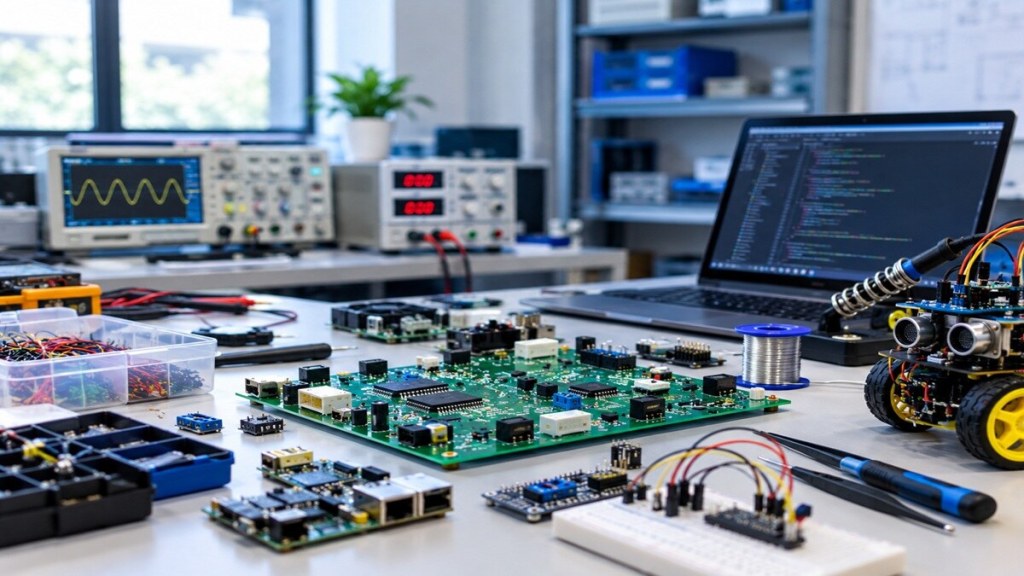

India’s next generation of technology entrepreneurs may not come from Bengaluru’s startup ecosystem. They could emerge from engineering colleges and incubators in Jaipur, Chandigarh, Mandi, Dehradun, Jammu or other smaller cities, armed with a prototype, a patent and now, potentially, government-backed capital.
Announced at the STPI Electropreneur Summit in Delhi, the Electropreneur 2.0 programme comes with a Rs 47 crore outlay and a bold target-nurture 500 startups in Electronic System Design and Manufacturing (ESDM), with a deliberate focus on talent outside metros.
The financial commitment behind Electropreneur 2.0 is substantial and strategically structured. Of the total 47 crore outlay, around Rs 17 crore comes from MeitY, with the rest pooled from the Software Technology Parks of India (STPI), IIIT-Delhi, the India Electronics and Semiconductor Association (IESA), and corporate social responsibility (CSR) support.
This isn’t just grant money—it’s end-to-end startup fuel.
The programme offers:
- Seed funding to help innovators build prototypes and validate ideas.
- Pre-incubation and acceleration support to guide startups from concept to commercial product.
- Mentorship with accountability, ensuring that experienced industry leaders are matched to startups based on specific needs.
- Access to infrastructure, including labs, testing facilities and design tools through STPI’s network of spoke centres across North India.
For a young engineer in Jaipur, Chandigarh, or even a smaller town like Dehradun, this means the barrier to entry is dropping dramatically. Instead of moving to Bengaluru or raising private capital at sky-high valuations, innovators can now access government-backed funding and mentorship close to home.
Tier-2 and Tier-3 cities: Next frontier for hardware innovation
A standout feature of Electropreneur 2.0 is its deliberate focus on smaller cities. The government recognises that India’s next wave of hardware innovators won’t all come from Hyderabad or other metropolitan cities—they’ll come from engineering colleges and incubators in places like Jaipur, Chandigarh, Mandi, and Dehradun.
To make this happen, STPI has signed MoUs with 11 spoke centres, including:
- ACIC RISE, Chandigarh Engineering College
- CGC Landran
- NSUT Incubation and Innovation Foundation (Delhi)
- KR Mangalam Incubation & Entrepreneurship Center (Faridabad)
- Manav Rachna University (Faridabad)
- IIT Mandi Catalyst
- University of Kashmir
- MNIT Innovation and Incubation Center (Jaipur)
- AKGEC Skills Foundation (Greater Noida)
- Sharda Launchpad Federation (Greater Noida)
- Swami Rama Himalayan University (Dehradun)
- UPES Council for Innovation & Entrepreneurship (Dehradun)
These centres will act as local hubs, providing innovators with access to funding, mentorship, and infrastructure without requiring them to relocate.
KK Singh, Joint Secretary at the Ministry of Electronics and Information Technology (MeitY) highlighted this priority, “It was the government’s priority to expand the IT, IT-enabled services and electronics industry in Tier-2 and Tier-3 cities.”
He added, “The Electropreneur programme would also extend opportunities to innovators from Tier-2, Tier-3 and Tier-4 cities.”
Electropreneur 1.0: Proof that hardware startups can scale
Before launching version 2.0, the government wanted proof that the model works. Electropreneur 1.0 delivered exactly that.
The first phase of the programme supported 59 startups in the ESDM sector. These startups filed 66 patents, developed 129 market-ready products and secured 27 trademarks. Together, they generated around Rs 150 crore in revenue, while their combined valuation crossed Rs 640 crore. It shows that Indian hardware startups can turn new ideas into products, generate revenue and build valuable businesses.
Arvind Kumar, Director General of STPI, said India’s tech focus has shifted from software services—which built a $200 billion export industry—to a booming electronics manufacturing sector. Over the past decade, domestic production grew sevenfold to over Rs 13 lakh crore, while exports surged eleven times to Rs 4.24 lakh crore.
Highlighting the success of Electropreneur Park 1.0—which delivered 129 products, 66 patent filings, and Rs 150 cr in revenue—he announced EP 2.0 aims to nurture 500 startups and build a connected ESDM innovation ecosystem across North India. With support from the India AI Mission’s GPU access and the Rs 1.275 lakh crore ISM 2.0 scheme, Kumar said, “This is the right time for young innovators to build hardware, design products, and lead global electronics manufacturing.”
Electropreneur 2.0: Scaling up with Rs 47 crore war chest
Building on that success, Electropreneur 2.0 is aiming much higher. The new phase targets:
- 500 startups over the next few years, a nearly tenfold increase from version 1.0.
- Deeper geographic reach, with dedicated spoke centres in 11 partner institutions across Chandigarh, Delhi, Haryana, Himachal Pradesh, Jammu & Kashmir, Rajasthan, Uttar Pradesh, and Uttarakhand.
- Focus on underserved innovators, particularly from Tier-2, Tier-3, and even Tier-4 cities, ensuring that talent outside metros gets a fair shot.
Singh said, “For young innovators and entrepreneurs, India has extraordinary demographic advantage today, a rapidly expanding digital economy, a large domestic market and a growing semiconductor and electronics ecosystem.”
India has long been a global leader in software and IT services, but the government knows the next phase of growth must include hardware. Semiconductors and electronics are the backbone of everything from smartphones and electric vehicles to defence systems and AI infrastructure.
Singh emphasised this shift during his address, “India’s technology journey is entering a crucial next stage combining our proven global leadership in software with an aggressive push toward Electronic System Design and Manufacturing and semiconductors.”
Shri K.K. Singh (@kksinghirsse) | Special Address
Joint Secretary, MeitY“Technology leadership ultimately depends on our ability to convert talent into intellectual property, intellectual property into products, and products into globally competitive companies.”
Shri K.K.… pic.twitter.com/BcwySFRI2P
\— STPI (@stpiindia) September 7, 2026
With global supply chains under pressure and countries diversifying away from China, India is positioning itself as a reliable alternative for chip design and electronics manufacturing. The broader Semicon India 2.0 initiative, with a massive Rs 1.27 lakh crore outlay, is already supporting fabrications, advanced packaging, materials and talent development across the value chain.
Electropreneur 2.0 fits into this important picture by focusing on the startup layer—where innovation happens fastest and where the next generation of Indian hardware champions will emerge.
From patents to products: The commercialisation challenge
“Technology leadership would ultimately depend on the ability to convert talent into intellectual property and products,” KK Singh said. He noted that while patent filings have increased many-fold, the number of patents being converted into commercial products remains limited.
That’s why Electropreneur 2.0 is laser-focused on commercialisation. The programme isn’t just about helping startups build cool tech—it’s about ensuring those technologies find buyers, generate revenue, and scale into globally competitive companies.
Singh added, “Our true benchmark for success will be converting this immense talent into commercialised intellectual property and globally competitive products.”
Mentorship with accountability: A new model for startup support
Another key innovation in Electropreneur 2.0 is the emphasis on structured, accountable mentorship. Singh pointed out that mentors should be matched with the specific requirements of startups and held accountable for the support they provide.
This is a departure from the traditional model where mentorship is often informal and inconsistent. Under the new framework, mentors will have clear roles and responsibilities, ensuring that startups receive targeted guidance on product development, market fit, fundraising, and scaling.
Singh made the government’s role clear, “The government’s role was to create a platform and enable innovators, while the ultimate responsibility for success rested with the startups themselves.”
India’s semiconductor ambitions
Electropreneur 2.0 doesn’t exist in a vacuum. It’s part of a much larger national strategy to build a self-reliant semiconductor and electronics ecosystem.
- Semicon India 2.0: A programme covering chip design, fabs, advanced packaging, materials, equipment, R&D, and talent development.
- Design Linked Incentive Scheme: Financial support of up to Rs 30 crore per company over five years for fabless chip design startups.
Key initiatives include:
- Chips to Startup: A talent development initiative training thousands of engineers in semiconductor design and fabrication.
- India AI Mission: Providing GPU access and compute infrastructure for AI and hardware startups.
Together, these programmes create a supportive environment for hardware innovators at every stage—from student projects to IPOs.