


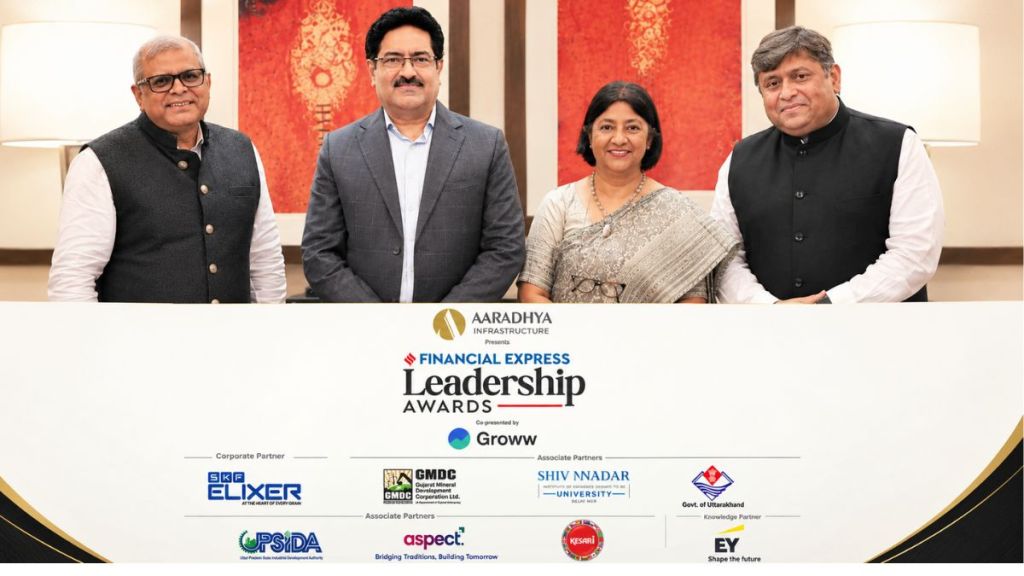

What sets a great leader apart? For the distinguished jury that met in Mumbai recently to choose the inaugural FE Leadership Award winners, the answer came down to a rare combination: the courage to place big bets, the discipline to see them through, and the conviction to build in India, for India and beyond.
“What struck me most during the jury process was how quickly the conversation moved beyond balance sheets and valuations,” said jury chair Kumar Mangalam Birla, chairman of the Aditya Birla Group. Corporate governance, he said, was central to the assessment, alongside innovation, appetite for growth, the ability to confront competition and resilience. “We looked for companies that could balance ambition with discipline, speed with sound judgment, and opportunity with responsibility.”
That spirit was best embodied by the winner of the awards’ marquee honour. Mahindra & Mahindra’s Anish Shah was named CEO of the Year for turning the company into a winning machine: dominant in SUVs, setting the pace in electric vehicles and a magnet for talent across a diversified group. Jurors pointed to the sharp rise in M&M’s market value since he took charge in 2021, and to a quiet style that lets results do the talking.
“Transformation is never just about numbers; it’s about bringing people along, making difficult decisions and believing in a better tomorrow,” said Arundhati Bhattacharya. “That is what makes Anish’s leadership so inspiring.”
Besides Birla and Bhattacharya, president and CEO, Salesforce South Asia, the seven-member jury comprised Cyril Shroff, managing partner, Cyril Amarchand Mangaldas; Sanjay Nayar, founder, Sorin Investments; Amit Chandra, chairman, Bain Capital; Rajiv Memani, chairman and CEO, EY India; and Manish Kejriwal, founder and managing partner, Kedaara Capital. Memani, who was in Delhi, and Nayar and Shroff, who were in London, joined via video conference. The discussions, Birla said, were “candid, rigorous and, at times, contested, as the best jury discussions should be.”
EY, the knowledge partner, oversaw the evaluation, analysing data on nominees and drawing up shortlists using parameters such as revenue and profit growth, three-year shareholder returns, market capitalisation and, where relevant, ESG ratings. Each category had eligibility filters: MSME nominees, for instance, had to be listed and have revenues below Rs 500 crore. The jury then whittled each field down to two contenders before settling on a winner.
Sun Pharmaceutical Industries was named Company of the Year in a keenly contested category. “Sun Pharma was a compelling choice because it combines the qualities of a well-run business with the ambition of a genuinely global pharmaceutical company,” said Birla. Its growth has been steady and disciplined, backed by a strong balance sheet and robust operating cash flows, but what set it apart, he said, was its willingness to use that strength to redefine the scale of its opportunity. The proposed $11.75-billion, all-cash acquisition of Organon, he noted, ranks among the boldest overseas transactions attempted by India Inc. “That combination of consistent execution and audacious ambition made Sun Pharma stand out.”
JSW Group’s Parth Jindal won the Young Turks award for building well beyond an inherited legacy, from paints to electric vehicles. “Parth represents something special: the courage of a new generation,” said Bhattacharya. “He reminds us it’s never too early to dream big.”
Titan’s Ashok Sonthalia was chosen CFO of the Year for his key role in big bets such as the full takeover of CaratLane and the Gulf push through Damas. “Good CFOs report numbers accurately. Great CFOs help companies shape the future,” said Chandra.
Nayar described the Emerging Entrepreneur and Standout Innovator winners as “real examples of Indian science, Indian research and Indian first.” Sarvam AI’s Vivek Raghavan and Pratyush Kumar have built foundational AI models for Indian languages, while Skyroot Aerospace founders Pawan Kumar Chandana and Naga Bharath Daka, two former Isro scientists, put Vikram-1 into orbit with largely home-grown technology, making the company what Nayar called “a symbol of India’s space entrepreneurship revolution.”
Resilience defined the Standout Unicorn award for Falguni Nayar’s Nykaa. When sentiment towards new-age companies cooled after its listing, Memani noted, she rebuilt Nykaa into a multi-engine business, investing in its own brands and opening a new store almost every week.
“MSMEs are the backbone of India, and Bella Casa Fashion & Retail truly exemplifies that,” said Memani of the MSME of the Year. Under Saurav Gupta, the Jaipur company has grown from a family-run business into a design-led manufacturer supplying around 50 leading brands.
Hindustan Unilever won the Sustainability award for coal-free plants, sharp cuts in water use and its work with rural women entrepreneurs. ABB India, MNC of the Year, was hailed for localising fast, with over 80% local value addition.
The jury also had suggestions for future editions: a tighter age cut-off for startups, since some long-established firms bristle at the label, and a new category for mid-sized companies that have outgrown it but are not yet giants.