


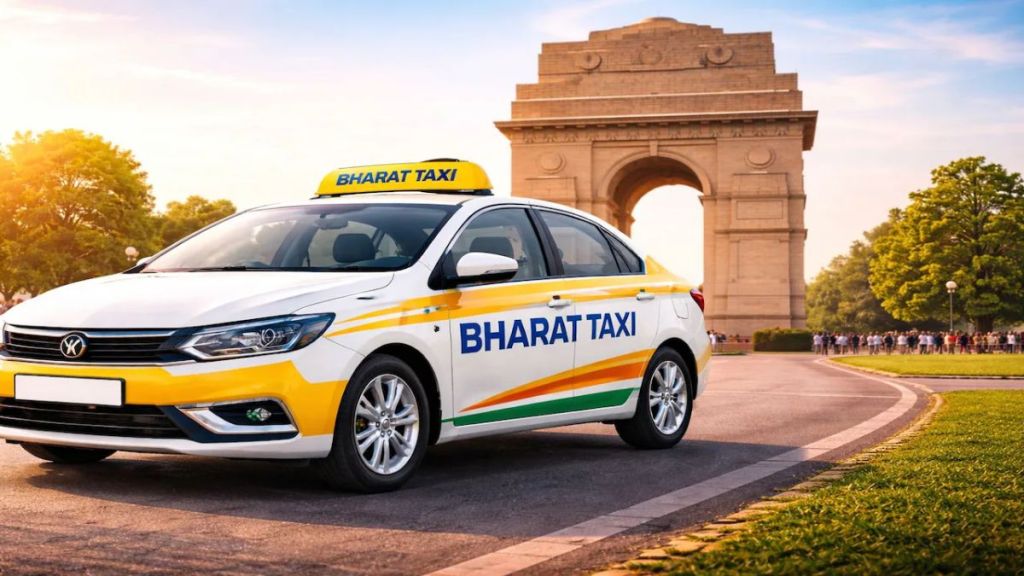

The government-backed ride-hailing platform, Bharat Taxi, has completed seven months of operations. Balancing driver earnings with affordable fares is its biggest challenge, as it faces competition from established peers. Banasree Purkayastha looks at its cooperative business model and the constraints it faces
What is Bharat Taxi & who owns it?
Bharat Taxi is India’s first cooperative-sector ride-hailing platform, run by Sahakar Taxi Cooperative Ltd, a multi-state cooperative society. Established in June 2025, under the Multi-State Cooperative Societies Act, 2002, it started its services in February 2026 from Delhi-NCR.
At its core, Bharat Taxi seeks to offer an alternative approach to app-based mobility by combining digital ride-hailing with cooperative participation, transparent fares, social security support and shared economic benefits.
It has been created with the support of eight national-level cooperative institutions — National Cooperative Development Corporation (NCDC); Indian Farmers Fertiliser Cooperative Limited (IFFCO); National Bank for Agriculture and Rural Development (NABARD); Krishak Bharati Cooperative Limited (KRIBHCO); Gujarat Cooperative Milk Marketing Federation Limited (Amul); National Agricultural Cooperative Marketing Federation of India Limited (NAFED); National Dairy Development Board (NDDB); and National Cooperative Export Limited (NCEL).
Where are its services available?
BHARAT TAXI’S services are available in several big cities as well as Tier-2 cities including Delhi-NCR, Ahmedabad, Surat, Lucknow, Chandigarh, Mumbai, Jaipur, Kanpur and Pune. As of July 2026, it has registered over 8,48,000 drivers, 4.43 million customers and is facilitating more than 11,000 daily rides across the country. The broader rollout is planned in phases, with Bharat Taxi aiming for a nationwide presence by 2029.
In addition to app-based bookings, Bharat Taxi operates prepaid booths at select airports for direct ride booking. The ride-hailing service operates on a zero-commission, surge-free pricing model under which ride earnings go directly to drivers rather than being split with a private aggregator.
Meanwhile, Rapido operates in over 400 cities with over 9 million registered driver-partners while Uber has over 14 million active driver-partners across 225 cities.
What is the business model?
The central feature of Bharat Taxi is its driver-centred cooperative ownership model. The drivers are called “Sarathis” and are positioned as member owners rather than simply drivers operating on a digital platform. The model gives them a stake in the cooperative and enables them to participate in its governance. Sarathis can become member owners by subscribing to the cooperative’s share capital. Shares are valued at Rs 100 each, while a Sarathi wishing to become a partner can obtain ownership rights by purchasing shares worth Rs 500.
The platform follows a subscription-based approach. Under the cooperative’s earnings model, 20% of the cooperative’s earnings are credited to Bharat Taxi as Sarathis’ capital, while the remaining 80% is distributed among Sarathis based on the kilometres travelled by their taxis.
What is holding Bharat Taxi back?
Bharat taxi has entered the ride-hailing space at a time when competition is fierce. The three existing platforms — Uber, Ola and Rapido — together have a strong grip on the market, especially in the metros. According to media reports, Rapido – which has been in the market for around two years — is the biggest ride-hailing app in India with a 50% market share. The India ride hailing services market generated a revenue of $2.51 billion in 2025 and is expected to reach $11.06 billion by 2033, as per market intelligence firm Grand View Horizon.
Higher standard fares, predatory pricing by rivals, and high cancellation rates make it difficult for Bharat Taxi to be the first choice for drivers and passengers alike. Rivals are willing to absorb short-term losses to price the new cooperative model out of the market. While Bharat Taxi ensures fair wages for drivers with a minimum base rate per kilometer, this makes its fares 20-30% higher than that of its peers.
How can it overcome these challenges?
The cooperative will have to tweak its playbook to make its platform a more reliable source of regular income for drivers as well a more dependable mobility option for customers. While maintaining the minimum base rate for drivers, the cooperative could look at a flexible off-peak discount framework funded by a temporary allocation of its 20% corporate earnings reserve.
It also needs to aggressively market its “No Surge Pricing” value proposition during monsoon seasons and peak rush hours — a direct, side-by-side estimated savings counter against surge pricing can help convince daily commuters. That could help build a direct connect with customers and promote its ethical business proposition — transforming the gig economy from a profit-seeking corporate engine into a sustainable, driver-centric cooperative, on the lines of Amul’s business model which ensures product quality without sacrificing earnings.