


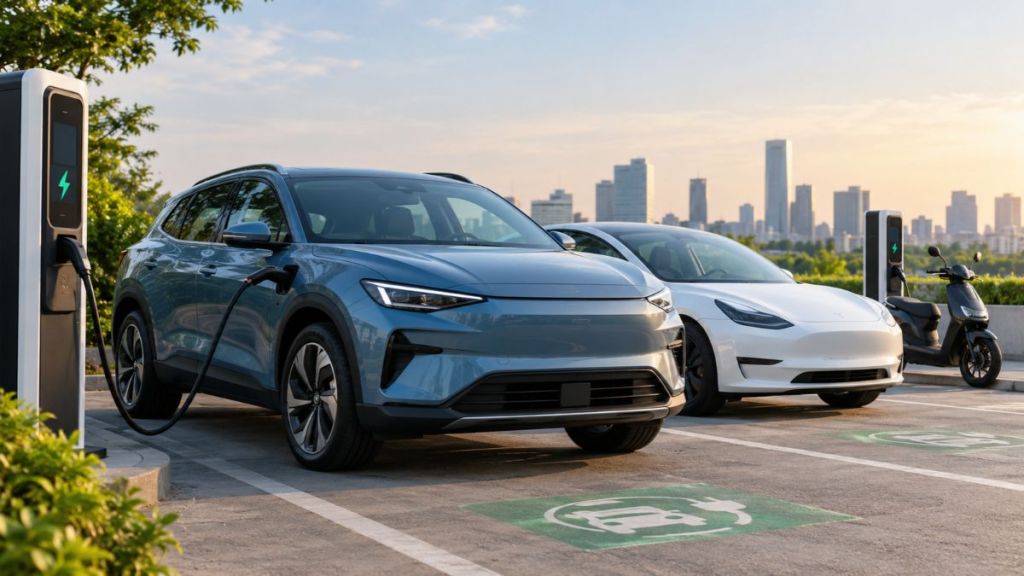

Electric vehicles made up 11.6% of two-wheeler retail sales in India in September, up from 6.5% in FY26. In the passenger vehicle segment too, the share of electric variants rose to 7.9% from 4% over the same period. According to the Japanese brokerage firm Nomura, the data points to an inflexion point across vehicle segments. They expect EVs to make up more than 12% of overall passenger vehicle sales by FY30.
Rising fuel prices improve EV economics
Petrol, diesel and CNG prices have gone up 8%, 9% and 13% respectively since December 2025, as per the report. The rise followed the crisis in West Asia. With crude oil near $103 a barrel, retail fuel prices may need to go up by another Rs 5 to Rs 7 a litre, according to the report. That estimate assumes refining margins return to a long-term average of $15 a barrel. They are currently near $50, the report added.
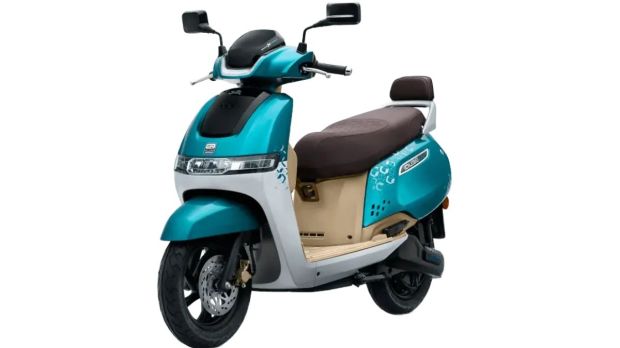
Higher fuel prices have made the running cost gap harder to ignore. A TVS iQube costs about Rs 1.40 lakh on-road in Delhi, against Rs 1.03 lakh for a petrol Jupiter, as per the report’s calculations. The electric scooter costs about Rs 0.3 per kilometre to run. The petrol one costs Rs 2.6 per kilometre.
At 20 km a day, the extra purchase price is recovered in about 2.4 years, according to the report. The buyer would take 8.8 years to recover the full cost of the vehicle through fuel savings, assuming no resale value.
EV adoption varies across states
The payback period for electric cars has also shortened. It is about three years for compact SUVs, 2.5 years for mid-size SUVs and two years for large SUVs, as per the report.
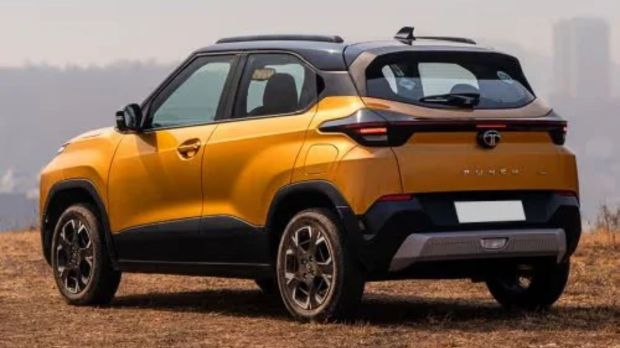
The report’s example for compact SUVs is the Tata Punch. The electric version costs Rs 12.74 lakh on-road, against Rs 9.51 lakh for the petrol variant. Its running cost is Rs 1.32 per km, compared with Rs 7.4 for petrol. At 50 km a day, the extra cost is recovered in three years, according to the report.
Demand is strongest at higher price points. BMW India gets about 30% of its bookings from electric models, which has led to a waiting period of two to three months, as per the report.
EV subsidies and charging infrastructure expand
Delhi leads in passenger vehicles at 21.9% in September. Telangana follows at 21.0% and Odisha at 17.0%, according to the report.
Odisha tops the two-wheeler list at 23.0%. Karnataka is at 19.3% and Goa at 17.5%. Electric scooters alone reached 25% of scooter sales in September, led by Madhya Pradesh, Odisha and Rajasthan, as per the report.
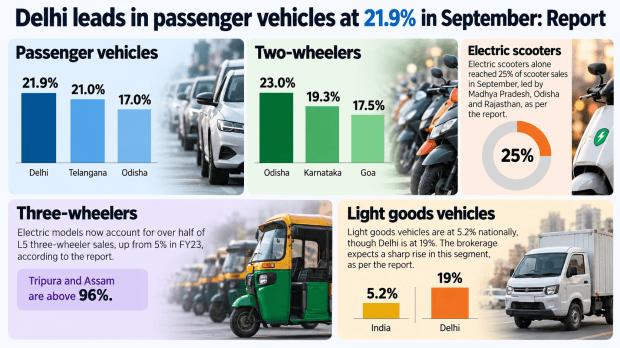
Three-wheelers have moved the furthest. Electric models now account for over half of L5 three-wheeler sales, up from 5% in FY23, according to the report. Tripura and Assam are above 96%. Light goods vehicles are at 5.2% nationally, though Delhi is at 19%. The brokerage expects a sharp rise in this segment, as per the report.
Nomura’s EV sales forecast for FY30
State governments have backed adoption with tax relief. Delhi offers a full road tax exemption on EVs, except cars priced above Rs 30 lakh, and the policy runs from 2026 to 2030, as per the report. Maharashtra offers a full waiver of motor vehicle tax and registration charges. Passenger EVs there also get free passage on key expressway, according to the report.
Charging access has grown as well. Charging stations at fuel retail outlets rose to about 29,500 in June 2026 from about 4,100 in September 2022, as per the report, citing data from the Petroleum Planning and Analysis Cell.
The energy mix is also shifting. India imports 89% of its crude oil and 50% of its gas, according to the report. Non-fossil sources now account for 29% of power generation, and the government has a target of 50% by 2030, as per the report. That means the carbon footprint of each EV sold should fall over time.
EV sector growth: What Nomura expects next
According to Nomura, EVs will account for 12.7% of passenger vehicle sales by FY30. It puts the figure for two-wheelers at 22% and for three-wheelers at 70%, as per the report. For FY27, it expects about 380,000 electric passenger vehicles and 2.4 million electric two-wheelers, according to the report.