


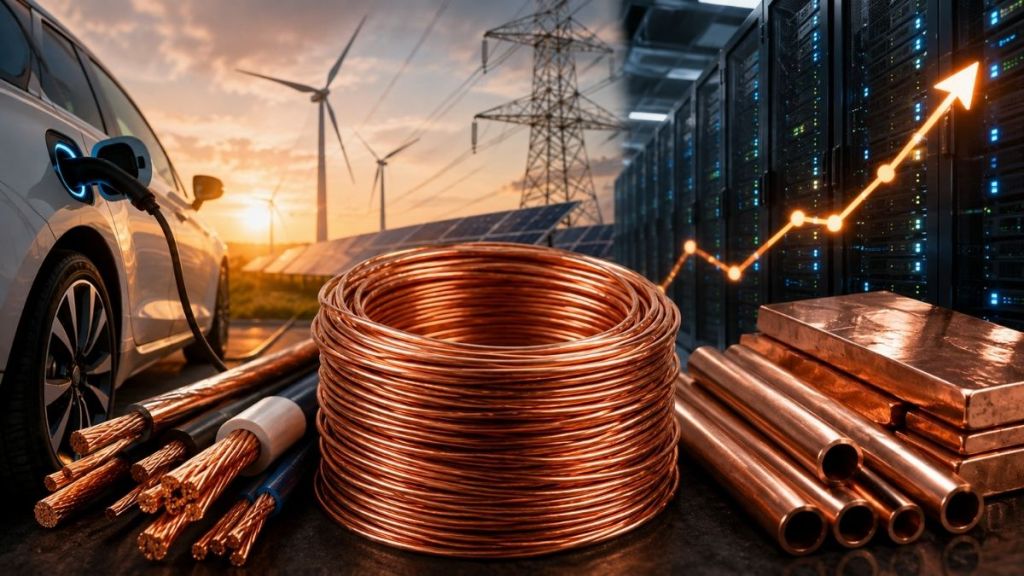

Surging copper prices is expected to boost the revenue growth of India’s cables and wires (C&W) industry. International brokerage firm Jefferies believes that the industry may grow fourfold by 2035 as copper prices rise 38%.
“Indian C&W industry is estimated at Rs 90,000 crore and is expected to grow approximately 4x by 2035 (implying +15% CAGR)”
However the brokerage firm also warns of pressure on volumes and operating margins. Here’s why
Copper up 38% in a year, cable prices rise 20%
The sharp rise in copper prices has pushed cable manufacturers to increase product prices. Copper price fluctuations are generally passed on to customers in the Indian cables and wires industry, helping companies protect themselves against higher input costs.
The distributor said manufacturers have largely passed on raw material price increases to end consumers without significant demand disruption.
Copper prices have risen 38% over the past 12 months, while aluminium prices have increased 16%. Against this backdrop, average price hikes across the cables and wires industry are estimated at around 20% over the same period.
Steady Channel Inventory Signals End-User Absorption
Channel inventory also remains normal at around 35-40 days, suggesting that higher prices have not triggered a major change in stocking patterns.
Jefferies noted that Cables and wires account for only a small share of the total cost of large infrastructure projects. As a result, customers have continued to place orders despite price increases, as delays in project completion can prove costly.
Demand is healthy
Demand conditions in the cables and wires industry remain healthy, with power and real estate emerging as the key drivers, the report said.
Power cable demand is increasing as state governments, electricity boards and select private-sector players ramp up projects. State governments remain important drivers of demand for power transmission and distribution products.
States such as Maharashtra and Gujarat are seeing steady growth in cables and wires consumption. Eastern and northeastern India could also emerge as promising markets in the coming years.
In the real estate sector, premiumisation in residential housing, particularly in metropolitan cities, is supporting demand for cables and wires.
Data centres and solar projects are also emerging as additional growth opportunities. Data centres require copper cables to ensure a reliable power supply, while solar projects are driving demand for cables, including aluminium-armoured cables.
The distributor did not report any major challenges in the availability of raw materials or labour across most end-user sectors.
Jefferies flags volume growth concerns
Price-led revenue growth does not necessarily indicate an equivalent increase in volumes, Jefferies highlighted.
The pace of demand and the ability of manufacturers to manage input costs will remain important factors in determining profitability.
Operating Leverage Deficit to Squeeze Operating Margins
The global investment bank has identified Polycab India and Finolex Cables as its key buys. They expects the two companies to report sales growth of 18-20% year-on-year in Q2FY27, driven mainly by higher prices.
However, it expects average operating profit margins (OPM) for the two companies to decline by around 150 basis points year-on-year.
Lower volume-driven operating leverage compared with the previous year could weigh on margins. Operating leverage refers to the benefit companies get when higher sales volumes help them spread fixed costs across more products.
Conclusion
The brokerage’s outlook suggests that while demand remains healthy, investors will need to track volume growth, margin performance and pricing trends to assess the sustainability of earnings growth.