


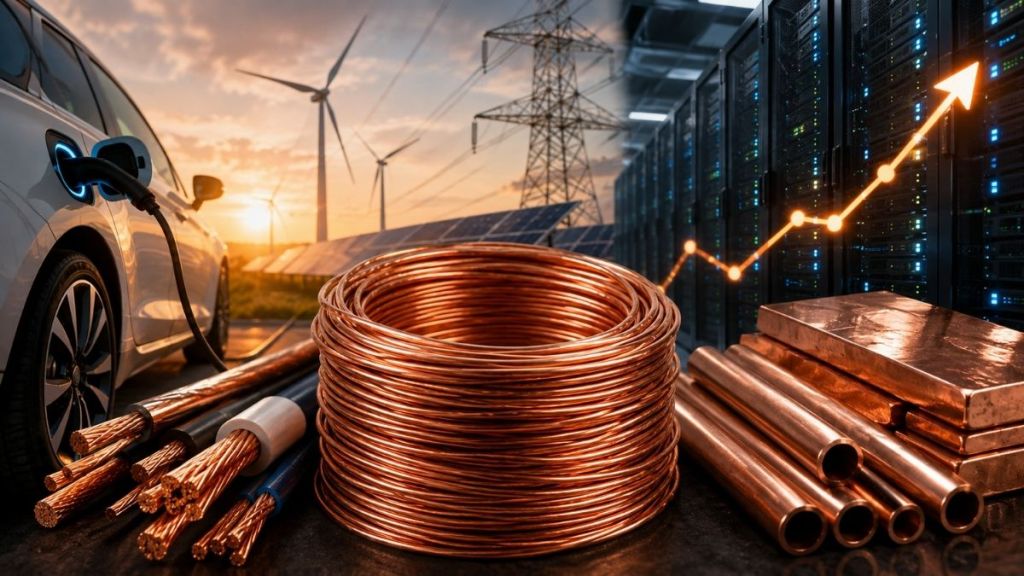

Copper prices have jumped 45% over the past year. That surge is now pushing Indian electronics manufacturers to rethink what goes inside their products. Many are turning to aluminium instead, according to a report by Axis Capital.
Copper prices rise 45% as AI demand tightens the market
Copper on the London Metal Exchange has climbed steadily since 2020. Prices have moved up 8% over the last 60 days and 2% in the past 30 days, the report noted. On a day-on-day basis, the metal was up 1%.
Aluminium has also risen, but not as sharply. It is up 28% year-on-year against copper’s 45%. Aluminium prices actually fell 10% over the last 90 days, even as they gained 7% over 60 days and 3% over 30 days, the report showed. That volatility has made the metal look more attractive on a relative basis to manufacturers watching input costs.
Part of the broader rise in metal prices is being driven by demand from AI infrastructure, the report said. Data centres and cloud computing hardware use large amounts of copper for wiring and components. That demand is now competing with traditional manufacturing for the same raw material, tightening supply and pushing prices higher.
Electronics makers turn to aluminium as copper costs climb
Electronics producers are adapting by changing their material choices, according to the Axis report. Aluminium is now favoured over copper in products like refrigerators and air conditioners. It is cheaper and more readily available, making it an easier substitute for manufacturers trying to manage costs.
Companies are also raising prices on finished goods, according to the report. At the same time, they are absorbing some of the cost increase rather than passing all of it on to consumers. Product designs are being fine-tuned as well, with manufacturers looking for ways to cut expenditure without compromising on output or quality.
This is not an isolated adjustment, the report suggested. This is a pattern across the consumer durables industry where companies are trying to protect margins while commodity costs remain elevated.
India’s electronics industry steps up localisation of component manufacturing
The shift in materials is happening alongside a push toward local manufacturing, the report said. Pacific Cyber Manufacture Technology Co., an electronics manufacturing services provider with operations in Daman, has expanded its printed circuit board assembly (PCBA) capacity in India. The company is targeting production of up to 3 million PCBA units in 2026, supported by an installed annual capacity of 5 million units, according to the report.
Its facility supplies control boards for air conditioners, refrigerators, smart projectors and other connected devices, the report noted. The expansion is a transition to the effort among electronics makers to reduce reliance on imported components while also managing input costs.
Other companies are making similar moves. UltraTech Cement has entered the wires and cables business with an investment of $190.5 million, the report said. Established players outside the traditional electronics spare parts space are betting on demand for wiring products, even as raw material cost persists to be a challenge.
Rising electronics prices push consumers towards refurbished smartphones
Rising input costs are not confined to manufacturers. They are showing up in retail prices as well, according to the report. India’s refurbished smartphone market grew 13% year-on-year in the first half of 2026, even as sales of new devices fell around 11%, the report said.
The trend suggests that rising handset prices, particularly in the entry and mid-range segments, are pushing budget-conscious buyers toward second-hand devices, the report noted. New launches continue regardless. Philips introduced its S7221 5G model in India, featuring a 6.67-inch display and a 64-megapixel primary camera, and the device is already available on Amazon, according to the report.
PVC pipe makers see margin recovery as resin prices rebound
Not every commodity-linked sector is facing the same pressure. Plastic pipe manufacturers are expected to see improved performance in the second quarter as PVC resin prices recover from recent lows, the report said. Better realisations and margins are expected to follow, aided by healthy demand from infrastructure, housing and irrigation segments.
This is in contrast to the electronics and durables space, where rising metal costs are squeezing margins. In building materials, a recovery in resin prices is instead expected to support earnings growth for pipe companies, according to the report.
India’s semiconductor ambitions face a long road to global scale
India’s broader ambitions in electronics manufacturing extend beyond assembly and materials substitution. Building a globally competitive semiconductor industry in India could take decades, the report said, given the need for stronger supply chains, customer demand and capital, not just manufacturing plants. Plans to expand research and development as well as go-to-market operations within the country were also flagged in the report.
Meanwhile, South Korea’s semiconductor exports have surged, driven largely by AI-related demand, the report noted. Exports reached a record $46.65 billion in August, a jump of 209% from a year earlier. Semiconductors accounted for 47.5% of South Korea’s total goods exports of $98.25 billion that month, largely on the back of expanded capital spending by large cloud providers, according to the report.
Dixon, Amber and Voltas lead earnings growth projections
Among electronics manufacturing services companies, Dixon Technologies is projected to post an EPS CAGR of 46% between FY26 and FY28, while Amber Enterprises is expected to post 97% growth over the same period, according to the report’s valuation matrix. Kaynes Technology and Syrma SGS Technology are also part of the coverage list, with more moderate growth projections of 30% and 41% respectively.
In household durables, Voltas stands out with a projected EPS CAGR of 82% through FY28, while Aditya Infotech is expected to grow 69%, the report showed. The report also upgraded Aditya Vision to a Buy rating from Add, maintaining a target price of Rs 723, noting the company’s expansion in underpenetrated markets and improving cash generation.
For now, Copper has become expensive enough that manufacturers are willing to redesign products around a cheaper alternative. How long that substitution continues will likely depend on where metal prices head next.