


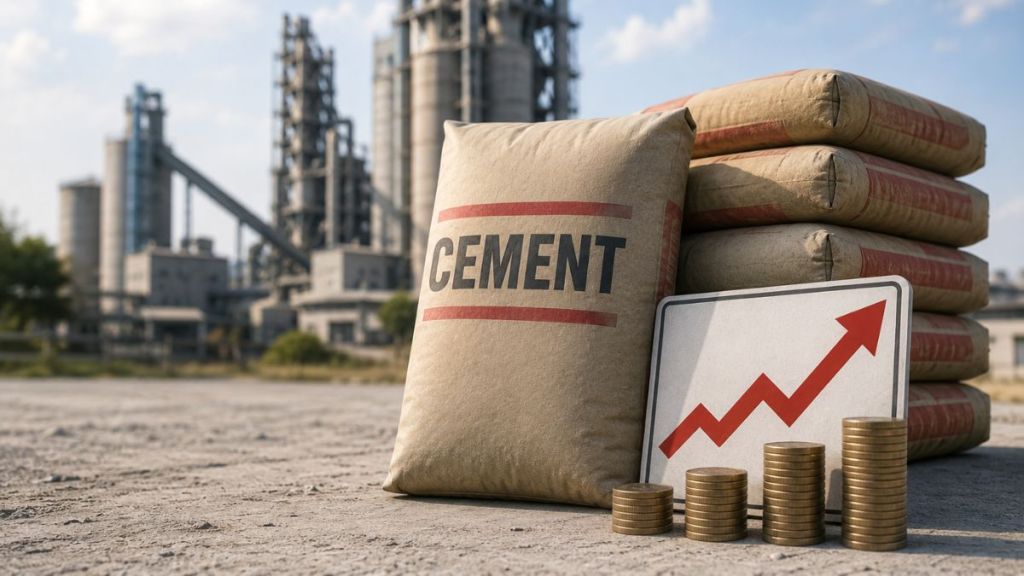

Cement prices remained broadly stable across the country in August despite peak monsoon season, analysts said, with the industry’s ability to push through price hikes in September likely to be critical to protecting margins in the December quarter.
All-India average cement prices stood at around Rs 330 a bag in August, unchanged from July. “Cement prices have witnessed much lower correction during the current monsoon season, declining only Rs 3/bag between April 2026 and August 2026, compared with an average decline of Rs 13/bag over the past four years. Relatively lower intensity of rainfall this year has supported construction activity and aided price stability,” analysts from Prabhudas Lilladher said.
Companies have nevertheless begun attempting price hikes in September, although dealers remain cautious about their quantum and sustainability. A Rs 30-a-bag hike has been announced in Chennai from September 1, but dealers expect only Rs 15-20 of it to sustain. In Hyderabad, a Rs 20 hike is possible, although dealers expect around Rs 10 to hold.
A similar Rs 20 increase announced in Patna is expected to translate into only about Rs 10. In Lucknow, companies are discussing a potential hike, with its implementation and sustainability depending on demand conditions, dealers said. Mumbai is also expected to see a Rs 10-per-bag hike in September.
Demand, meanwhile, was uneven across the country, tracking region-wise rainfall trends.
“Industry cement demand is estimated to have grown in mid-single digits year-on-year in August 2026 and in high single digits YoY in Q2FY27 to date,” analysts from JM Financial said.
Management commentary from the sector’s largest players suggests companies are also seeking to defend realisations rather than chase volumes through the monsoon. UltraTech Cement Chief Financial Officer Atul Daga, during the first-quarter earnings call, said the company would attempt to keep prices higher in the monsoon quarter, after June exit prices had increased in the south and east.
He said pricing ultimately depends on demand. “If demand is strong all India basis, prices can go up,” Daga said, adding that prices need not necessarily fall if the cost curve declines.
Ambuja Cements Chief Executive Vinod Bahety has similarly emphasised pricing discipline, premiumisation and a higher trade mix. He said brand pull, the trade segment and premium products would increasingly differentiate price movement, while net selling prices should improve in line with the industry.
Analysts added that Q2 is a seasonally weak quarter, while elevated power and fuel, freight and other operating costs are creating uncertainty around margins in H2FY27.
“Elevated fuel costs coupled with weaker operating leverage are likely to keep industry margins under pressure in Q2FY27E,” analysts from JM Financial added.
Demand is expected to improve as the monsoon recedes, supported by the release of pent-up construction activity and a gradual pickup in project execution. Over the medium term, demand is likely to compound at 6–7%, underpinned by sustained government focus on infrastructure along with a gradual recovery in rural and urban demand, experts said.