


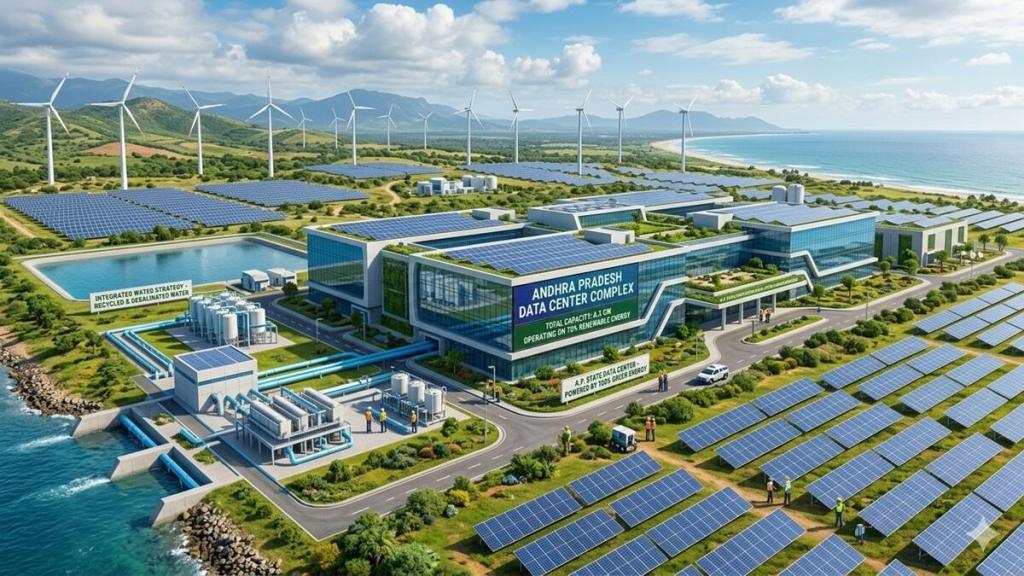

Andhra Pradesh is linking large data center investments to a 70 per cent renewable power requirement. AP’s Information Technology and Human Resources Development Minister Nara Lokesh said the rule aims to attract major technology investments while reducing the energy and water impact of data centers.
According to state government officials, data centers are among the most capital-intensive infrastructure projects a state can host, bringing in billions of rupees in investment, long-term power purchase agreements and high-value jobs. But they are also power-hungry and water-intensive, raising concerns about grid stress and local resource competition.
Andhra Pradesh’s answer is to make sustainability a precondition for access to this money. “The first thumb rule is that a minimum of 70 per cent of the energy used by data centers must come from renewable sources,” Lokesh said, listing solar, wind, pumped storage and battery-based systems as eligible sources.
With a renewable energy requirement, Andhra Pradesh plans to attract major data center investments while reducing dependence on fossil fuels.
VIDEO | Delhi: Andhra Pradesh IT Minister Nara Lokesh (@naralokesh), speaking at a fireside chat organised by the Public Affairs Forum of India (PAFI) in Delhi, highlighted the state’s approach to developing data centres while addressing concerns over their environmental impact.… pic.twitter.com/pGl3gcywqQ
— Press Trust of India (@PTI_News) September 24, 2026
Visakhapatnam as the data center hub
The policy is built around Visakhapatnam, which Andhra is positioning as a major data center cluster on the east coast. “The state has already secured agreements for about 6.5 GW of data center capacity, with projects now moving from Memorandum of Understanding (MoUs) to execution,” Lokesh said.
At full build-out, this ecosystem is expected to need roughly 3 thousand million cubic feet (tmc ft) of water a year, based on current cooling technologies, he told the Andhra Pradesh Assembly earlier.
Pleasure meeting Mr. Bajrang Bothra, Chairman of EPACK Group, in Ahmedabad.
With Visakhapatnam rapidly emerging as a major data centre hub, EPACK is setting up a dedicated prefabricated construction facility in Vizag to support the growing data centre ecosystem. I was delighted… pic.twitter.com/ao4FWXWKO3
— Lokesh Nara (@naralokesh) September 25, 2026
Water plan: Polavaram canal, not city taps
Water is the most sensitive part of the equation. Andhra IT Minister Lokesh has repeatedly said the state’s design is to keep data center water separate from municipal supplies.
“Water required for the facilities will be met from the allocation earmarked for the industries,” he said, adding that dedicated pipelines would be laid instead of tapping into existing city infrastructure.
The main source is the Polavaram Left Bank Canal. The plan is to use a portion of Godavari water that would otherwise flow into the Bay of Bengal, divert it through Polavaram and bring it to Visakhapatnam by gravity for industrial use.
“Once the proposed data center ecosystem reaches the targeted 6.5 GW capacity, it is estimated to require around 3 tmc ft of water annually based on current technology,” Lokesh added.
He also told the Assembly that drinking, irrigation and industrial requirements of Visakhapatnam will be protected, and that Polavaram water for the city will arrive by gravity within 18 months.
Water concerns over Vizag data centers
Advocacy groups like the Human Rights Forum (HRF) have raised alarm over Andhra Pradesh’s push for Google’s proposed data centre in Visakhapatnam, warning that the city is already under acute water stress and the project could intensify the problem.
A November 2025 BBC News report noted that HRF and other critics have flagged the risk of public resource diversion for the hyperscale facility, pointing to Visakhapatnam’s recurring water shortages and the strain that large, water-intensive data centres could place on local supplies.
The BBC also reported that Google directed it to a company document stating it uses a “peer-reviewed, context-based water-risk framework” to assess watershed risk at new sites and guide decisions on whether to draw from freshwater sources.
Desalination push to cut freshwater dependence
Alongside canal water, Andhra is pushing desalination to reduce pressure on freshwater resources. The state is incentivising data center companies to set up their own desalination plants as part of their infrastructure.
Lokesh noted that one company is already establishing a 100-million-litre-per-day (MLD) desalination facility near Pudimadaka, which will feed into the overall water security plan for the region.
According to the state government, this mix of canal water and desalination is meant to ensure that data center growth does not come at the cost of farmers or urban residents.
“Holistic approach”: Energy, water and environment together
Lokesh described Andhra’s strategy as a “holistic approach” that treats energy, water and other environmental requirements as a single package, not separate issues.
“From the energy consumption point of view, the state government has set a norm that a minimum of 70 per cent of the energy used by the data centers must come from renewable sources, including solar, wind, pumped storage and battery storage,” he mentioned at the PAFI event.
On water, he has argued that the state is using surplus flows and industrial allocations rather than reallocating scarce drinking or irrigation water.
“Water is being given from sustainable sources. It will not take water away from farming or from the city, number one,” Lokesh said while updating legislators on the progress of the plan.
Why the new rule matters for investors and the grid
For investors, the renewable mandate creates a clear, long-term framework because if they want to set up a data center in Andhra Pradesh, their power mix must be predominantly green. That aligns with global corporate targets on carbon reduction and can make Visakhapatnam more attractive to multinational cloud and AI firms under pressure to decarbonise.
For the state grid, it means a large new load that is tied to renewable generation, pumped storage and battery systems rather than adding only thermal capacity. Andhra already has a target of 50 GW of renewable energy by 2029–30, and the data center policy is being framed as part of that broader green push.