


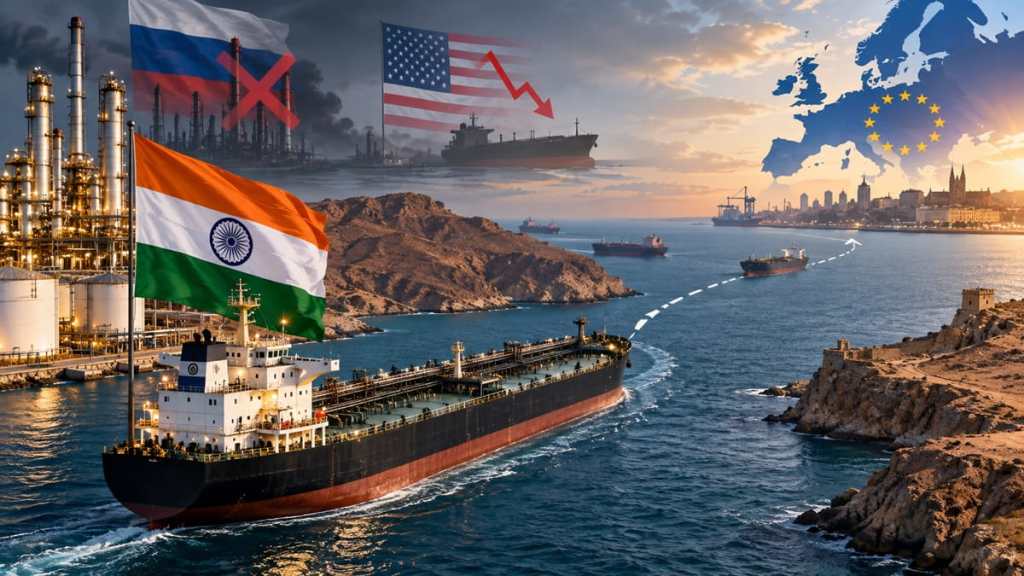

India has emerged as a key diesel supplier to Europe, accounting for around 60% of the fuel transiting the strategic Bab-el-Mandeb route to the region in August. This comes as Russian exports remain severely constrained and US shipments begin to decline.
According to analytics platform Vortexa, around 2,00,000 barrels per day (bpd) of diesel (gasoil) moved through the Bab-el-Mandeb in August on vessels bound for Europe, close to year-earlier levels after flows through the key shipping corridor nearly stalled in March and April. Indian refiners supplied roughly 60% of those volumes, making India an increasingly important source of diesel for Europe’s eastern supply routes.
The shift highlights the increasing strategic importance of India’s refining industry in global fuel markets, as sanctions, refinery disruptions and geopolitical tensions reshape established petroleum-product trade flows.
India is the world’s fourth-largest refining hub, with installed capacity of 258.1 million tonnes per annum, higher than domestic fuel demand.
That refining surplus has allowed India to establish itself as a major exporter of petroleum products. In 2025-26, the country exported 61.5 million tonnes of petroleum products, placing it among the world’s largest exporters of refined fuels.
European demand is now providing an important market for Indian diesel as supplies from Russia, historically a major source of European fuel, remain depressed.
However, the ability of Indian refiners to sustain elevated exports could face a test as crude availability tightens.
Crude and condensate shipments into India fell for a second consecutive month to around 3.8 million bpd in August, compared with 4.8 million bpd a year earlier, Vortexa data showed.
Russian diesel exports remain under pressure
Russian diesel exports, once a key source of European supply, have remained sharply below normal levels despite the scheduled lifting or partial relaxation of the country’s diesel export ban from September 1.
Seaborne Russian diesel and gasoil exports averaged only around 1,50,000 bpd during the first 25 days of August, down about 6,10,000 bpd from a year earlier and 81% below the five-year seasonal average, according to Vortexa data.
A rapid recovery in Russian exports could remain difficult as Ukrainian drone strikes continue to disrupt the country’s refining and export infrastructure.
Thirty-two attacks on Russian refineries were recorded across July and August. An attack on the 2,60,000-bpd Perm refinery left only around 28% of its crude distillation capacity operational.
The disruptions have also affected export terminals. The Black Sea accounted for around 44%, or 3,80,000 bpd, of Russia’s diesel and gasoil exports last year, but refinery and port disruptions have reduced available volumes.
According to news agency PTI, no diesel cargoes have been exported from Tuapse since a strike in May. The port handled around 90,000 bpd, or roughly 10% of Russia’s total diesel exports, in 2025.
Russia increasingly turns to imports
The disruption to domestic refining has also pushed Russia towards higher imports of refined products.
Its seaborne gasoline imports surged to a record of around 1,25,000 bpd in August, equivalent to approximately 4,70,000 tonnes during the month, PTI reported.
Around 55% of those imports arrived on sanctioned tonnage, while India, Turkey and Morocco were among the suppliers.
In August, Indian gasoline cargoes to Russia were carried on sanctioned fleets and involved ship-to-ship transfers in the Mediterranean. This showed the extent to which sanctions and refinery outages are reshaping petroleum-product flows.
US diesel shipments to Europe begin to fall
India’s importance to the European diesel market is increasing at a time when supplies from another major source, the US, are also showing signs of weakening.
The US accounted for around half of Europe’s seaborne diesel imports from outside the region in August, supplying approximately 5,20,000 bpd. Its share was around a quarter a year earlier.
However, US shipments to Europe peaked at nearly 5,40,000 bpd during the first half of August before falling to around 3,50,000 bpd in the second half, PTI reported.
With Russian supplies still depressed and US shipments retreating, European buyers are becoming reliant on alternative sources, putting Indian refiners in a stronger position to fill part of the supply gap.
Hormuz offers limited relief
The Strait of Hormuz is offering little additional relief to the clean-products market. Only 37 crossings by MR2-sized or larger tankers carrying clean petroleum products were recorded during the first 27 days of August, down from 55 in July and 69 in June.
Ship-to-ship transfers off the coast of Oman have continued, but most of the activity has involved crude rather than refined products.
Around 2,30,000 bpd of clean products originating west of Hormuz were transferred through ship-to-ship operations offshore Oman during the first three weeks of August, down from around 4,00,000 bpd during the same period in June.
India faces a supply-side challenge
The changing trade landscape presents a major opportunity for India’s refiners, but also raises questions over feedstock availability.
With crude and condensate inflows falling even as Indian refiners become more important to European diesel supply, refiners could face a balancing act between domestic fuel requirements, export opportunities and access to crude.
For Europe, the situation is becoming particularly critical ahead of the winter demand season.
Diesel inventories are already low, while refineries in Europe and North America are heading into autumn maintenance after operating at elevated rates.