


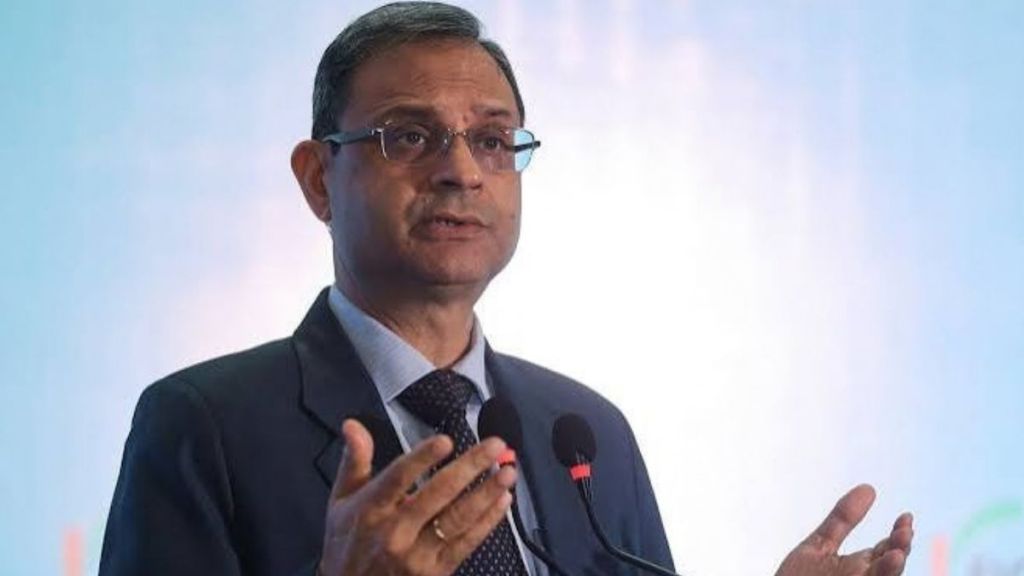

The Reserve Bank of India (RBI) is keeping its options open on further monetary tightening, with Governor Sanjay Malhotra saying the depth of future rate hikes will depend on evolving macroeconomic conditions. In the post-policy press conference on Wednesday, the RBI brass addressed concerns around inflation, liquidity, and credit growth.
Did the MPC consider a 50-basis-point rate hike? And as inflation normalises, should we expect further recalibration of the real rate?
We discussed all possibilities and thereafter looked at what would be appropriate. On the real rate, whether more recalibration is required is a call that will be taken going forward. By changing the stance, we have clarified that there is no rate cut being contemplated. It is either a pause or a rate hike. How deep or shallow the rate hike will be will depend on evolving macroeconomic conditions and dynamics. Headline inflation is our target, as given to us by the government, and we continue to focus on bringing it to 4%. But headline inflation alone may not be the right measure, especially when much of the increase is because of base effects and supply-side factors. We also need to look at measures of underlying inflation.
Is a CRR hike off the table as a liquidity-management tool?
Nothing is off the table. I do not want to rule out anything because it is still an evolving and uncertain world. When we talk about whether an operation is cheaper or more expensive for the Reserve Bank, we need to look at the cost and benefits to the economy as a whole. Whether it is FCNR(B), liquidity operations, monetary policy changes or macroprudential measures, profit or surplus for the Reserve Bank is incidental. The primary consideration is the impact on the economy.
Do you expect the introduction of MDR on certain UPI transactions to affect transaction volumes?
A decision on MDR has already been taken. As of now, we do not see any drop in volumes. I do not personally think that a small charge will have a major impact.
Has India’s potential growth rate increased? Does stronger growth also imply a higher neutral real interest rate?
RBI Deputy Governor Poonam Gupta: If you look at the past few years, especially post-Covid, growth has been highly resilient to multiple global shocks and has coexisted with low and stable inflation. That indicates a high potential growth rate. Even in Q1, growth of 7.8% coexisted with very low inflation. While we do not have a specific estimate, indicators suggest that the underlying strength and potential of the economy have increased.
The neutral real rate is a highly theoretical and fluid concept. It is important, but it cannot necessarily guide monetary policy. India is also relatively insulated from rising global capital costs because of fiscal prudence, domestic sources of savings and investment, corporate cash balances and strong bank credit growth.
Are higher supply-side costs beginning to feed into broader inflation?
We have seen only a partial pass-through. Some of it is happening and some will happen. The extent will depend on the persistence of supply-side pressures. That is why we need to be data dependent going forward with respect to monetary policy. To what extent these pressures pass through further is something we need to watch.
Given that banks and NBFCs are having a good run on the credit growth fund, so will this rate hike not dampen the loan demand?
RBI DG Swaminathan: The credit growth has been at a decadal high at about 18-19%. But if you take a long-term average of 10 years, generally it is in the range of about 12-14%, which is very sustainable and very supportive of growth. So, some moderation in any case will occur. Yes, as we have seen, it will take about a couple of quarters for transmission to materialise, so some moderation will occur related to demand as well as rate. But the moderation from 18 to 20% is not bad and will be adequate enough to support growth.
How concerned is the RBI about the impact of the weak monsoon on rural incomes and inflation?
Obviously, it has an impact, but the impact has moderated over the years. The resilience of India’s rural economy—both farm and non-farm—has increased because of measures taken on irrigation and other areas. While there is going to be some impact on rural incomes, we believe the rural economy will remain quite resilient.
Why is the RBI setting up a technical consultative committee for financial markets?
RBI DG Rohit Jain: Financial markets have been widening and deepening and we have undertaken several reforms. Given the extreme volatility globally, and the need to have expert views better in a structured way, we are institutionalising this arrangement. The technical committee will meet periodically and provide inputs and suggestions. This should improve policymaking and give us a better understanding of operational issues faced by financial markets.
With ECL implementation six months away, how prepared are banks? Have they flagged any major implementation challenges?
RBI DG Shirish Chandra Murmu: The ECL framework was announced well in advance, so banks are well prepared. We are continuously in touch with banks and, whenever there are issues, they are being addressed. Our assessment is that the transition will be smooth. We do not feel there will be any major issue. We are continuously monitoring implementation and are also conducting workshops.
The RBI has flagged AI as a global risk. What worries you most—asset bubbles, labour-market disruption or financial stability risks?
All these risks are material. For us as central bankers, the most significant is cyber risk. Financial systems today are highly interconnected and technology is being used across systems. AI adds another dimension to those risks. We therefore have to remain very vigilant and are taking our cyber-risk preparedness to another level.
Has the RBI changed its oil-price assumption since August?
RBI DG Poonam Gupta: The oil-price assumption in the Monetary Policy Report has increased by $5 a barrel. This reason is re-escalation of the conflict, prices remaining elevated and forward markets indicating higher prices than seen during the last couple of policies. The situation remains evolving and this is our best estimate at this point of how the annual average will turn out.