


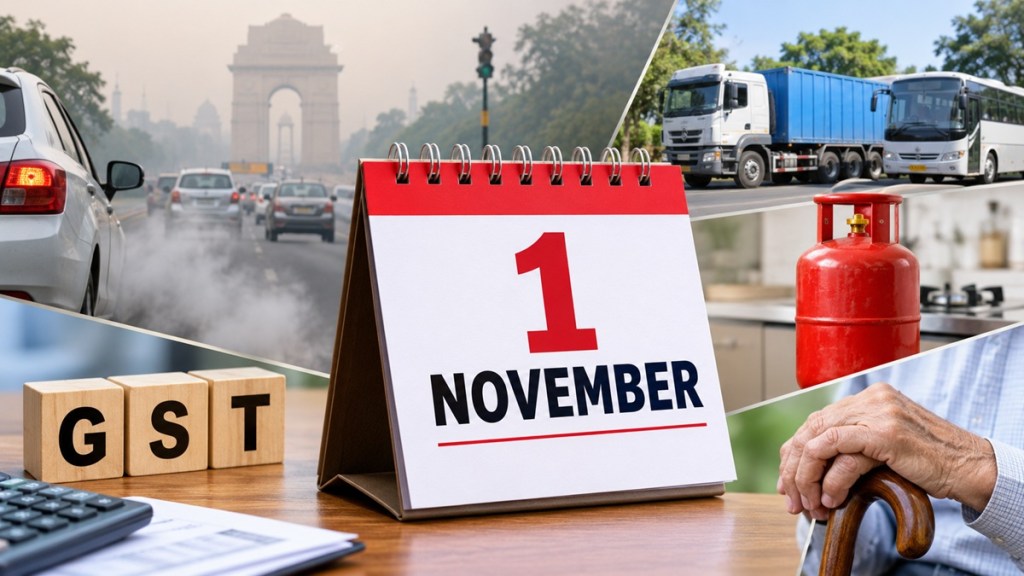

The month of November brings a set of changes that will affect daily life in Delhi-NCR and financial matters across India. Commercial LPG has become costlier and Delhi’s winter pollution restrictions take effect from Sunday (November 1). Across India, changes to GST provisions also take effect, while the Centre launches its largest nationwide Digital Life Certificate campaign for pensioners.
Other measures follow later in the month, including additional pollution restrictions across Delhi-NCR from November 5 to 20. November 21 is also the extended income-tax return filing deadline for specified taxpayers whose accounts require audit.
Delhi’s Winter Action Plan
Delhi’s Winter Action Plan 2026-27 covers the period from November 1, 2026 to February 28, 2027. It targets major sources of winter pollution, including vehicular emissions, road dust, construction dust, industrial emissions and open burning of waste.
Chief Minister Rekha Gupta has announced a 10-point plan covering vehicle checks, public transport, dust control, industrial enforcement and hotspot monitoring. According to Indian Express, implementation will involve coordination between the Centre, Delhi government, pollution-control authorities, local bodies and other agencies.
VIDEO | Noida: Winter pollution restrictions come into effect in Delhi from November 1; curbs apply to vehicles below BS-VI emission standards, vehicles without a valid PUCC, non-compliant interstate buses and trucks not destined for Delhi, which must use peripheral expressways. Early morning visuals from Noida Mor, Noida-Delhi border.
(Full video available on PTI Videos – https://t.co/bIyFWTfmBd)
— Press Trust of India (@PTI_News) November 1, 2026
Work from home from November 1
Government and private offices in Delhi will have to ensure that no more than 50% of employees attend office physically from November 1 to January 31, 2027, under the notified winter pollution framework. Essential and emergency services will remain exempt.
Office timings will also be staggered to reduce peak-hour traffic. Municipal Corporation of Delhi (MCD) offices will function from 8:30 am to 5:00 pm, while Delhi government offices will operate from 10:00 am to 6:30 pm. The staggered timings apply from November 1 to February 28.
Vehicle rules: ‘No PUC, No Fuel’
The Delhi government has announced stepped-up enforcement of its “No PUC, No Fuel” policy from November 1. According to Indian Express, vehicles without a valid Pollution Under Control Certificate, and vehicles that have crossed their prescribed lifespan, will not be allowed to refuel at 500 petrol pumps equipped with Automatic Number Plate Recognition systems.
The PUC requirement applies to petrol, diesel, CNG and LPG outlets. Delhi’s notified pollution-control framework makes this a year-round requirement. Verification may involve physical certificates, Automatic Number Plate Recognition (ANPR) systems or electronic records.
Entry ban for non-BS-VI vehicles
Petrol and diesel vehicles registered outside Delhi that do not meet BS-VI emission norms will be barred from entering the capital from November 1 to January 31, 2027. This particular entry restriction applies to vehicles registered outside Delhi.
CNG vehicles, electric vehicles, ambulances, fire tenders, police vehicles and other specified essential or emergency-service vehicles are exempt.
Parking charges doubled
Parking charges at authorised parking facilities in Delhi will be doubled from November 1 to February 28 to discourage private-vehicle use. Delhi Metro parking facilities are exempt from the increase.
The government has also set daily ridership targets of 72 lakh for the Delhi Metro and 42 lakh for Delhi Transport Corporation buses, aiming to shift commuters towards public transport, Indian Express reported.
Construction and dust control
Dust-generating demolition and outdoor civil construction work will be banned from November 1 to January 31, except for essential public infrastructure projects. A broader construction and demolition ban is scheduled from December 10 to January 20, barring urgent government projects for public utility and emergency works.
The plan requires CCTV coverage at construction sites and registration on the “Malba App” for building-plan approvals. The government also plans to redevelop around 3,000 km of roads to control dust; 1,193 km had been completed when the plan was announced, according to Indian Express.
Other dust-control measures include mechanised sweeping, water sprinkling, deep cleaning, improved footpaths, paved road surfaces and clearing garbage accumulation points. The government said 98 mechanical road-sweeping machines had been deployed in two shifts.
Industrial pollution enforcement
The Delhi government said 2,283 polluting industrial units had been sealed or shut down after a survey of 11,271 units. It has also warned of action against industries violating pollution norms, including units operating in non-conforming areas, Indian Express reported.
Separately, the Central Pollution Control Board (CPCB) has directed pollution-control authorities in Delhi, Haryana, Uttar Pradesh and Rajasthan to issue show-cause notices proposing closure to defaulting industrial units in Delhi-NCR.
According to IE report on the October 30 order, units must provide satisfactory evidence of work orders for installing or upgrading pollution-control equipment, valid exemption certificates or adequacy assessment reports within five days. Units failing to meet the requirements face closure directions.
The requirements cover 17 highly polluting industrial categories, along with specified other industrial units, including those in food processing, textiles and metals.
CAQM’s November 5-20 curbs
Separately, the Commission for Air Quality Management (CAQM) has ordered additional restrictions from November 5 to 20. State government and private offices in Delhi, Gurugram, Faridabad, Sonipat, Ghaziabad and Gautam Buddha Nagar must limit physical attendance to 50%, with the rest working from home. Industrial establishments and essential services where such arrangements are not feasible are exempt.
CAQM has also restricted dust-generating demolition and outdoor civil construction across the National Capital Region during this period. Projects involving Railways, Metro services, airports, inter-state bus terminals, hospitals, water and sanitation work, defence and national security, and projects of national importance are exempt.
The commission said historical air-quality data showed that pollution in Delhi-NCR had reached the “Severe” and “Severe+” categories on several days in early and mid-November between 2018 and 2025. It said local emissions, agricultural-residue and biomass burning, low wind speeds and limited vertical mixing contribute to the buildup of pollutants.
GST changes from November 1
Amendments introduced through Sections 153 to 155 of the Finance Act, 2026 take effect from November 1 under a notification issued by the Central Board of Indirect Taxes and Customs. The changes relate to post-supply discounts, credit notes and GST refunds.
Eligible post-sale discounts can be excluded from the taxable value when the supplier issues a credit note and the recipient reverses the corresponding input tax credit, subject to the statutory requirements.
The amendments also extend the provisional refund mechanism to eligible claims arising from inverted duty structures, where tax rates on inputs are higher than those on the resulting supplies.
Separately, the GST Council has approved in principle a proposed optional Annual Return Quarterly Payment scheme for businesses with turnover of up to Rs 5 crore in the preceding financial year that supply exclusively to unregistered customers. The Council’s announcement does not establish November 1 as the scheme’s launch date.
Delhi commercial LPG cylinder becomes Rs 10 costlier
Oil marketing companies have increased the price of a 19-kg commercial LPG cylinder by Rs 10, taking it to Rs 2,820 in Delhi from November 1. The cylinder was priced at Rs 2,810 on October 1. This is the third consecutive monthly increase, adding to fuel costs for restaurants, hotels, eateries and small commercial vendors during the festive season.
The price of a 5-kg Free Trade LPG cylinder for a new connection stands at Rs 1,903, while a 5-kg FTL refill is priced at Rs 782, according to the rate list cited by ANI.
The revision follows a volatile year for LPG prices. Commercial cylinder rates had surged by nearly Rs 1,000 on May 1, crossing Rs 3,000 in Delhi, and rose further in June before falling by a cumulative Rs 375.50 in July and August, IndianOil’s price records show. Prices rose again in September and October, with a Rs 62.50 hike on October 1, followed by the latest Rs 10 increase.
November 21 income-tax deadline for specified audit cases
The Central Board of Direct Taxes (CBDT) has extended the income-tax return filing deadline for specified taxpayers whose accounts require audit. For Assessment Year 2026-27, the deadline has been moved from October 31 to November 21, 2026. The extension was announced on September 28.
The extension applies only to specified categories of taxpayers and does not apply to all individual taxpayers. Taxpayers should verify their applicable due date against the Income Tax Department’s official communication or e-filing portal.
Pensioners’ Digital Life Certificate campaign
From November 1 to 30, the Department of Pension and Pensioners’ Welfare is conducting its fifth nationwide Digital Life Certificate campaign across 2,000 cities and districts. The government aims to generate 2.30 crore Digital Life Certificates, including 1.50 crore through face authentication.
Face authentication allows pensioners to submit life certificates using Android or iOS smartphones, making the process easier for elderly people who may find it difficult to visit banks or offices. The Ministry of Personnel, Public Grievances and Pensions said the campaign’s main focus is promoting face-authentication technology.
The campaign involves 19 banks, 785 district post offices and 56 welfare associations, along with India Post Payments Bank, pension-disbursing agencies, state governments and government technology agencies. Camps will offer additional services such as health check-ups and Aadhaar updates, while doorstep services will be provided where required, the ministry said.