


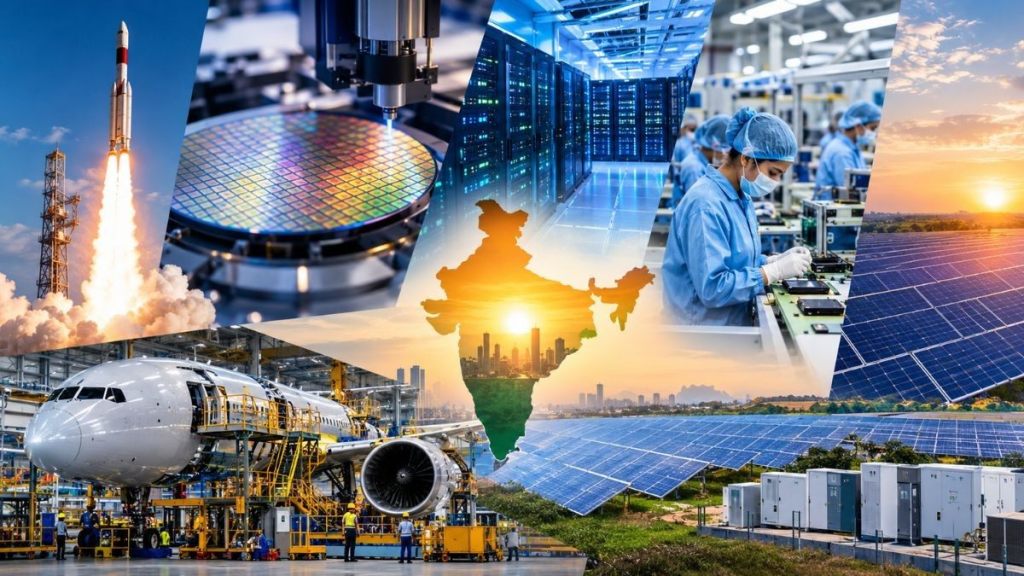

India’s data centre capacity is set to grow fivefold in the next five years, from about 2 gigawatts today to nearly 10 gigawatts. This might seem like the next big thing. However, as per the latest Jefferies report, India’s data centre capacity is just one of the six markets set to push the country in its next industrial leap.
The report names six sectors, ranging from space to data centres, where it expects private investment and government support to drive India’s next phase of industrial growth. India’s manufacturing base is already large, the report said. It is the world’s second-largest producer of steel, cement and passenger cars, and a major global manufacturer of mobile phones and solar modules.
India’s space sector eyes $45 billion economy by 2030
India opened its space sector to private players in 2020. The number of space startups has since grown from one in 2014 to more than 400 in 2026, the report said. Cumulative private investment in the sector touched around $0.6 billion in FY26.
The government expects India’s space economy to expand fivefold between 2023 and 2030, from about $8.4 billion to $40-45 billion, and further to $100 billion by 2040, according to the report.
Companies such as Skyroot Aerospace, Pixxel, Agnikul Cosmos and Digantara have moved from early-stage innovation to commercial execution. Skyroot became the first private Indian company to place payloads into orbit, with its Vikram-1 launch in July 2026.
As per the Jefferies report, the Indian Space Policy of 2023 opened the entire space value chain to private participation. IN-SPACe now works as a single-window regulator. NSIL, ISRO’s commercial arm, has enabled more than 70 technology transfer agreements to industry, the report noted.
Semiconductor push gains pace with $20 billion investments
India’s semiconductor push has moved past the announcement stage, the report said. About $20 billion of investment has already gone into a chip fab and several assembly and testing projects.
Tata Electronics is building an $11 billion fab in Gujarat for 28-110 nanometre chips, in partnership with Powerchip Semiconductor Manufacturing Corp of Taiwan. Micron’s assembly and testing plant in Sanand became the country’s first operational facility under the India Semiconductor Mission, starting commercial production in February 2026. CG Power and Kaynes Technology have also begun commercial production at their plants this year, the report said.
A second phase of incentives worth around $13 billion was launched in 2026, about 70% higher than the first phase in rupee terms. This phase widens support to chip design, equipment, materials, speciality chemicals and gases. The government expects it to draw about $42 billion in investments and generate $21 billion of production, according to the report. India currently accounts for about 20% of the world’s semiconductor design workforce.
Data centre capacity to reach 10 GW, creating $45 billion opportunity
India’s colocation data centre capacity has grown five-fold over the past five years to about 2 gigawatts, driven by cloud adoption and data localisation rules. According to Jefferies, this capacity could grow another five times to around 10 gigawatts over the next five years.
According to the brokerage, this expansion represents a $9 billion revenue opportunity for data centre operators. It also sees a $45 billion investment opportunity spread across power, cooling, construction and network infrastructure. Power and electrical systems alone are expected to account for about 35% of this capital expenditure, the report said.
India’s cost advantage is a key driver here. Industrial power costs in the country are among the lowest globally at $123 per megawatt-hour, compared with $445 in the United Kingdom, according to the report. A 20-year tax holiday for cloud service providers and data localisation rules under the DPDP Act are also expected to support demand from hyperscalers.
India’s electronics manufacturing push shifts to components
India’s electronics production doubled over five years, rising from Rs 5.5 lakh crore in FY21 to Rs 12.1 lakh crore in FY26. Mobile phones accounted for nearly half of this output. Almost all phones sold in India today are assembled domestically. Value addition, though, has stayed low, at an estimated 15%, the report said.
Two schemes aim to change that, as per the report. The Electronics Component Manufacturing Scheme (ECMS has approved 106 backward integration projects so far, with committed investments of about Rs 69,500 crore. Jefferies expects ECMS to cover about 50% of a mobile phone’s bill of materials within six years, up from less than 20% now.
Printed circuit boards remain a key gap, with import dependence of 85-90% despite a market size of about $7 billion, according to the report. Separately, the Mobile Phone Manufacturing Scheme, cleared in July 2026 with an outlay of Rs 62,500 crore, aims to scale up domestic mobile manufacturing further. India now accounts for more than 25% of global iPhone production and has overtaken China as the top exporter of smartphones to the United States, the report said.
India targets 90% localisation of solar manufacturing by 2030
India has become the world’s second-largest solar PV manufacturer, with about 35 gigawatts of cell capacity operational and another 100 gigawatts under construction. As per the report, the annual cell capacity is set to reach about 130 gigawatts by the end of 2027.
A string of policy measures has driven this. The Approved List of Models and Manufacturers, first introduced for modules in 2024, was extended to cells from June 2026 and will cover ingots and wafers from June 2028. According to the brokerage firm, about 90% of the solar manufacturing value chain will be localised in India by 2030.
Solar power combined with battery storage has also turned cost-competitive against thermal power. Tariffs are now in the range of Rs 4.5-5 per unit, compared with Rs 5.8-6.3 for marginal thermal capacity, the report said. This is expected to support annual solar installations of around 70 gigawatts by FY28.
Aerospace exports hit $7 billion as India expands global role
Global aerospace manufacturers are grappling with capacity constraints, an ageing workforce and a backlog of more than 17,000 aircraft, equivalent to about 12 years of current production, according to the report. According to the report, this is an opening for India’s cost-competitive manufacturing base.
Indian exports of aircraft, spacecraft and parts rose nearly five-fold, from $1.4 billion in FY20 to $7 billion in FY25. Boeing currently sources about $1.4 billion annually from more than 375 suppliers in India. Airbus sources over $1.6 billion and has set a target of $2 billion by 2030, the report said.
Companies such as Aequs, Azad Engineering, Bharat Forge, Samvardhana Motherson and Sansera Engineering have emerged as suppliers to global aircraft makers and their tier-1 vendors. India’s civil aviation market is expected to add further momentum, with domestic carriers holding a combined order book of more than 1,700 aircraft, the report noted.
Jefferies on the 6 major growth drivers ahead
As India prepares for this next industrial leap, the common thread across all six sectors is the same, according to the report: Policy incentives are now being matched by actual construction, production and export orders, not just investment announcements. Whether that translates into lasting global scale will depend on how quickly supply chains, talent and capital catch up with the ambition.