


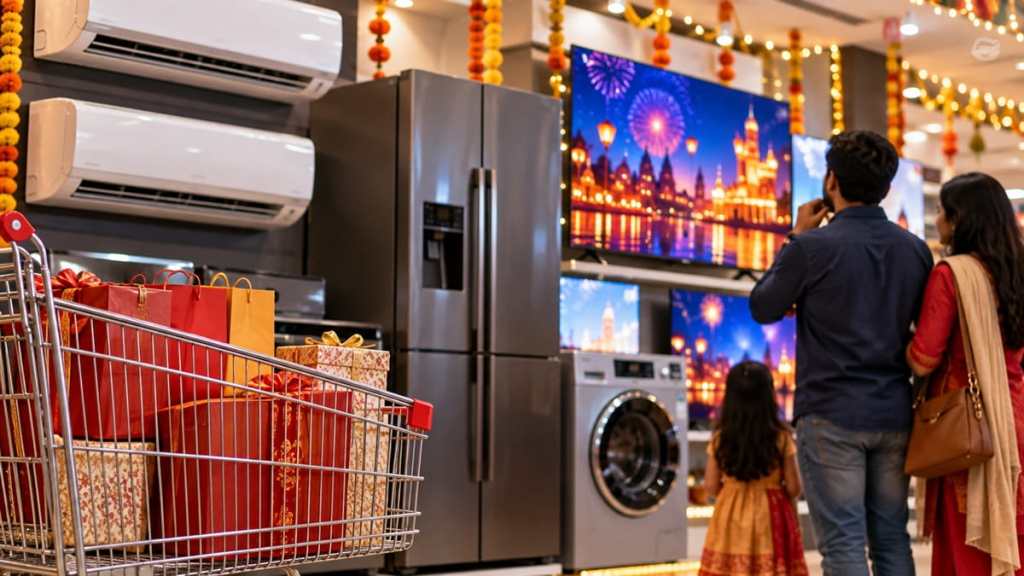

Festive shoppers looking for a deal on a new television, refrigerator or air-conditioner may have to factor in rising prices. Several appliance makers are preparing increases ahead of the festival season starting in October, PTI reported. But the announced hikes may not tell the full story of what buyers will pay. Their impact at the shop counter could depend on when and what consumers buy.
So, what is driving the price hikes, which products will be affected and will consumers still get festive-season deals?
Which appliances are becoming more expensive?
Air-conditioners are likely to see the biggest immediate increase. Manufacturers are looking at price hikes of around 5-8% for ACs, with some companies having already raised prices, industry executives told PTI.
Prices of other products such as LED televisions, washing machines, refrigerators and deep freezers are also expected to rise, although the size and timing of increases vary by brand and category.
According to news agency PTI, Daikin has already increased AC prices by around 8-10%, while Blue Star has raised prices of ACs and deep freezers by 5-8%.
Haier India President NS Satish told PTI that the company plans to increase room air-conditioner prices by around 5% from October 1 and has indicated a 2-3% increase for products including LED TVs and washing machines.
Super Plastronics (SPPL), which manufactures and markets television brands including Thomson, Kodak and Blaupunkt in India, plans to increase TV prices by around 7% after October, its director Avneet Singh Marwah told PTI.
Why are appliance companies raising prices again?
The biggest reason is input costs. Manufacturers are facing higher prices for several commodities used in making consumer appliances, particularly copper, steel, aluminium, plastics and crude oil derivatives, as well as higher freight and logistics costs, according to executives quoted by PTI.
The report also cited currency exchange volatility amid the ongoing West Asia crisis.
How much have prices increased this year?
This is not the industry’s first price increase in 2026. According to PTI, manufacturers describe the October increase as the third round of price hikes this year.
Blue Star Managing Director B Thiagarajan told PTI that commodity prices had risen significantly and the company had already increased prices three times this year.
Godrej Enterprises Group’s Kamal Nandi, Business Head and Executive Vice President, Appliances Business, told PTI that commodity prices had risen around 8-10% since the previous price revision, making another industry-wide increase difficult to avoid.
Will ACs become significantly more expensive?
Potentially, yes. Air-conditioners are particularly exposed to copper prices. Daikin Airconditioning India Chairman and Managing Director Kanwaljeet Jawa told PTI that copper prices had increased substantially and the company had already raised prices by 8-10% from September 16.
Blue Star has also increased AC prices by 5-8%. However, the actual increase a consumer sees at a retail store could differ depending on the model, retailer, inventory and discounts.
That distinction is important as manufacturers may announce a price increase while retailers continue selling older inventory purchased before the increase.
Why can some consumers still buy at the old price?
This is where dealer inventory becomes important. Dealers and distributors have built inventory ahead of the festive season through pre-buying schemes in August and September, according to PTI. This stock was purchased at earlier prices.
Godrej’s Kamal Nandi told PTI that this existing inventory could last for around one to one-and-a-half months.
That means some consumers could still find products at older prices during the early part of the festive season, including around Diwali. Nandi said Diwali would largely be covered by existing old-price inventory, with the higher prices expected to become more visible after that inventory is exhausted.
Does that mean festive discounts will disappear?
Not necessarily as the PTI report does not say festive offers will be withdrawn, although it does not specify what discounts will be available.
But there is a difference between a discount on a higher price and a genuinely lower final price.
SPPL Director Avneet Singh Marwah told PTI that higher prices could affect festive demand as consumers typically expect discounts and promotional offers during the season.
How much of appliance companies’ annual sales come during the festive season?
The timing of the price increase is significant because the festive period is one of the most important sales windows for the industry. The period covering Onam, Dussehra and Diwali typically contributes around 30-40% of annual sales for appliance manufacturers, according to sector reports cited by PTI.
Haier’s NS Satish summed up the problem in comments to PTI, saying avoiding a price increase would hurt company margins, while increasing prices could affect sales.
What happens if commodity prices keep rising?
Consumers could see another round of increases. Haier has already indicated the possibility of further price increases after Diwali and again in January if input costs continue to rise. Satish told PTI that the company planned a cumulative increase of around 15% between October and January 2027.
That means the October 1 increase may not necessarily be the final price revision.