



Once again, GDP turned into a reality show. Real GDP growth in the first quarter of this fiscal year was 7.8%. A solid eight! But it is not likeable, it seems.
Former Finance Secretary Subhash Chandra Garg didn’t buy it. He recalculated nominal GDP growth at 2.6%, while the real growth was zero. Opposition leaders nodded. Some economists backed him too. And then suddenly everyone became an economist with their own growth numbers.
So, now it’s my turn. I’m not a big-shot economist, but I worked through the data and ended up near 10%. Yes, ten. Hear me out, before you throw your phone. Afterall, you heard out Garg and his detractors too.
We expect an upward revision
The quarterly GDP revision record is loud and clear. The growth rates were revised upwards 28 out of 44 times. The average revision was 1.05 percentage points.
The Q1 record, in particular, is even more telling. Between FY15 and FY25, it was revised upward in 7 of 11 years. And from FY22 to FY25, the average upward revision was 1.06 percentage points.
Based on this, let’s revise the 7.8% to 8.8%, up by 106 basis points.
The night sky phenomenon
The GDP has many limitations. One of them is that it fails to capture the full extent of economic activity.
Night-time luminosity tries to overcome this limitation. It captures the real-time light intensity from streets, shops, factories, offices and houses. It doesn’t wait for surveys and filings. Yes, it doesn’t replace GDP, but it can tell us in advance what the official data may be missing. I am not kidding. This is a real thing.
The RBI’s 2019 study found a strong relationship between night lights and GDP, industrial production, and other indicators. Between 1992 and 2017, night‑time luminosity grew 7.1% a year. That was faster than official real GDP growth by 0.6%.
GDP does not ignore this effect; it simply notices it with a lag. Including this in the upward revised estimate, we arrive at 9.4%.
Bihar & UP’s catch-up effect
It’s tempting to round it off to 10% right away. But let’s pretend to be scientific.
The RBI’s luminosity research stops at 2017. That alone tells us the story isn’t complete. The missing years matter because the night sky has changed more than most economic indicators.
Luminosity growth in poorer states of Bihar, Chhattisgarh, Uttar Pradesh and Odisha was much higher than in other states. Bihar’s light intensity jumped 220% between 2012 and 2019. Uttar Pradesh accounted for 11.96% of India’s total light intensity by 2018–19. And earlier this year, the viral NASA Black Marble image corroborated this trend. Faster electrification, higher infrastructure growth and rising consumption have changed the night sky of the Ganges belt.
Aren’t these reasons enough to round the figure to 10% yet?
What Have We Just Done?
Well, if you agree, thanks a lot.
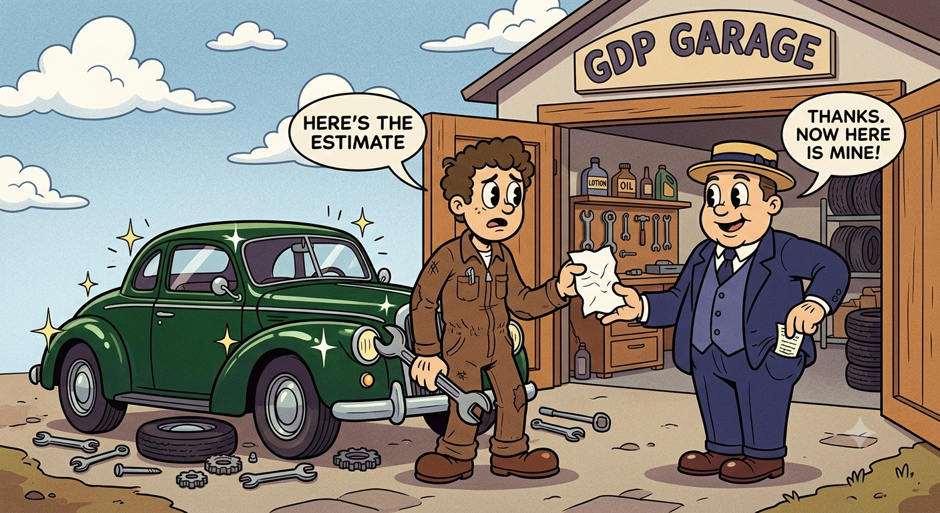
And yes, congratulations, you have just witnessed the birth of yet another GDP estimate. 10%!
I used real data and real research (click on the links to verify) to arrive at this number. But I’m sorry. I have committed a crime. I stacked those numbers on top of the official GDP rate and called it analysis. It was like mixing cola with coffee. Any “serious” economist would call it nonsense, or blasphemy.
It was a waste of your time, mine as well. I made up numbers, but I read a lot to do it. I swear.
What’s the point?
Let me clarify. I am not saying the critics are wrong. Nor am I defending the official numbers. My point is simpler: we are making too much noise about a number that was never designed to answer all the questions we are asking of it.
If we want to make noise, there are plenty of better (or worse) things to complain about. But GDP isn’t one.
It doesn’t know if you are happy. It has no idea you cannot afford an international trip like your cousin. It doesn’t know if your food is adulterated. It doesn’t care about potholes. It has no emotions about the shortage of toilets or teachers in schools. It has no idea how many forms you had to fill out and how many people you had to tip to start a business. It is blissfully unaware of everything.
GDP is just a number. An imperfect number. But still useful. It helps us understand the economy’s direction (although it misses that too, sometimes).
Weird nature of growth rates
The problem starts when we forget it is a statistic. Change the methodology, the base year, the coverage or the underlying economic structure, and the number can change dramatically.
Take Ghana in 2010 and Nigeria in 2013. After rebasing their economies and adding previously ignored activities, their real GDP jumped by roughly 60% and 89%, respectively. That didn’t change people’s income.
Ireland’s real GDP jumped 26% in 2015, largely because multinational companies shifted head offices and intellectual property into the country. But the Irish didn’t suddenly get 26% richer. That has made it an irrelevant measure ever since.
None of this makes GDP useless. It is still one of the most useful and easy-to-track measures.
Don’t let politics ruin it
But that is precisely why we shouldn’t be treating it as gospel.
It is good to see politicians and bureaucrats talking about growth. Ideally, officials should be judged partly on economic outcomes. But the moment you make that the target, you create a problem.
China has seen it. It rewarded local officials for economic outcomes. That created an obvious incentive to report higher growth. Eventually, the numbers didn’t add up, forcing downward revisions.
This was Charles Goodhart’s warning: when a measure becomes a target, it stops being a good measure.
When governments and their supporters over-hype GDP, they risk falling into the “sab changa si” (everything is fine) trap. When critics dismiss GDP numbers, they fall into the opposite trap – everything is broken. And once people pick a side, changing that becomes expensive.
Final take
Let’s stop turning GDP into a celebrity. A quarterly growth rate is not a measure of national happiness, governance or a crystal ball. Also, we shouldn’t call it fake data based on perceptions. Both things can be true. The economy can grow while many people struggle, and vice versa.
The answer isn’t to stop questioning GDP. The answer is to question it with care, nuanced debates and fewer theatrics.
Disclaimer: The views expressed are the author’s own and do not reflect the official policy or position of Financial Express.
Swapnil Karkare likes bridging economics and storytelling. A Chartered Accountant and economist by profession — he analyses finance and policy through research, writing, and podcasts.