



Knowing your peers’ increments can be difficult. There is jealousy, frustration, and an urge to leave. But would you take to the streets?
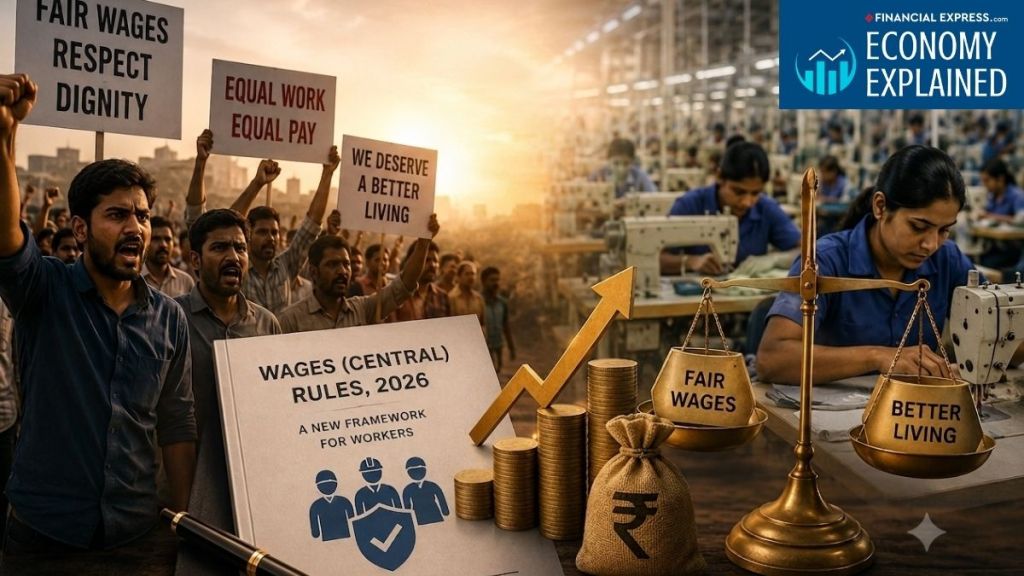
Workers at a textile factory in Noida made that move. Their peers in Haryana had just got a 35% raise. So, Noida workers protested. Haryana’s unskilled workers earned Rs. 580-750 a day after the hike. That was around 70% more than what Noida workers earned.
Although these protests turned violent, the Uttar Pradesh government narrowed that gap. It increased minimum wages by nearly 21% in Gautam Buddha Nagar and Ghaziabad districts.
Haryana’s decision sparked another protest in Bhiwadi, an industrial hub in Rajasthan. Unskilled workers there earned Rs. 285 a day. According to a Bhaskar English report, the state could increase wages by 22-45%.
Karnataka increased wages by up to 60%, the highest in the country. It looks unusually high. But trade unions say it was overdue. Wages in the state have remained stagnant since 2016-17. The law requires minimum wages to be reviewed at least once every five years.
Karnataka’s neighbour Telangana shares the same experience. The last time wages rose was in undivided Andhra Pradesh some 12 years ago. This year, Telangana increased minimum wages by 25-35%. Even Punjab revised them by 15%, the first time since 2012. In all these cases, the basic pay component remained unchanged, while the dearness allowances changed.
What is actually changing?
It’s a special year for labour markets.
In May 2026, the central government notified the Wages (Central) Rules, 2026. It replaced laws like the Minimum Wages Act, 1948, the Payment of Wages Act, 1936, and others. This law changes the nature and rules around minimum wages.
The old system relied on 1957 Indian Labour Conference norms and later Supreme Court additions. The calculation included high-calorie food, fixed yards of clothing, and a fixed share for rent, fuel, education, medical costs and essentials. States did not use uniform norms. The system also covered only scheduled jobs. As a result, minimum wages lagged real living costs and left many unorganised workers out.
The new code is designed to be more scientific. It accounts for inflation, actual spending, skills, geography and work difficulty. It also covers all employees, including those in the unorganised sector. The process is more uniform and data-driven.
The law also sets a national floor wage. No state can set minimum wages below that level. The central government is yet to define it.
States are increasing minimum wages before the new floor sets in. Some states used this moment to clear long pending revisions. When one big state raises it, others follow under pressure. That’s why around 15 states raised minimum wages in the last few months.
Will higher wages kill jobs?
The common perception is that raising minimum wages hurts jobs. We study it in economics classes. David Card’s Nobel winning research challenged that view.
We cannot guarantee that raising wages works. But enforcement matters.
That’s what Vidhya Soundararajan’s study on India shows. However, Kashif Mansoor and Donal O’Neill find widespread non compliance in India. Non-compliance rates are as high as 90% in some cases. Workers then do not receive the full increase.
But when compliance is high, wages rise, and living standards improve without reducing overall jobs. Another study by Khurana, Mahajan & Sen shows that rising minimum wages have, in part, reduced wage inequality over two decades.
The new law could improve compliance. The studies suggest that higher wages could boost demand. This matters amid weak consumption, rising fuel costs, high youth unemployment and falling savings. A bigger advantage is that the government doesn’t bear the wage bill. Corporates, MSMEs, contractors and service firms do. Wage hikes could therefore boost low-income consumption without adding to the government’s wage bill.
Who pays for higher wages?
Companies can feel the pinch, though.
Delhivery’s earnings before interest, taxes, depreciation and amortisation (EBITDA) margins got hit due to wage increases. Its Q1 FY27 service EBITDA margin fell about 3 percentage points quarter-on-quarter. Management said minimum wages had a bigger impact because there was no contractual pass-through clause. The company is renegotiating contracts, increasing automation, and front loading staffing. It is treating this as a short term margin overhang rather than a structural change.
Swiggy’s impact is smaller. Its contribution margin declined by roughly 20 basis points (bps) sequentially. One per cent is one hundred basis points. However, Eternal’s CEO Albinder Singh Dhindsa said the new code has increased labour costs. Its employee benefit costs rose about 45% year-on-year (YoY) in Q1 FY27.
Value retailers show broad based wage pressures. V Mart saw employee costs up about 17% YoY in Q1. Vishal Mega Mart reported about 13% YoY growth in employee cost per square foot. V2 Retail saw the steepest rise at about 64% YoY. The increase was due to wage revisions and expansion.
Amber Enterprises noted that the new labour law and the war in West Asia have increased labour and raw material costs during the first quarter.
SIS is the opposite case. For it, wage hikes are an opportunity. Its contracts reprice automatically when statutory wages rise. So, the impact on margins is limited. Godrej Agrovet offers a muted signal, saying it has factored in the entire impact of wage changes and expects no further hit. Travel Food Services reports labour code impact as minimal.
If higher wage costs can be passed on as per the contract, like SIS, it can protect margins. But if pass through is negotiated, wage hikes hit margins. Firms with wages close to the statutory minimum may feel the heat more. The impact could be larger when their labour costs are highly variable. That said, no firm has hinted at reducing hiring.
The inflation question
Then the next question: can it increase inflation?
There is no India-specific study. But one on the 29 OECD countries can be useful. They find that a 10% minimum wage increase raises consumer inflation by only 0.3% over five months. That seems small.
India’s labour market is complicated, especially today.
Many advanced economies face labour shortages. NITI Aayog’s report highlights the scale of the shortage. Europe, the US and the GCC have around 10 million, 7 million and 3 million vacancies, respectively. India’s blue-collar labour is therefore in huge demand. That has prompted the Indian government to sign labour exchange arrangements with countries such as Germany, Japan and Taiwan.
Job sites suggest Indians can earn two to five times more for similar jobs abroad. Sometimes, the gap is even higher. This could affect the domestic labour market. Other factors adding pressure include elections, the Special Intensive Revision of the electoral roll, reverse migration to villages, ageing in southern states, and subsidies.
I spoke to a couple of contractors. They share a familiar story. They say that workers are reluctant to work because of the subsidies. Although I disagree with their interpretation, I can understand what is happening. It’s called the reservation wage effect.
Workers finally have more bargaining power
The reservation wage is the lowest pay a worker accepts for a specific job. All the factors discussed above have pushed up that floor.
This is not new or restricted to blue-collar jobs. Many professionals wait for the right job if they have sufficient savings. Similarly, we demand higher salaries to compensate for negative experiences like long hours or strenuous tasks.
For low-skilled workers, subsidies support financial security. Some workers may also compare pay abroad, increasing the reservation wage. This means the urgency to take any job has fallen. Workers, therefore, have more bargaining power.
Therefore, a wage hike fits this moment perfectly.
But there is no free lunch. Increased labour costs creep into the economy. Companies and contractors may choose to pass this cost to customers. They raise prices of their goods. That can make everything more expensive over time. But the government and RBI can handle that part later.
We cannot assess this impact today. But the trajectory could be slow, layered and upward. Right now, we see it in labour shortages and wage increases in pockets. Over time, it could show up in wholesale and consumer price indices.
Many industries and trade unions have opposed the hike. They threaten to move industries to another state. We have heard that argument again and again. But moving industries is not so easy.
We should welcome this long-pending move. For years, workers have had limited bargaining power. That is finally changing. Workers can now get a higher share of economic gains.
Swapnil Karkare likes bridging economics and storytelling. A Chartered Accountant and economist by profession — he analyses finance and policy through research, writing, and podcasts.
Disclaimer: The views expressed are the author’s own and do not reflect the official policy or position of Financial Express.