


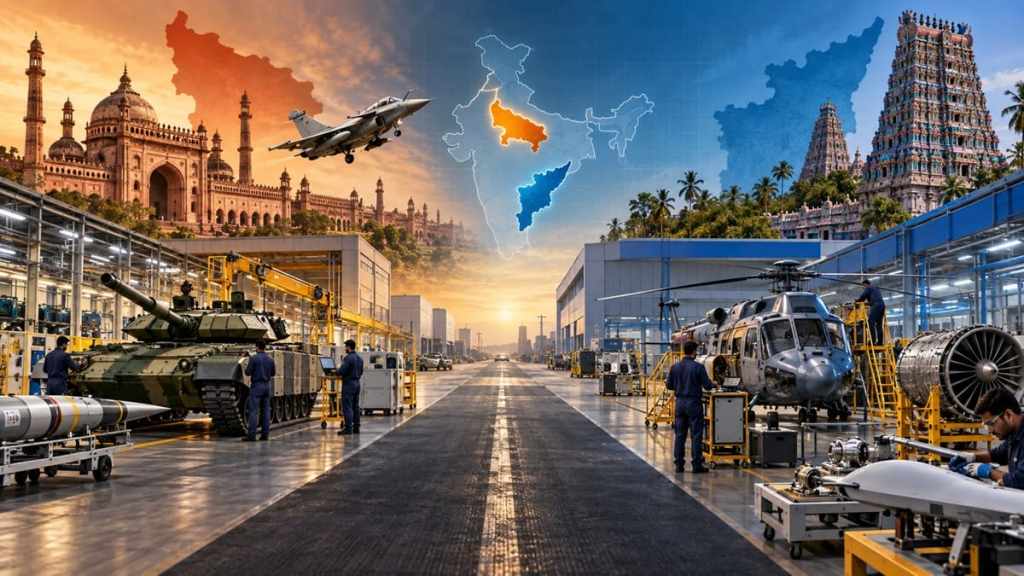

India’s defence corridor strategy is beginning to create a new contest between two of the country’s biggest manufacturing states: Uttar Pradesh and Tamil Nadu.
The two states are together attracting investments of around Rs 71,000 crore across their defence corridors, with Uttar Pradesh currently ahead on the size of the investment pipeline, according to an InCred Research report dated September 7.
Uttar Pradesh’s defence corridor has six nodes with investments of around Rs 38,700 crore, compared with five nodes and Rs 32,300 crore in Tamil Nadu. That gives Uttar Pradesh an investment lead of roughly Rs 6,400 crore, or about 20%, over Tamil Nadu.
The gap is significant because the two corridors are at the centre of the government’s effort to move India’s defence industry beyond traditional public-sector manufacturing and create a larger domestic ecosystem of private manufacturers, suppliers and technology companies.
But the numbers also come with an important caveat: higher announced corridor investment does not automatically mean Uttar Pradesh has already overtaken Tamil Nadu in actual defence manufacturing output or exports. The InCred report uses the investment figures to highlight the scale of the two corridor programmes, rather than providing a state-wise comparison of realised production.
Uttar Pradesh has the bigger investment pipeline
The InCred report identifies six nodes in the Uttar Pradesh Defence Industrial Corridor, with investments of Rs 38,700 crore.
Tamil Nadu’s corridor, meanwhile, has five nodes with investments of Rs 32,300 crore. Difference is Rs 6,400 crore higher.
Together, the two corridors account for about Rs 71,000 crore of investment, making them among the most important regional bets in India’s attempt to build a domestic defence manufacturing base.
The Uttar Pradesh lead is not enormous in percentage terms, but it matters in an industry where large defence programmes can generate long supply chains extending from prime contractors to component and subsystem manufacturers.
The bigger bet is on the supply chain
The defence corridor story is not simply about building factories for tanks, aircraft or missiles.
India’s procurement reforms are gradually opening different layers of the defence value chain to private companies.
The InCred report describes this as the Ministry of Defence having “opened the floodgates” for private-sector companies, with private players selectively moving up the value chain. The report’s illustration shows the industry evolving from a model dominated by defence public-sector undertakings towards greater participation by private companies across prime, Tier-1, Tier-2, Tier-3 and sub-component levels.
That is where the economic significance of the corridors becomes clearer.
According to the brokerage firm, a defence factory does not operate in isolation. Large platforms require electronics, sensors, radar systems, communications equipment, avionics, propulsion systems, weapons, software and thousands of components.
The report’s defence-electronics map, for instance, identifies opportunities across radars, missile and torpedo electronics, electronic warfare, communications and software-defined radios, satellite communications, ground stations, fire-control systems, avionics, nano and microsatellites and testing. It lists companies including Data Patterns, L&T, BEL, Paras Defence, Mahindra Defence, Tata Advanced Systems, Astra Microwave, Godrej & Boyce, Centum Electronics, Alpha Design and Adani Defence among the players in different parts of the value chain.
For the two corridors, the real prize could be the ecosystem around the headline investment number.
UP’s advantage is not just the Rs 38,700 crore
The Uttar Pradesh corridor’s six-node structure gives it a broader geographic footprint than Tamil Nadu’s five-node corridor, according to the report.
That could potentially help the state build a network of manufacturers rather than relying on a handful of large projects.
But investment announcements alone do not establish which state will ultimately emerge as India’s dominant defence manufacturing hub.
The InCred report does not provide a state-wise comparison on all parameters. Its corridor numbers show investment momentum, rather than proof that UP has already overtaken Tamil Nadu in defence manufacturing.
The timing is important
The corridor investments come as India’s defence procurement pipeline is expanding sharply.
On September 7 alone, the Defence Acquisition Council (DAC) approved proposals worth Rs 1.1 lakh crore, taking the cumulative value of Acceptance of Necessity (AoN) proposals in 2026 to Rs 7.6 lakh crore, according to the Ministry of Defence.
The report’s three-year AoN table puts the total value of listed proposals at Rs 17.808 lakh crore from March 2023 through September 2026. These are procurement approvals/proposals, not completed orders, but they indicate the potential size of the market that Indian manufacturers could eventually address.
That creates an important connection between the corridors and defence procurement.
The factories being established today are effectively positioning themselves for a much larger order pipeline tomorrow.
Private companies are moving deeper into defence
The shift is already visible in procurement policy.
The InCred report points to a series of measures aimed at increasing private-sector participation, including the two defence corridors, indigenisation lists, higher FDI limits, the iDEX innovation programme and the Srijan portal.
India has also created five positive lists covering 509 major equipment/platforms and five indigenisation lists covering 5,012 subsystems and assemblies, according to the report.
These lists matter for corridor investments because they potentially create a domestic market for products that were earlier sourced from overseas.
For manufacturers, that means the opportunity is not restricted to becoming the prime contractor for a major weapons programme. Companies can participate further down the chain as suppliers of components, electronics and specialised systems.
Defence spending could keep the race going
The report expects India’s defence capital outlay to grow at a 20-25% CAGR over the next four to five years, driven by rising geopolitical risks. Its chart shows defence capital outlay continuing to rise, while capital expenditure has remained around 29-33% of the overall defence budget over the past 15 years.
If that spending trajectory materialises, the competition between Uttar Pradesh and Tamil Nadu could become less about which state has the bigger initial corridor investment and more about which state can convert investment commitments into a deeper industrial ecosystem.
That means attracting anchor manufacturers will be only the first step.
The bigger challenge will be building the network of smaller suppliers around them, ensuring testing and certification facilities, developing skilled manpower and creating enough local demand to keep factories running at scale.