


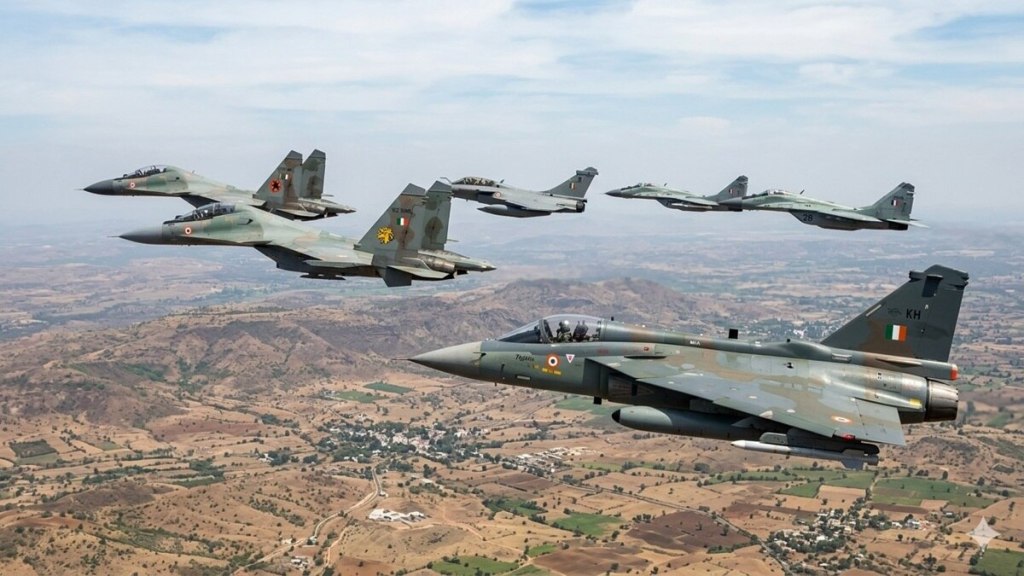

India has already committed well over Rs 1.1 lakh crore to two big Tejas Mk‑1A deals that were supposed to start delivering fighter jets years ago, but not a single aircraft has reached the Indian Air Force (IAF) so far.
Against this backdrop of stalled spending and shrinking squadron strength, IAF chief Air Chief Marshal AP Singh on Saturday (October 3) said the delays in the Tejas programme have been significant and are now directly affecting the force’s combat readiness.
Speaking at the annual press conference ahead of the 94th Air Force Day, AP Singh made it clear that while some slippage is normal in defence projects, the current situation is unusually severe.
“It happens that you plan something, but things get delayed. But this time, the delay has been much,” he said, adding, “We are also looking towards Mark 2. All these will be able to fill in the gaps that exist.”
#WATCH | On whether HAL will be penalised for the delays in LCA Mark 1A, IAF chief Air Chief Marshal AP Singh says, "It happens that you plan something, but things get delayed. But this time, the delay has been much. We are also looking towards Mark 2. All these will be able to fill in the gaps that exist…"
— ANI (@ANI) October 3, 2026
Big money, zero jets: The Tejas Mk‑1A contracts at a glance
The financial scale of the delay is stark:
- In February 2021, the defence ministry signed a Rs 48,000 crore contract with Hindustan Aeronautics Ltd (HAL) for 83 Tejas Mk‑1A jets (73 fighters and 10 trainers). Deliveries were to begin by 2024.
- In September 2025, a second deal worth Rs 62,370 crore was signed for 97 more Mk‑1A aircraft, further expanding the order book.
Together, these contracts tie up more than Rs 1.1 lakh crore of defence spending on a platform that has yet to enter IAF service in its Mk‑1A form.
As of early October 2026, no Mk‑1A jet has been formally handed over to the IAF, even though the first deliveries were due over two years ago.
The defence ministry has already warned that HAL could face liquidated damages (contractual penalties) for missing delivery schedules, after imposing similar penalties on engine supplier GE for its own delays.
‘It is going to hurt us’: IAF chief on squadron shortfall
The human and operational cost of these delays is visible in the IAF’s depleting fighter strength. Singh said the force now has only 29 fighter squadrons, far below the 42 squadrons officially sanctioned to handle a two‑front threat from China and Pakistan.
To simply stop the decline and begin rebuilding, the IAF needs to induct 36–40 new fighter jets every year for the next few years, he said.
“We need to induct two fighter squadrons every year. That means anything between 36 and 40 aircraft should be produced and inducted into the IAF for us to stop going down from the current 30 fighter squadrons and start improving towards the target of 42 squadrons. Actually, we need even more than that,” Singh said.
On the Tejas Mk‑1A specifically, he added, “There is some extra delay, and there is no doubt that it is going to hurt us.”
Beyond Mk‑1A: Mk‑2, AMCA, MRFA and even Su‑57 on the table
With Mk‑1A deliveries lagging, the IAF is pinning its hopes on multiple parallel programmes:
- Tejas Mk‑2: A more powerful, medium-weight fighter still under development. Singh confirmed the force is “also looking towards Mark 2” to help close capability gaps.
- AMCA (Advanced Medium Combat Aircraft): India’s indigenous fifth‑generation stealth fighter programme.
- MRFA (Multi‑Role Fighter Aircraft): The plan to buy 114 foreign fighters, now centred on the Rafale under a government‑to‑government deal with France.
Singh said he hopes the MRFA deal can be signed within this financial year if negotiations go smoothly.
“I think if things go well, we should be able to sign MRFA deal in this financial year. That’s what my hope is. But it is a two-way process,” he said, referring to talks between India and France.
At the same time, he also flagged a contingency plan if AMCA faces delays. “If there are delays in the AMCA fifth-generation fighter programme, we may have to look at other options. Russia has offered the Su‑57, but no decision has been taken yet,” he said.
#WATCH | Indian Air Force chief Air Chief Marshal AP Singh holds annual press conference in Delhi, says, "If there are delays in the AMCA fifth-generation fighter programme, we may have to look at other options. Russia has offered the Su-57, but no decision has been taken yet. We… pic.twitter.com/ehOO652f6A
— ANI (@ANI) October 3, 2026
Neighbour’s stealth jets: ‘A cause for worry’
IAF Chief Singh also expressed concern over regional developments, particularly reports of Pakistan collaborating with China on advanced and fifth‑generation fighter projects, while China already operates stealth jets like the J‑20 and is developing others.
“It is a cause for worry,” he said, while adding, “We do have capabilities. It is not that one platform matters so much.” Now, India needs to speed up both home-grown and foreign fighter programmes to maintain its defence capability.
Theatre commands: ‘Not against the idea, but sequencing matters’
On the long‑pending theatreisation plan to integrate the Army, Navy and IAF under unified geographic commands, Singh said the IAF is not opposed in principle. “I have made it clear that the Indian Air Force is not against theatre commands. We have been working towards it, and we have been a part of discussions throughout,” he said.
However, he indicated that recent operational experience—referred to in reports as ‘Operation Sindoor‘—has led to a rethink on how and in what sequence theatre commands should be created. “Following Operation Sindoor, the discussions on the theatreisation plan have taken a slightly different direction,” he said, adding that the government will decide whether to move in one go or incrementally.
AI, drones and the push for an Indian jet engine
On modernisation, Singh said the IAF must become an “AI‑augmented force”, using artificial intelligence to enhance decision‑making and operations, while keeping humans in charge of critical choices. “We have to have an AI-augmented force,” he said.
He also reiterated the need for India to develop its own fighter jet engine, a long‑standing gap in the country’s aerospace ecosystem. On drones, he ruled out creating a separate “drone force”, saying unmanned systems should remain integrated with existing combat units. “Drones are not revolutionary to the Indian Air Force, but evolutionary. We have not thought of having a separate drone force,” he said.
Where things actually stand now
Tejas Mk‑1A: Over Rs 1.1 lakh cr committed; first deliveries now more than two years late; penalties under consideration against HAL.
IAF strength: Down to 29 squadrons vs a sanctioned 42; needs 36–40 jets/year just to stabilise.
Future mix: Mk‑1A, Mk‑2, AMCA, MRFA (Rafale) and, if needed, an interim fifth‑generation option like Su‑57.
For the IAF, the focus is now on speeding up fighter deliveries and reducing delays, as several major defence programmes face long timelines and the number of operational fighter squadrons remains below the required level.