


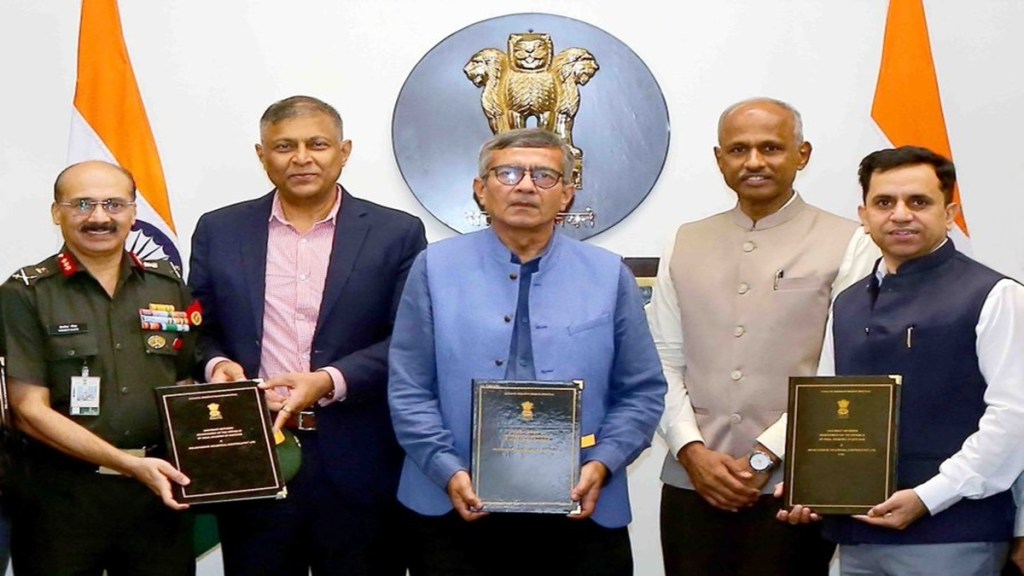

The Ministry of Defence (MoD) has signed a Rs 586-crore contract with Accurate Industrial Controls Private Limited to procure Auxiliary Power Units (APUs) for the Indian Army’s T-72 and T-90 tanks. The procurement is expected to improve the operational readiness, reliability and sustainability of the Army’s mechanised formations.
According to the defence ministry, the agreement is also a step towards reducing dependence on imported components for armoured platforms and enhancing India’s defence manufacturing capabilities.
What are Auxiliary Power Units?
An Auxiliary Power Unit is an alternative source of electrical power for a tank. It allows several critical systems to operate without requiring the tank’s main engine to run continuously. The APUs will provide power to key systems, including:
- The fire-control system
- The firing circuit
- The gun-stabilisation system
- Other electrical and operational equipment installed on the tanks
The availability of an alternate power source can help reduce unnecessary engine usage, support silent operations and improve the efficiency of the tank’s onboard systems. It can also help ensure that essential systems remain available when the tank is stationary or when its main engine is switched off.
MoD signs a Rs 586 crore contract with Accurate Industrial Controls Pvt Ltd for indigenously developed Auxiliary Power Units (APUs) for T-72 & T-90 Tanks. The APUs will enhance operational readiness, reliability & sustainability of the Indian Army’s Mechanised Formations, while… pic.twitter.com/3bx29WYoFj
— Ministry of Defence, Government of India (@SpokespersonMoD) September 21, 2026
Boost to mechanised formations
The induction of indigenously developed APUs is expected to increase the performance of the Indian Army’s armoured units. T-72 and T-90 tanks form a major part of India’s mechanised formations and operate in demanding conditions.
According to the Ministry of Defence, the new APUs will contribute to the reliability of these formations. By supplying dependable auxiliary power, the systems are expected to support the functioning of critical tank equipment during various operational situations. The procurement may also help improve maintenance and lifecycle support by creating a domestic source for an important tank subsystem.
Make-II initiative and indigenisation
The contract has been placed under the government’s Make-II framework, which encourages industry-led research, development and production of defence equipment. It was signed in Delhi on Monday (September 21) in the presence of Defence Secretary Rajesh Kumar Singh.
The Ministry of Defence described the procurement as a “significant step towards indigenisation of critical sub-systems of armoured platforms.” It said the project demonstrates how indigenous innovation can be developed into a production-ready capability and subsequently inducted into the armed forces.
The ministry added that the agreement reflects the effectiveness of the Make-II mechanism in translating private-sector research and development into military equipment.
T-72 and T-90: India’s armoured fleet
The T-72 is a Soviet-designed main battle tank that forms a major part of the Indian Army’s armoured fleet. It is known for its relatively compact size, good mobility and ease of maintenance. The tank is powered by a diesel engine and uses a torsion-bar suspension system, allowing it to operate effectively across varied terrain, including desert and semi-arid regions.
It is armed with a 125 mm smoothbore gun capable of firing armour-piercing, high-explosive and anti-tank guided missiles, supported by coaxial and anti-aircraft machine guns. Over the years, India has upgraded many of its T-72s with improved fire-control systems, night-vision equipment and better armour protection to extend their service life and combat effectiveness.
The T-90 is a more advanced main battle tank, also of Soviet origin, and serves as the backbone of India’s modern armoured formations. It features a more powerful engine, enhanced mobility and superior protection compared to the T-72, including explosive reactive armour and advanced composite armour modules.
The T-90 is equipped with a 125 mm smoothbore gun, advanced fire-control systems, thermal imaging sights and laser warning receivers, giving it strong all-weather and night-fighting capabilities. It also has improved command-and-control systems and can operate as part of networked battlefield environments. India operates both Russian-origin T-90S variants and indigenously upgraded versions, with ongoing efforts to further localise components and subsystems.
Supporting ‘Aatmanirbharta’ in defence
The deal is aligned with the government’s broader objectives under the ‘Aatmanirbhar Bharat’ initiative and its vision of ‘Viksit Bharat @2047.’ The Ministry of Defence said the contract is a step towards making India’s defence industry more self-reliant and competitive.
The involvement of Accurate Industrial Controls in supplying domestically developed APUs is expected to strengthen the role of Indian companies in designing and manufacturing specialised equipment for the armed forces. Such procurements can also encourage further investment in defence research, engineering and manufacturing, while helping develop domestic expertise in critical subsystems for armoured vehicles.
The APU contract follows another major agreement signed by the Ministry of Defence earlier in September. On September 17, the ministry signed a contract with General Atomics Aeronautical Systems Inc. for the lease of two MQ-9B SeaGuardian High-Altitude Long-Endurance Remotely Piloted Aircraft Systems for the Indian Navy. The 30-month lease is valued at approximately Rs 1,943 crore.
The MQ-9B SeaGuardian systems are equipped with advanced sensors, specialised payloads and other sophisticated systems. They are likely to provide persistent intelligence, surveillance and reconnaissance coverage across large areas of the maritime domain.