


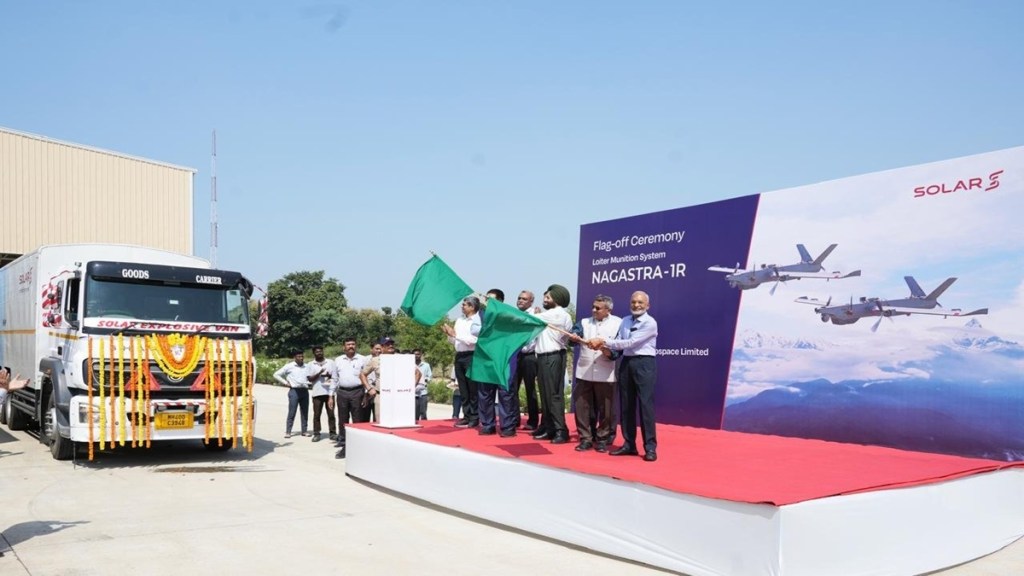

The Indian Army has received 450 Nagastra-1R loitering munitions under a Rs 158-crore emergency-procurement contract, completing one of the largest single-batch supplies of indigenous “kamikaze drones” to the force. The systems, developed by Nagpur-based Solar Defence and Aerospace Ltd (SDAL), are designed to hover over a target area and strike with precision, adding a short-range offensive capability to the Army’s battlefield arsenal.
The Rs 158-crore order was placed in June 2025 after technical trials. It works out to an average contract value of roughly Rs 35 lakh per unit, though the final cost per system may include spares, training, support and other components.
What the Army has received
Nagastra-1R is a loitering munition—a weapon system that can remain airborne over a designated area, identify a target and then dive into it. Unlike a conventional missile, it gives operators time to assess the target before engagement.
The Nagastra-1R variant was configured for the Army’s short-range operational requirements. According to SDAL, it can carry out kamikaze attack missions and also offers an abort-and-recovery option, allowing commanders to discontinue an attack under specified conditions.
“SDAL said the system’s performance was evaluated through multiple live trials, including assessments of target-hit accuracy,” according to the company’s account of the procurement process. It described the platform as a cost-effective indigenous option that provides precision without compromising quality.
Solar Defence and Aerospace Limited (SDAL) completes the delivery of the largest supply of Loitering Munitions to the Indian Army. 450 Loitering Munitions supplied to the Indian Army in a single supply batch. Order was placed by Indian Army under emergency procurement after rigorous trials for Nagastra 1R. Though 4 companies participated in the technical trials, only SDAL was able to demonstrate all operational parameters.
This version of Nagastra was configured on specific requirement of the Army for short-range operations of kamikaze attack mode and option of abort and recovery. With ongoing Iran-US-Israel conflicts, this indigenously developed system is a very cost-effective solution without any compromise in accuracy and quality. System performance was evaluated along with multiple live trials for target hit accuracy.
(Pic: Indian Army)
— ANI (@ANI) October 13, 2026
Emergency procurement route
The Army placed the order under its emergency procurement powers, a route used to induct critical equipment quickly. According to the ANI news report, SDAL said four companies participated in the trials, but claimed it was the only firm able to demonstrate all required operational parameters.
The contract is a follow-on to the Army’s earlier order for 480 Nagastra-1 loitering munitions, which was placed in 2024 and fully delivered by December that year. The repeat order indicates continued demand for SDAL’s loitering-munition line and suggests the Army is building a larger inventory of recoverable precision-strike drones.
Past deliveries and market position
Solar Industries, through its defence subsidiary SDAL, has already delivered 480 Nagastra-1 loitering munitions to the Indian Army under a 2024 emergency-procurement contract; the full consignment was handed over by December 2024, with the system carrying over 75% indigenous content.
The company has also supplied Pinaka rockets and related munitions, and in February 2025 its subsidiary Economic Explosives signed a roughly Rs 6,084-crore contract with the Ministry of Defence for Area Denial Munition Type-1 and High Explosive Pre-Fragmented Mk-1 rockets for the Pinaka multiple-launch rocket system.
Why it matters for the Indian Army
For field commanders, the Nagastra-1R provides a short-range strike option against high-value or time-sensitive targets without committing a larger missile or aircraft mission. Its recovery capability can also reduce the cost of training, testing and aborted operations.
The delivery comes at a time when loitering munitions have become central to modern warfare, with such systems increasingly used for surveillance, precision strikes and saturation attacks against ground targets. SDAL cited the ongoing Iran-US-Israel conflict as part of the broader security context driving demand for such capabilities.
Solar’s defence push
SDAL is a subsidiary of Solar Industries India, earlier known as Economic Explosives Ltd. The completed Rs 158-crore Nagastra contract adds to the listed company’s growing defence-order book and shows its diversification beyond its traditional explosives business.
The company is also developing ‘Bhargavastra’, an indigenous counter-drone system. In July 2026, SDAL Chairman Satyanarayan Nuwal said the technology would support the development of an ambitious “Sudarshan Chakra” air-defence system by 2030.
#WATCH | Solar Defence completed the delivery of the highest quantity of loitering munitions (450 nos.) to the Indian Army in a single supply batch.
With on going Iran US Israel conflicts, this indigenously developed system is a very cost-effective solution without any compromise in accuracy and quality. System performance was evaluated along with multiple live trials for target hit accuracy.
(Video Source: Solar Defence)
— ANI (@ANI) October 13, 2026
According to Nuwal, Bhargavastra’s radar can detect aerial threats up to 10 km away, while its Electro-Optical Tracking System has a six-km range—beyond the Army’s current operational requirement of 2.5 km.
Together, the Nagastra delivery and Bhargavastra development show SDAL building capabilities on both sides of drone warfare i.e, offensive loitering munitions and counter-drone air defence, two areas where the Indian armed forces are rapidly expanding requirements.