


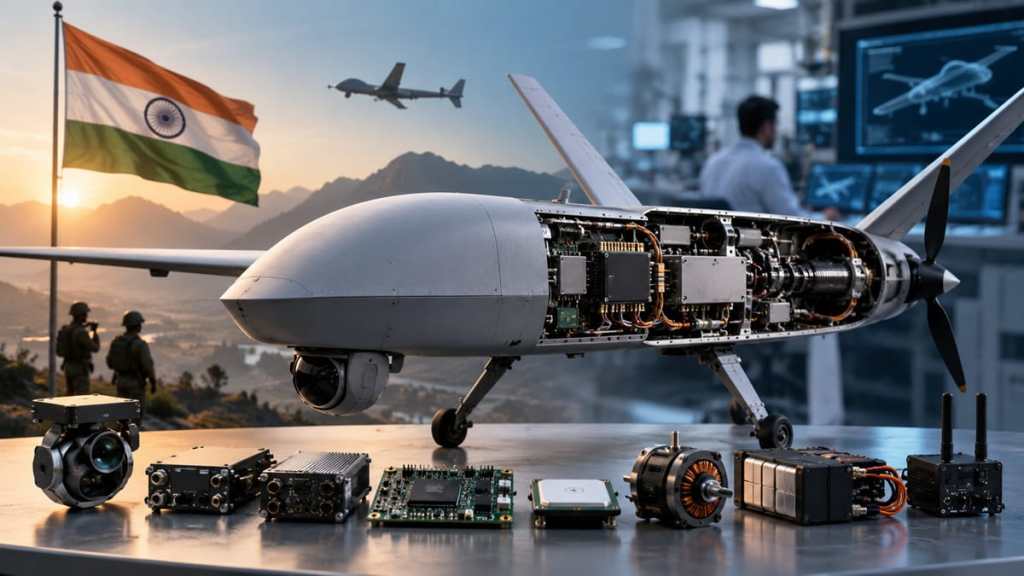

India’s drone industry is entering a more demanding phase. After years in which much of the focus was on building and assembling unmanned aerial vehicles (UAV), attention is gradually shifting to the depth of the domestic manufacturing ecosystem. The shift comes as drones take on a wider role in India’s defence strategy, spanning surveillance, logistics, intelligence gathering and combat operations. As their deployment expands, the question of what qualifies as an indigenous UAV is also becoming more important.
Industry players that Financial Express Online spoke to, including Paras Defence and Space Technologies and AKSI Aerospace Group, said the next phase of growth will depend on how far Indian companies can build capabilities beyond assembling complete platforms.
Their assessment points to an emerging opportunity for specialised suppliers as well as a larger strategic challenge for the sector. While the airframe remains the most visible part of a drone, much of its performance, reliability and operational value is determined by the technologies operating beneath it.
However, building those capabilities domestically will require companies to navigate questions of cost, scale, technological maturity and qualification. How the industry addresses these gaps could determine both the level of indigenous control over India’s military drones and where the most valuable business opportunities emerge.
Next battleground for India’s defence-drone industry
As India expands its use of UAVs for surveillance, logistics, intelligence, precision missions and combat operations, the business opportunity is also moving from companies that simply build complete drones to those capable of supplying the high-value systems and subsystems underneath them.
Paras Defence and Space Technologies, which operates in defence electronics and optical systems, told FE Online that localisation needs to move beyond the airframe.
“A UAV can be designed and assembled domestically, but genuine technological sovereignty requires control over its mission-critical subsystems,” the company said.
It also said that sensors, electro-optics, avionics, flight-control systems, communications and navigation directly influence a UAV’s performance, reliability and operational effectiveness.
Why the airframe is only the beginning
One of the easiest ways to understand the problem is to think of a drone as a layered technology stack. At the most visible level the airframe is the body, wings, structure and other physical components.
But beneath it sits the technology that actually turns that structure into an autonomous aircraft.
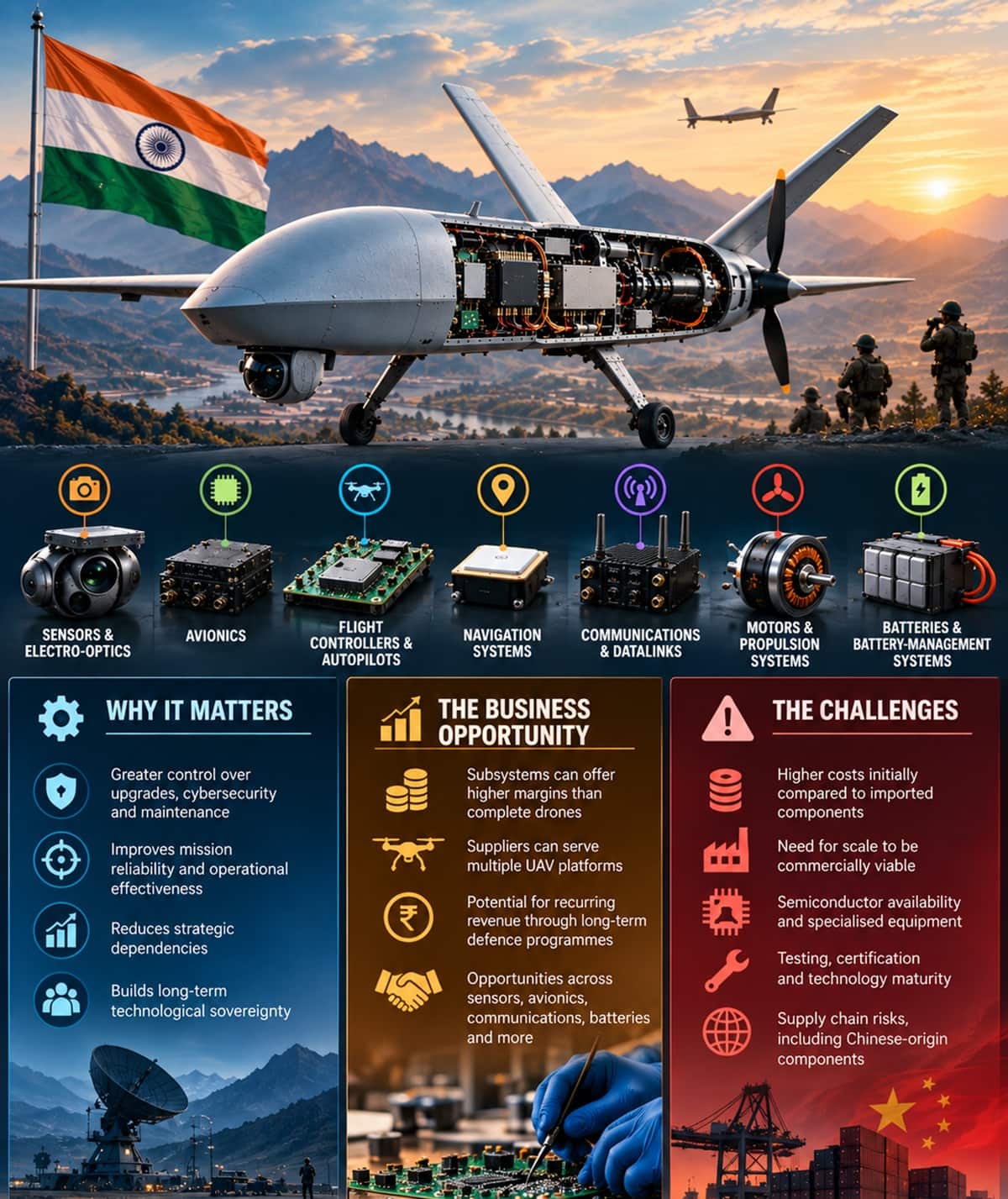
The flight controller and autopilot determine how the UAV flies. Navigation systems tell it where it is. Communications and datalinks connect it to the operator or command network. Sensors and electro-optics allow it to see and collect information. Batteries and battery-management systems provide power, while motors and propulsion systems convert that power into flight.
For military UAVs, the stakes are even higher as these systems can affect mission reliability, cybersecurity, survivability and the ability to upgrade the platform over its lifecycle.
Paras Defence said that localising these technologies gives India greater control over “upgrades, cybersecurity, maintenance, lifecycle support and future product development”.
The question is no longer who built the drone. But who controls the technology inside it.
Why imported components are a problem
The drone industry in the country has expanded rapidly, but much of the ecosystem has historically been focused on integration, putting together components sourced from different suppliers into a complete UAV.
That model can work in commercial markets where price and availability are the primary considerations. But for defence, it is different.
If a critical component comes from an overseas supplier, the Indian OEM may have limited control over its software, firmware, future availability, upgrades or supply.
That can create strategic vulnerabilities even when the final aircraft is manufactured domestically.
The Financial Express Online reached out to Pankaj Akula, Group Managing Director of AKSI Aerospace Group, who described the issue as one of “operational sovereignty” rather than simply a Make in India requirement.
“A drone assembled in India can still carry significant strategic dependency if its flight controller, propulsion electronics, communications, sensors, batteries or navigation stack originate overseas,” Akula told FE.
A domestic drone company could potentially be dependent on a foreign supplier for the very subsystem that determines whether the aircraft can navigate, communicate or execute its mission.
The China question
The issue becomes more complicated when the imported technology originates from a strategically sensitive supply chain.
India has already tightened scrutiny of Chinese-origin components in military drones amid concerns around communications, cameras, radio transmission and software.
For defence manufacturers, replacing such components is not necessarily a simple procurement exercise.
For example, changing a flight controller can mean changing the software architecture, integrating the new hardware, conducting ground and flight testing, validating reliability and potentially going through customer requalification.
As Akula puts it: “An indigenous airframe with a foreign-controlled electronic nervous system is not necessarily an indigenous strategic capability.”
This is where the distinction between assembly and technological sovereignty becomes critical.
But there is another issue for the industry: What does it cost to replace that foreign technology?
Localisation comes with a price
Imported components benefit from global production volumes, established suppliers and highly optimised manufacturing ecosystems. Indian manufacturers operating at smaller volumes can therefore find it difficult to match international prices.
Paras Defence identifies cost and scale as two of the biggest commercial challenges.
“Imported components often benefit from enormous global production volumes and highly optimised supply chains,” the company said.
Indian manufacturers also face hurdles involving raw materials, semiconductor availability, specialised equipment, testing infrastructure, certification, technology maturity and quality consistency.
This creates a classic manufacturing problem: localisation can increase costs initially, while scale is needed to make localisation economically viable.
For defence companies, therefore, the opportunity is not simply to replace an imported component with a domestic one. The bigger challenge is to build a component business that can achieve enough scale to compete on cost while meeting the reliability and certification requirements of military customers.
The higher-value business may sit below the drone
This is where the economics of the UAV industry could become particularly interesting for Indian defence companies.
AKSI Aerospace expects assembled commercial and agricultural drones to operate broadly in the 20–30% gross-margin range, while its indicative target for drone subsystems is 30–50%. Autopilots and flight-control systems, which have a higher intellectual-property and software component, could potentially reach 45–60% gross margins at scale, according to the company.
These are AKSI’s indicative targets rather than industry-wide margins, but they illustrate why the economics of drone manufacturing could increasingly move towards high-value subsystems.
The commercial attraction is straightforward. A company manufacturing a complete UAV has to win and execute a platform programme. A company supplying an autopilot, sensor, battery-management system, propulsion component or communications system could potentially supply several UAV manufacturers.
The opportunity, therefore, is not just the value of one drone but the recurring demand generated by every platform that uses the same critical subsystem.
One drone, multiple revenue pools
A UAV is not a single product from an industrial perspective. It is a collection of technology layers, with each layer representing a potential supplier and revenue pool.
These include flight controllers and autopilots, navigation systems, electro-optics and cameras, communications and datalinks, command-and-control systems, electronic warfare systems, batteries and battery-management systems, motors and propulsion electronics, avionics, mission systems, counter-UAS technologies and other specialised defence electronics.
That could create a new opportunity for Indian defence companies that do not necessarily want to compete for complete UAV programmes.
Paras Defence believes the future UAV ecosystem is unlikely to be dominated only by companies manufacturing complete platforms. Instead, specialised suppliers could provide high-value systems across multiple UAV platforms.
That distinction matters commercially.
A subsystem maker that qualifies its technology with one UAV manufacturer could potentially use the same capability across other platforms, subject to technical integration and customer qualification. This can create a broader addressable market and reduce dependence on the success of a single aircraft.
Qualification could be the gateway to recurring defence revenue
For subsystem manufacturers, however, developing the technology is only the first step.
Defence procurement typically involves technical evaluation, testing and vendor-development cycles before a component or system can enter production.
AKSI says successful completion of qualification and vendor-development cycles can potentially lead to multi-year production programmes rather than isolated one-time orders. Once a supplier and component are qualified, there can be repeat production opportunities over the programme lifecycle.
That makes qualification an important commercial inflection point.
The business model can move from engineering revenue to serial-production revenue and, eventually, recurring supply and lifecycle opportunities.
For investors and defence-industry players, that distinction could be more important than simply counting how many drones a company can manufacture.
Why 100% localisation may not be the immediate goal for India
India’s defence industry does not necessarily need to eliminate every imported component overnight. The more practical approach could be to identify the technologies that are mission-critical and strategically sensitive and localise those first.
Paras Defence makes this distinction explicitly.
“100% localisation should be treated as a long-term aspiration rather than an immediate requirement.”
The immediate priority, according to the company, should be technologies affecting the UAV’s “autonomy, navigation, sensing, communication, control and survivability”.
This creates a hierarchy of localisation.
India may continue to source certain commodity components from trusted global suppliers while simultaneously building domestic capabilities around the systems that have the greatest impact on mission assurance and strategic autonomy.
For the industry, this also means the biggest opportunities may emerge in areas where strategic importance, high technological value and repeat demand overlap.
The business opportunity is moving inside the drone
If India produces more UAVs for the armed forces, the market does not have to be captured only by companies selling complete aircraft. Every UAV requires multiple specialised systems.
That creates potential markets for companies making flight controllers and autopilots, navigation systems, electro-optics and cameras, communications and datalinks, command-and-control systems, electronic warfare systems, batteries and battery-management systems, motors and propulsion electronics, avionics, mission systems, counter-UAS technologies and sensors.
Paras Defence sees this as a major opportunity for Indian defence companies to become high-value system and subsystem suppliers.
The potential multiplier effect comes from the ability to serve multiple UAV manufacturers and, in some cases, extend those technologies into other defence platforms.
This could gradually change the structure of India’s drone industry: from a market dominated by complete-platform manufacturers to one supported by a deeper network of specialised component and subsystem companies.
The challenge is turning localisation into a scalable business
The strategic case for localisation may be clear, but the commercial case will ultimately depend on scale.
Indian companies need to move beyond developing one-off alternatives to imported components and build products that can be manufactured consistently, competitively and in sufficient volumes.
That means investment in testing and certification, manufacturing capacity, technology development and supply chains for the materials and components that sit further upstream.
It also means having enough demand to justify those investments.
For Indian defence companies, the opportunity could lie in creating technologies that are not tied to one drone, one customer or one programme.
The companies that manage to do that could capture a much larger slice of the UAV value chain.
Defence suppliers eye a bigger UAV opportunity
The emerging opportunity in high-value UAV subsystems comes as listed Indian defence companies expand their exposure to specialised electronics, optics and other technologies.
Shares of Paras Defence and Space Technologies closed at Rs 1,414.50 on Friday, September 4, down 1.72% over the week. The stock touched a weekly high of Rs 1,439.90 and a low of Rs 1,410, compared with the previous week’s close of around Rs 1,481.
(Disclaimer: This article is strictly information-only and does not constitute financial, investment, or legal advice. The discussion around defence equipment localisation, drone subsystem technology, and market opportunities reflects industry analysis and corporate commentary. Mention of specific listed companies, including Paras Defence and Space Technologies, and historical stock prices is provided purely for contextual news reporting and does not constitute a buy, sell, or hold recommendation. Investors should consult a SEBI-registered investment advisor or qualified financial professional to evaluate personal financial situations, risks, and suitability before making any investment decisions.)