


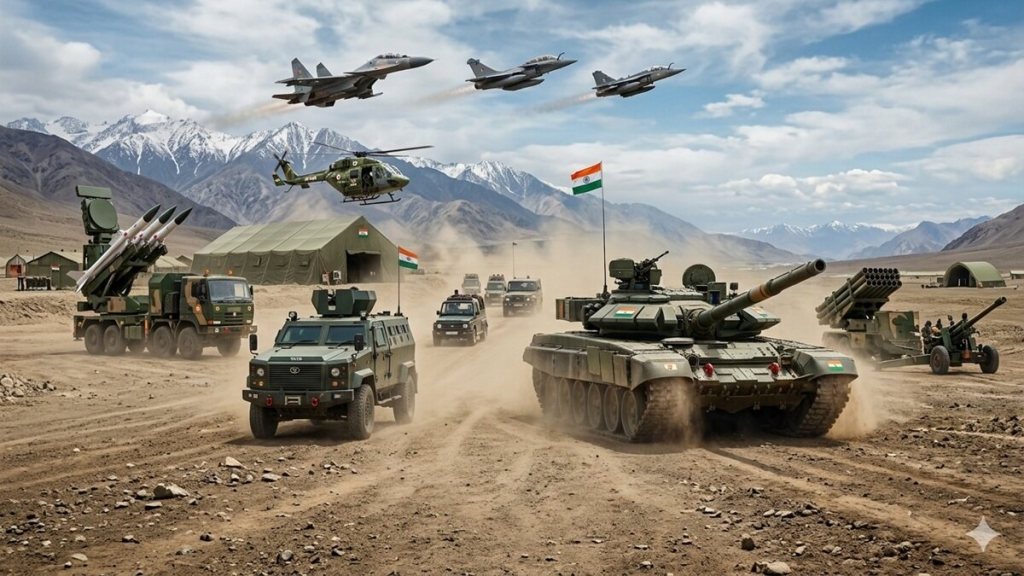

India is pouring more public money into defence modernisation and domestic aerospace manufacturing, but higher budgets alone have not created a self-reliant defence industry. Around 75% of the capital acquisition budget is reserved for domestic industry. The bigger question is how much of that spending builds Indian technology, intellectual property (IP) and supply chains, rather than funding the local assembly of systems built around imported components.
That creates a large market for Indian firms. But a report by 360 ONE Capital, based on discussions at the AEDEX 2026 conference in Delhi, says the opportunity depends on deeper capabilities in engines, sensors, materials, electronics and other critical subsystems. “True indigenisation is better measured by technology, readiness level, genuine technology absorption and full IP control,” the report said.
Domestic spending does not always mean indigenisation
The government raised the domestic industry’s share of the capital procurement budget to 75% in 2023–24, from 68% in 2022–23, according to the Ministry of Defence.
Roughly 90% of the Indian Air Force’s (IAF) capital acquisition went to domestic sources over the preceding two years, according to the 360 ONE Capital report, which does not specify the financial years or measurement basis. But a payment to an Indian company does not automatically mean the underlying technology is Indian.
A defence platform may be manufactured or assembled in India while still relying on imported engines, sensors, actuators, alloys, electronics or software. In such cases, the country may not have full control over the technology or the supply chain.
The focus is therefore shifting from the value of contracts awarded in India to the depth of domestic capability created by those contracts. The key questions are whether Indian companies own the intellectual property, whether they can modify and upgrade the system independently, and whether local suppliers can produce critical components at scale.
DAP 2026: From ‘indigenous content’ to IP ownership
The report describes the draft Defence Acquisition Procedure (DAP) 2026 as placing greater emphasis on intellectual property ownership. The Ministry of Defence’s published proposals also raise the indigenous content requirement in the Buy (Indian–Indigenously Designed, Developed and Manufactured) category from 50% to 60%. Technology ownership and local content remain distinct considerations.
Other measures have also expanded the industrial base. Industrial licences have increased from 258 in 2015 to 834 as of March 2026. In some cases, licence validity has been relaxed from seven years to lifetime validity, subject to conditions.
The government has also created new Defence Public Sector Undertakings (DPSUs) following the corporatisation of the Ordnance Factory Board. Defence Industrial Corridors in Uttar Pradesh and Tamil Nadu, supported by defence technology testing centres, are intended to reduce the cost and time involved in developing and certifying new products.
These initiatives have created the policy structure for domestic manufacturing. The unresolved issue is whether companies can now develop the technology and production scale needed to compete in India and overseas.
Aero-engines remain the biggest technology risk
The most serious gap is in aero-engines. India has design capability and a growing base of precision manufacturers, but it lacks several facilities needed to develop and certify a modern fighter engine. These include domestic turbine test rigs, compressor test rigs and a high-altitude test facility. In the absence of such infrastructure, Indian engine programmes have had to depend on overseas testing, including facilities in Russia. This can add years to development schedules and create uncertainty for major aircraft programmes.
The problem is not limited to the design of the engine. It extends to the manufacture and certification of hot-section components, specialised coatings and high-temperature materials. The issue became particularly visible in the Light Combat Aircraft (LCA) Mk1A programme. Deliveries of GE F404 engines for the fighter have faced delays, affecting the pace at which HAL can complete and deliver aircraft. GE Aerospace handed over the first F404-IN20 engine for the Mk1A programme in March 2025 under an order for 99 engines.
Later deliveries have allowed the programme to resume integration and pre-induction testing, but the episode showed how imported propulsion systems can affect an otherwise domestic platform, 360 One capital report added.
India’s domestic-development advocates argue that the country has enough design talent to make progress. They have pointed to the development of the small Manik turbofan for the Nirbhay programme as evidence that Indian teams can design engines. The more immediate weakness, they say, is the absence of test infrastructure.
The argument is especially relevant for the Advanced Medium Combat Aircraft (AMCA) programme. Without domestic turbine, compressor and high-altitude testing facilities, engine development could remain dependent on foreign test schedules. That could become a structural risk for future fighter programmes.
Global engine manufacturers have taken a more cautious view. They say India’s capabilities in critical hot-section components, coatings and certain raw materials are still limited. Much of the relevant intellectual property remains closely held by foreign companies and is unlikely to be transferred without a significantly larger commercial incentive.
Subsystem gaps are specific
India’s dependence is not limited to complete platforms. Several gaps remain in the subsystems used in modern aircraft and defence systems.
The list discussed by industry includes:
- AC generators and alternators
- Hydraulic and fuel pumps
- High-strength aluminium alloys
- Stealth materials
- Infrared sensors
- Flight-control actuators
- Carbon fibre
- Advanced environmental-control systems
High-end electronics and sensor-fusion components
The aircraft may be designed and assembled in India, but dependence on foreign suppliers can continue at the subsystem level. This limits the country’s ability to make rapid modifications, control costs and maintain the platform through its full operating life.
Carbon fibre illustrates the scale problem. The constraint is not necessarily the absence of technical knowledge, but insufficient demand across the defence and space sectors. Without enough orders, companies cannot invest in production lines that require substantial capital and long payback periods. The same problem applies to several specialised components. A supplier may be technically capable of manufacturing a part, but the domestic requirement may be too small to justify the investment.
Why import substitution alone is not enough
One of the strongest arguments made was that an item placed on an indigenisation list does not automatically become a viable business. The example cited was a relay for an Air Force aircraft. The Indian requirement could be around 500 units over ten years across 40 or 50 aircraft, while the global market could consume 5,00,000 units.
A domestic supplier cannot achieve competitive unit economics by serving only the Indian requirement. The production line, certification costs and engineering investment would remain too expensive for such a small order. The solution is for Indian suppliers to become part of the global value chains of foreign original equipment manufacturers. That would give them access to larger volumes and allow them to spread investment across multiple markets.
Safran’s operations in India were cited as an example. The company has 18 work centres in the country, providing manufacturing and engineering services to its group companies in the United States and Europe. Indian MSME suppliers are connected mainly through global contracts, rather than through one-off requirements linked only to an Indian defence order.
“Import substitution alone does not produce viable unit economics,” was the broader message in report. Indian companies need to become competitive suppliers, not just protected suppliers.
China-plus-one creates a window for Indian suppliers
The current global aerospace market offers a potential opening. Aircraft and defence manufacturers are looking to diversify their supply chains and reduce excessive dependence on China. India has a large engineering workforce, a growing precision-manufacturing base and an expanding domestic defence market. These factors have encouraged global companies to examine India as part of their “China-plus-one” strategy.
However, the opportunity will not remain open indefinitely. Suppliers need clear demand, certifications, financing and the ability to deliver consistently.
Industry’s main demands include:
- Long-term contracts that provide visibility for capital investment
- Production-linked incentives for imported electronics and materials
- Stronger Tier-II and Tier-III supplier networks
- Faster customs clearance for critical inputs
- Easier movement of components and specialised equipment
- Greater integration with global aerospace and defence programmes
Long customs procedures were flagged as a disadvantage compared with Asian competitors that complete similar processes within 48 hours. Recent trade arrangements with the United Kingdom and the European Union could help Indian companies integrate more deeply with international supply chains, but policy execution will determine how much of that opportunity is captured.
Investor view: ‘Perception of the past’
Munish Aggarwal, Managing Director and Co-Head of Investment Banking at Equirus Capital, told The Financial Express Digital (Online) about the perception that India is not technologically savvy enough to develop critical technology and infrastructure is “a perception of the past”.
“India is rapidly ascending the curve in terms of developing home-grown technical capabilities,” Aggarwal said. “Space, emerging technologies, virtual avionics and home-grown companies are building capabilities and getting empanelment domestically as well as globally.”
He pointed to Skyroot Aerospace’s successful launch of the Vikram-1 rocket in July this year as a milestone, marking India’s first privately developed orbital rocket mission.
“But this is only one part of the broader story,” Aggarwal said. “Across the ecosystem, a number of startups and companies are building capabilities across space and orbital solutions, launch and booster systems, BESS and proprietary energy technologies, as well as micro nuclear reactors. On the defence side, we are seeing companies develop indigenous arms, ammunition and other critical defence technologies.”
He added, “While significant technology gaps exist today in critical technology, our cost-effectiveness, resourcefulness and the combination of domestic and government initiatives are spurring innovation that will help us become increasingly self-reliant over the next decade.”
Private companies are targeting the subsystem opportunity
The growing defence market is creating opportunities for private companies beyond large platforms. BEL remains positioned around system integration in integrated air-defence networks, radars and electronic warfare suites. BDL is expected to benefit from demand for missiles and layered air-defence systems. The conflict in West Asia has highlighted the importance of multi-layered air defence, while the Russia-Ukraine war has demonstrated the value of mass-produced unmanned systems, loitering munitions and electronic warfare.
Companies such as Data Patterns, Astra Microwave and Apollo Microsystems are exposed to opportunities in radars, electronic warfare, seekers and fuzes. Solar Industries is positioned to benefit from demand for relatively low-cost, mass-produced munitions, including its Nagastra loitering-munition family, warheads and propellants.
The commercial opportunity will depend on whether the military moves from trial orders to predictable procurement. Start-ups and smaller companies are particularly vulnerable to delays because they do not have the balance sheets to absorb long gaps between development, testing and production orders.
Aerospace suppliers are preparing for a larger export market
A separate opportunity is emerging in aerospace manufacturing for global customers. Azad Engineering is focused on precision components for engines and turbines. PTC Industries produces titanium and superalloy castings. Unimech Aerospace works on tooling and precision assemblies, while Aequs supplies machined parts and assemblies to global aerospace manufacturers.
Bharat Forge and other engineering companies are also positioning themselves for orders from international aircraft and defence manufacturers. These businesses can benefit from the relocation of parts of global supply chains to India. Their prospects are stronger when they serve several global customers instead of depending entirely on Indian defence contracts.
For India, this model offers two advantages. It can increase defence manufacturing revenue and exports, while also improving the quality and scale of domestic suppliers. Companies making parts for global aircraft programmes are more likely to develop the process discipline, certifications and quality systems needed for advanced defence production.
Army modernisation provides a large domestic market
The Army’s equipment profile presents another major demand opportunity. Its current inventory was described as 57% legacy equipment, 32% current-generation equipment and 11% state-of-the-art systems.
The target is a 30% legacy, 50% current and 20% state-of-the-art mix. This gap gives domestic manufacturers a substantial market, particularly in drones, counter-drone systems, electronic warfare, communications, precision munitions, air defence and battlefield surveillance.
The Army is operating across several forms of conflict at the same time. It has to prepare for conventional warfare, proxy or fourth-generation conflict and fifth-generation contests involving cyber, information operations and unmanned systems.
The Russia-Ukraine war has reinforced the importance of low-cost drones, loitering munitions, electronic warfare and faster targeting cycles. Conflicts in West Asia have highlighted the need for integrated air-defence systems.
The cost-exchange problem is central to both theatres. Using a missile costing millions of dollars to destroy a drone costing around $100 is not financially sustainable at scale. Defence planners are therefore examining layered systems that combine interceptors with electronic warfare, soft-kill measures and directed-energy technologies.
DPSUs are being used to absorb start-up risk
Public-sector defence companies are also being repositioned. Instead of acting only as prime contractors or system integrators, they are being asked to help start-ups enter the defence supply chain.
A start-up that develops a radar, electronic-warfare module or sensor through the iDEX or ADITI schemes may struggle to survive the long period between prototype development and a production order. Defence demand is often irregular in timing, size and continuity, while a start-up generally has limited working capital.
BEL has developed several possible structures to address this problem. These include:
- Direct purchase of the start-up’s intellectual property
- Defined work-share after a production order is placed
- A dual-use arrangement in which BEL handles defence applications while the start-up pursues civilian or space markets
- A licensing agreement allowing BEL to manufacture the system when required
Direct IP buyouts remain uncommon under iDEX, but start-ups sometimes propose them. Work-share and licensing arrangements may offer a more practical way to combine the start-up’s innovation with the DPSU’s manufacturing capacity, certification experience and ability to handle large orders.
BEL has also established AI incubation cells for the Navy and Army at its Bengaluru facility. The company provides the infrastructure, while the Services identify operational problems that start-ups can address.
The Technology Development Fund (TDF) model itself has evolved from “build to print” to “build to specification” and now “build to capability”. The change gives companies more flexibility to develop solutions rather than merely reproduce a design already prepared by the government.
The challenge is managing development timelines
The design-to-induction process remains another concern. The Indian Air Force currently has around 177 Make, iDEX and TDF projects under its Directorate of Aerospace Design. These projects represent potential business opportunities of nearly Rs 210 billion for private companies, particularly MSMEs and start-ups.
The projects cover areas including space systems, intelligence and surveillance, communications, electronic warfare, weapons, simulators, artificial intelligence (AI), machine learning, biomedical systems, aircrew clothing, drones and counter-drone systems.
Officials said requirements generally do not change after the metal-cutting stage in Make and TDF projects because preliminary design reviews and other milestones are completed first. Requirements are also developed jointly with private industry.
However, development programmes can last five or six years. During that time, the operational environment may change and users may seek additional capabilities. Software-defined radio integration in the LCA was cited as an example of a change driven by the shift towards networked warfare.
The proposed solution is modular design. Standardised interfaces should allow new software, sensors and subsystems to be added without redesigning the entire platform.
There is also a practical limit to what can be demanded from industry. User agencies may ask for maximum capability, but the development agencies must balance those demands against cost, timelines, certification requirements and technical feasibility.
From ‘Aatmanirbharta’ to strategic interdependence
The broader policy debate is now moving beyond the phrase “import substitution”. One view is that India should focus on “indigenous development” rather than simply manufacturing foreign-designed systems locally. Another is that self-reliance does not require complete isolation. India can reduce strategic dependence while participating in trusted global supply chains.
This approach has been described as a shift from “Aatmanirbharta” to “Paraspar Nirbharata”—a model in which India becomes more self-reliant by making itself an important supplier to other countries.
The distinction matters for the defence aerospace sector. No country produces every component domestically at competitive cost. The objective is to control technologies that are strategically important while building global-scale capabilities in areas where Indian companies can compete.
The financial test is deeper than the budget allocation
India has established the main policy instruments to increase domestic defence spending. The 75% allocation, DAP 2026, defence corridors, testing centres and new procurement categories have created a substantial market.
But the financial impact will depend on what happens after the contract is awarded. If the money supports Indian intellectual property, domestic testing, component manufacturing and export-linked supply chains, it can create durable industrial value. If it mainly pays Indian entities to assemble systems dependent on imported engines, electronics and sensors, the impact on self-reliance will be limited.
The next phase of India’s defence manufacturing strategy will therefore be measured less by the value of contracts awarded to domestic companies and more by the capabilities those companies control. For aerospace manufacturers, the opportunity is large. For policymakers, the challenge is ensuring that public spending builds technology ownership, production scale and global competitiveness—not just a higher domestic procurement percentage.