


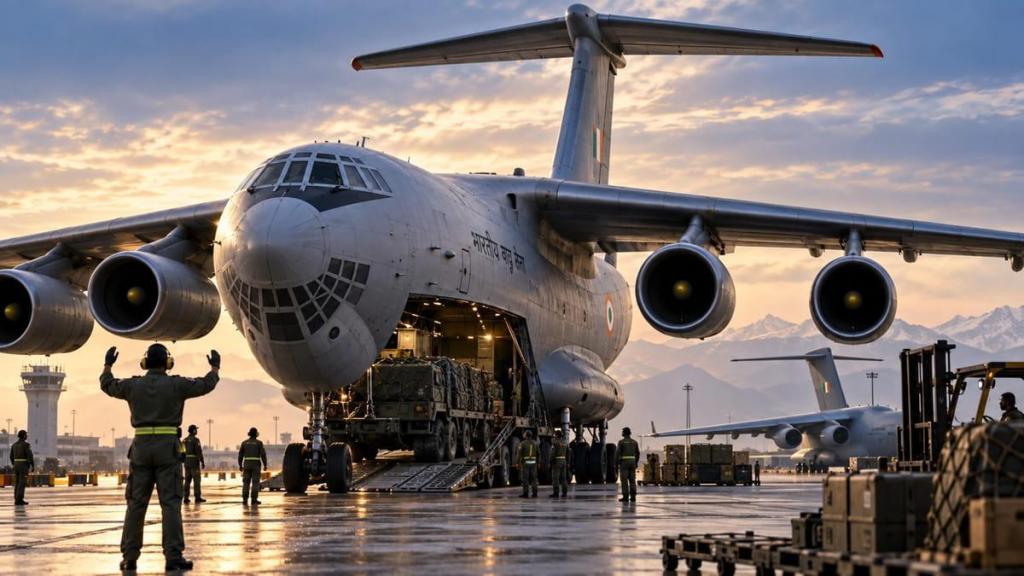

The sight of a Russian Air Force Il-76 at Noida International Airport during Russian President Vladimir Putin’s visit for the BRICS summit put one of the world’s best-known heavy transport aircraft back in the spotlight. But for India, the significance of the Il-76 goes far beyond its recent appearance.
More than 40 years after the Indian Air Force (IAF) inducted the aircraft, the Il-76 continues to form part of India’s strategic airlift capability. The aircraft’s survival in the fleet, despite the induction of newer platforms such as the C-17 Globemaster III, also reveals a less visible aspect of military modernisation, that is, replacing aircraft is only one part of building airlift capacity. Keeping existing platforms operational can be equally important.
From Soviet-era workhorse to India’s strategic airlift fleet
Il-76 was formally inducted by the IAF in June 1985, after the aircraft was brought into India earlier that year by No. 44 Squadron.
The squadron became the IAF’s first dedicated Il-76 unit and went on to play a major role in developing India’s strategic airlift capability. The Ministry of Defence has continued to list the aircraft as part of the IAF’s operational fleet.
The longevity of the Il-76 shows the type of capability it provides. Designed as a heavy transport aircraft, it was built to carry personnel, military equipment and heavy or outsized loads over long distances.
A Ministry of Defence account from 2016 revealed the aircraft’s ability to accommodate a T-72 tank for airlift while also carrying multiple heavy vehicles and other equipment.
That heavy-lift capability remains relevant as military transport requirements do not disappear simply because a newer aircraft enters service.
Why the IAF still needs the Il-76
India’s military transport fleet is considerably more capable today than it was when the Il-76 arrived. The IAF now operates the Boeing C-17 Globemaster III for heavy strategic airlift, while the C-130J Super Hercules provides another modern transport capability. The An-32 fleet also continues to support India’s transport requirements.
The Il-76 therefore operates within a bigger fleet rather than serving as India’s sole strategic transport platform.
This distinction is important. Military airlift is not simply a question of the maximum payload of an individual aircraft. The IAF also needs enough aircraft and available sorties to simultaneously support military deployments, logistics, training, evacuation and humanitarian operations.
The Il-76 has demonstrated its usefulness across that spectrum.
During Operation Maitri, India’s response to the 2015 Nepal earthquake, the IAF deployed C-17s, C-130Js, Il-76s and An-32s, along with helicopters, for relief and evacuation operations.
In May this year, an IAF Il-76 Gajraj flew from Delhi to Mongolia carrying the sacred relics of Arahant Sariputta and Arahant Mahamoggallana. The Ministry of Defence described the aircraft as a strategic airlift platform.
The missions are very different, but they point to the same requirement: the ability to move substantial loads quickly over long distances.
Strategic airlift is not only about war
For India, heavy transport aircraft have importance beyond conventional military operations. The country has a long land border, high-altitude areas, difficult terrain, island territories and a growing requirement to respond quickly to humanitarian emergencies.
Strategic airlift can support the movement of troops and equipment as well as disaster relief, evacuation and assistance to partner countries.
The history of No. 44 Squadron shows this broader role. The defence ministry describes the unit as a pioneer of strategic airlift and notes its participation in military as well as humanitarian-assistance operations.
This also explains why the transition from legacy aircraft to newer platforms is unlikely to happen as a simple one-for-one replacement.
India needs a transport fleet capable of generating sufficient sorties across multiple theatres and mission types. Until replacement capacity is available at the required scale, legacy platforms can continue to contribute.
Airframe no longer biggest challenge, it’s sustainment
The Il-76’s continued service comes with a major challenge: maintenance. The defence ministry described the Il-76 as a “legacy fleet” in 2016 and noted that its maintenance posed “enormous challenges”.
Aircraft ageing affects virtually every part of the support chain. Engines, landing gear, wheels, brakes, electrical systems, avionics and other components require sustained maintenance and replacement.
For India, there is an additional complication. The Il-76 originated in the Soviet Union, meaning that sustaining the aircraft can involve dealing with a supply chain built around Russian-origin equipment and technologies.
The result is a strategic dilemma: India continues to need the capability provided by an ageing aircraft while simultaneously trying to reduce dependence on overseas sources for spares and maintenance. That is where indigenisation becomes important.
India’s push to manufacture Il-76 spares
The IAF has increasingly sought to develop domestic capabilities for the repair, overhaul and manufacture of components used by legacy aircraft.
According to the IAF’s latest official review, 223 lines of spares have been identified for manufacturing and repair or overhaul in India. Among these is a proposed joint venture involving Magnum Aerospace Solutions and Rubin Aviation Corporation for 76 lines of spares covering wheels, brakes and hubs for IL-series aircraft, Mi-17 helicopters and An-32 aircraft.
The IAF has said it was in the process of placing supply orders for the required lines under the applicable inter-governmental agreement guidelines.
India continues to operate a large installed base of Russian-origin military aircraft and helicopters. A company that develops the capability to manufacture, repair or overhaul components for one platform can potentially serve several aircraft families. That creates a broader industrial opportunity around sustainment.
Why wheels, brakes and hubs matter
Defence manufacturing is often associated with fighter aircraft, missiles, radars and large weapons systems. But an aircraft’s operational availability ultimately depends on thousands of individual components.
For a heavy transport aircraft, seemingly conventional parts such as wheels, brakes and hubs are critical to safe operation. Their availability can directly affect how quickly an aircraft can return to service.
Therefore, the government’s wider indigenisation programme covers everything from relatively simple consumables and mechanical components to sophisticated avionics and aero-engine accessories.
The defence ministry has previously identified opportunities involving nuts, bolts, cables and gaskets as well as more complex systems.
For Indian aerospace companies, the opportunity presented by legacy Russian platforms is consequently not necessarily about building another Il-76. It is about building the industrial capability to support the aircraft already flying.
The Il-76 ecosystem extends beyond transport
The importance of the platform also extends beyond its transport role. India operates the Il-78 aerial refuelling aircraft, which is derived from the Il-76 family. This gives the broader Il-series ecosystem relevance to India’s aerial-refuelling capability as well.
The IAF’s current Air Officer-in-Charge Maintenance, Air Marshal KAA Sanjeeb, has extensive experience with the Il-76. He was also the project-management team leader involved in inducting the first Il-78 flight refueller aircraft into the IAF in 2003.
This means India’s accumulated technical knowledge, maintenance infrastructure and supply-chain experience around the Il-series have implications beyond a single transport aircraft.
What happens when the Il-76 is eventually replaced?
The long-term trajectory is clear: the IAF needs to modernise its transport fleet. But modernisation and sustainment are not mutually exclusive.
One track involves acquiring and integrating newer aircraft capable of providing strategic and tactical airlift. The other involves ensuring that existing platforms remain operational until adequate replacement capacity is available.
For a fleet that has been in service since 1985, that transition is likely to be gradual rather than instantaneous.
The continued use of the Il-76 does not necessarily indicate a lack of modern alternatives. Instead, it shows the operational value of having multiple transport platforms available for different missions.
The larger defence-industry opportunity
The Il-76 story also illustrates an important shift in India’s defence-manufacturing strategy. The headline value of defence procurement is usually associated with the acquisition of new platforms. Yet the economic life of a military aircraft does not end after the purchase. Decades of demand can follow in the form of spares, repairs, maintenance, overhaul, upgrades and component replacement.
For India, this becomes particularly relevant because a substantial number of Russian-origin platforms remain in service across the armed forces.
The IAF’s effort to indigenise tens of thousands of spare lines shows this approach. The force has said around 76,000 lines of spares have been indigenised over the past decade, including 1,482 during production year 2024-25. For Indian industry, that installed base represents a potential long-term market.
The Il-76 may now be more than four decades old, but the capability it provides (heavy airlift) remains relevant to India’s military and humanitarian requirements.