



India has emerged as a growing global defence exporter in recent years — marking a drastic pivot from its tag as of the largest arms importers of the world. Exports have expanded beyond basic gear to include major missile systems, artillery, radar, aerospace components, naval platforms, and protective equipment. India has also seen its export clients surge, with more than 80 nations now purchasing defense systems.
Data released by the government in early April also highlighted the massive surge in defense exports — rising 62.16% year on year to a record Rs 38.424 crore in FY26. The country is now eyeing Rs 50,000 crore in exports by 2029.
Govt eyes Rs 50,000 crore in defense exports
The Indian government is targeting ₹3 lakh crore in annual defence production and ₹50,000 crore in exports by 2029. As per the latest figures, the Indian Army has achieved roughly 91% self-sufficiency by indigenizing 159 out of 175 ammunition variants in its inventory.
According to a PIB release, there has also been 56x growth in defence exports from the Rs 686 crore reported in FY14. Exports now reach more than 80 countries — marking an increase of more than 5500% in 12 years. The private sector contributed ₹1,7353 crore or 45.16% in FY26 while Defence Public Sector Undertakings (DPSUs) contributed the remaining ₹2,071 crore or 54.84% of defence exports.
The country saw its annual defence production surging to an all-time high of ₹1.78 lakh crore in FY26. The figure represented a 15.6% growth over the previous fiscal and a staggering 110% increase since FY21. Data shared by the government in August also indicates a corresponding surge in defence exports — reaching Rs 38,424 crore in FY26.
Missile deals in Central Asia
Official data indicates India currently exports defense equipment — ranging from missiles and artillery to radar systems and electronic components — to more than 80 countries. The surge in exports has come even as India remains the world’s fifth-largest military spender and second-largest arms importer after Ukraine.
In recent years, New Delhi has transitioned from exporting minor components to selling highly sophisticated complete weapon platforms to various countries. The Philippines became the first to strike a deal for BrahMos missiles in 2022 — with more recent agreements struck with Vietnam and Indonesia.
“”BrahMos is a kind of benchmark for our emerging export story. This is one of the high-end strategic systems that we’ve been able to export. We’ve got contracts or agreements to sell it to three Southeast Asian countries, starting with the Philippines, and now Indonesia and Vietnam as well. The system has been proven in battle during Operation Sindoor,” Defense Secretary Rajesh Kumar Singh told ANI.
According to a source-based Reuters report earlier this year, India has also received interest from Thailand, South Africa, Brazil, and Chile. The publication reported that the government was also in talks with the United Arab Emirates to sell some of its flagship defence systems, including the supersonic cruise missile.
“This missile also has an air-launched version, which exists and is a great success on Sukhois. There is tremendous potential for this particular system, and I hope that this will continue to be one of the anchors of our export momentum…The exports should be about $100 million to start with for Vietnam, and for Indonesia, it should be around $200 million,” the top official added.
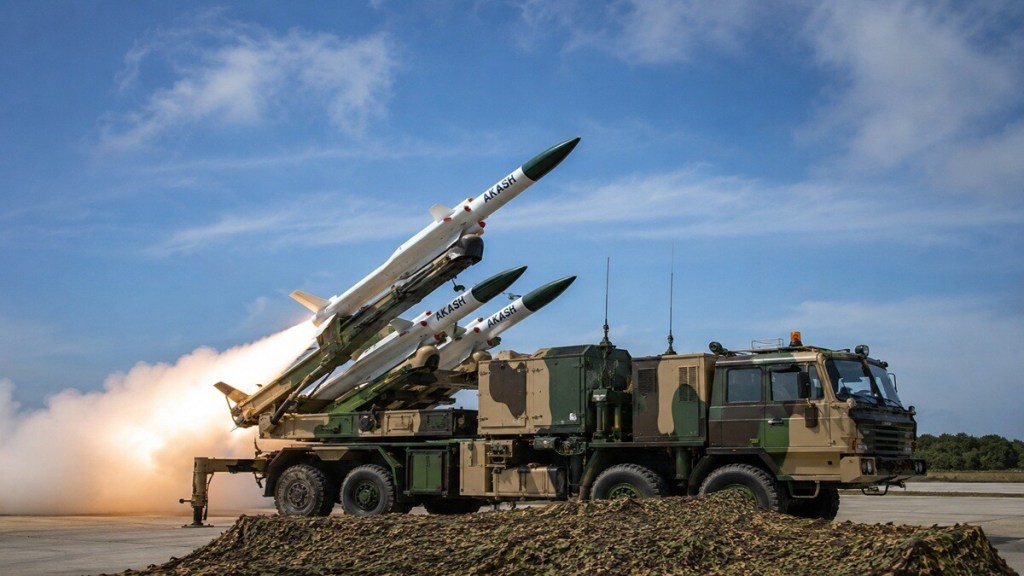
The Akash air defense system has also evoked interest — with Singh recently calling it “one of our success stories”. The top official confirmed on October 1 that the short-range surface-to-air missile system was now being exported to Armenia, Tajikistan, and Turkmenistan. He also told news agency ANI that the country had received “additional orders for our own services” without divulging details.
“The first customer was Armenia, which has taken multiple batteries. Thereafter we have also exported it to Tajikistan and Turkmenistan. Production has stabilised,” he told ANI.
Singh added that production for Akash missiles had stabilised — with active procurement continuing for the Indian armed forces while orders from foreign nations grew.
The missile system was developed by the DRDO and manufactured by Bharat Dynamics Limited and Bharat Electronics Limited. It is designed to engage supersonic targets at ranges up to 25 to 30 km (up to 50 km for newer variants like Akash-NG) using ramjet propulsion and command guidance.
How India became Armenia’s primary arms supplier
The Second Nagorno-Karabakh War in 2020 and subsequent Armenia-Azerbaijan border crisis in 2021-2022 have also played a role in this military diversification. Armenia has made a dramatic shift away from Russian arms following the victory of Azerbaijan in the 2020 clash. According to the CPC report, Russia had supplied 87% of its arms imports by volume from the breakup of the Soviet Union in 1991 until 2020.
Armenian officials had deemed Russian support ‘unreliable’ after the other country failed to intervene with Russian peacekeeping forces present in the region. The sale of advanced Russian military hardware from Belarus to Azerbaijan during the conflict (likely with Russian permission) was potentially also seen by Yerevan as proof of Russia’s unreliability as a security partner.
India and France have gradually replaced Moscow as key suppliers for Armenia. A Reuters report citing the Stockholm International Peace Research Institute noted that New Delhi had supplied 43% of Armenia’s total arms imports between 2022 and 2024. A separate report by the Caspian Policy Center added that the country had supplied Armenia with over 52% of its arms by volume between 2020 and 2023. Aside from the recently announced Akash missile deal, India has also provided (or remains in the process of delivering) multiple launch rocket systems, self-propelled howitzers, artillery locating radar, anti-aircraft missiles, air defense systems, an anti-drone system, and various combat ammunition.
Why is Central Asia changing its defence suppliers?
Russia has traditionally been the dominant arm supplier for this region while China gained ground in recent years. The changing defence supply landscape also comes with geopolitical implications as New Delhi seeks to become a major global arms exporter.
Regional conflicts and drawn-out wars have triggered a significant shift in the arms market — with alternative security actors and suppliers such as Türkiye, France, Italy, and India stepping in to fill the Russian vacuum. According to data released by the Caspian Policy Center in 2024, the nature of weapons purchased has also changed as demand grows for modern systems and new technological capabilities.
The report added that Central Asia and the South Caucasus have seemingly opted to diversify away from their traditional, post-Soviet arms relationship with Russia after its invasion of Ukraine in 2022. The decision might have been boosted by the fact that “Russian military equipment had not fared favorably against modern drones and high-tech alternatives”. Moscow had reportedly seen its arms imports to the region fall sharply between 2021 and 2023 by 23% and 44% when compared to levels in the previous decade. Many remain sceptical that Russian manufacturing can sustain heavy demand beyond its own war requirements.
“An increasing number of agreements have also been signed to produce foreign-designed weapons systems domestically in the region. The importance of domestic military production capabilities has been highlighted by Ukraine’s ongoing struggle to secure foreign weapons systems and could offer a potential explanation for the increase in these deals,” CPC analysed.
Yerevan has made the most pronounced leap away from Russian weapons over the past few years — with India now providing a majority of its arms imports.
Turkmenistan is also increasingly purchasing military hardware from alternative suppliers like China and India. Ashgabat unveiled Chinese-made air defense systems including the FK-2000 self-propelled anti-aircraft missile and gun systems during a military parade in late September. The Akash missiles purchased from India are expected to compliment the recently displayed Chinese short-range systems.
The situation is somewhat different for Tajikistan as it remains a member of the Collective Security Treaty Organization and relies heavily on Russia for border security against threats from Afghanistan. Moscow also maintains its largest military deployment on foreign soil across Dushanbe and Bokhtar in Tajikistan. The Russian state-owned TASS news agency wrote in July this year that the 201st Military Base “includes motorized rifle, tank, artillery, reconnaissance, air defense, NBC defense troops and communications units”. Unverified estimates over the past decade suggest it includes about 7,000 troops.
Geopolitical implications for Russia and China
The sale of Akash air defence missile systems to Tajikistan, Turkmenistan, and Armenia gives India a formal foothold in Central Asia. Reports quoting experts suggest Moscow would likely prefer India entering the Central Asian defence market than have the region move close to NATO or the Chinese military. India and Russia are also long-term military partners — with ties dating back to the Cold War era. The country has historically been the primary arms supplier for New Delhi — with Russian-origin systems making up roughly 50% of Indian military hardware currently in service.
Russia has delivered multiple squadrons of its S-400 system to India under a landmark $5.5 billion contract signed in 2018 — with the final tranche expected in November. The Reciprocal Exchange of Logistics Support agreement signed in January also shifted the bilateral ties into operational military logistics and gave India access to Russian Arctic and Far East facilities. Multiple pacts have also been formulated in recent years as the two countries gradually explore a co-development model. It is pertinent to note that the BrahMos system — currently a major military export for India — is a joint venture between India and Russia.
The expansion into Central Asia however creates a far more adversarial relationship with Beijing due to overlapping interests. India and China do not directly import finished weapons or major defense platforms from each other. But the latter views Central Asia as a vital buffer zone for its western Xinjiang province — sharing borders with Kazakhstan, Kyrgyzstan, and Tajikistan. The region is also a foundational pillar of the Chinese Belt and Road Initiative and provides vital resources such as oil, natural gas, and rare-earth minerals.