


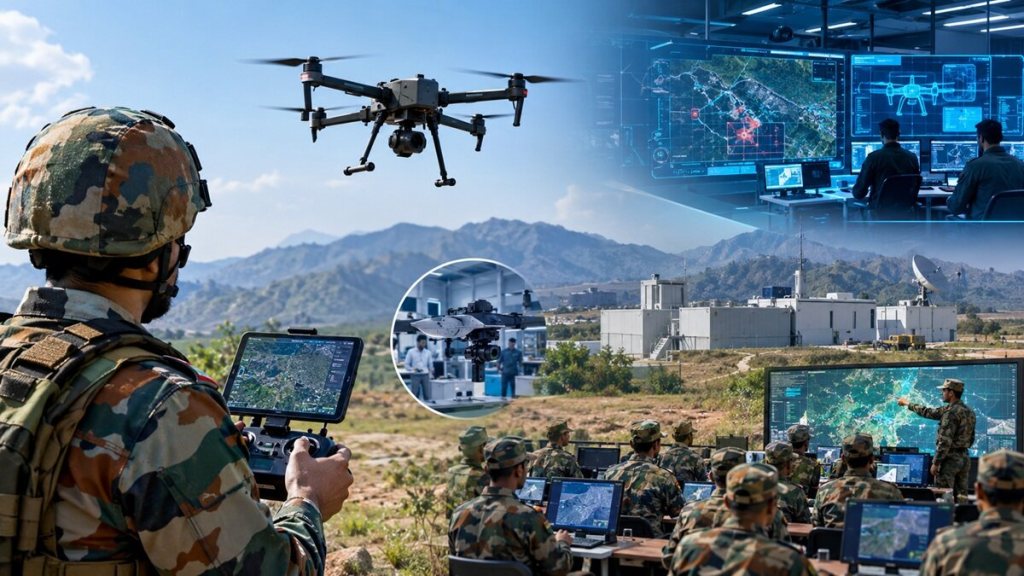

Two separate initiatives are aimed at strengthening drone security and training within the Indian Army. The first is a planned network of six security-testing labs called ‘AASHVAST’, according to an Indian Express report. These labs will check drones for hidden software bugs, firmware vulnerabilities and foreign components, especially from China, that could pose risks during operations. One lab has been inaugurated in Delhi, and at least five more are planned. The aim is to reduce the risk of interference with Army drones during operations in hostile areas.
Separately, Zuppa Geo Navigation Technologies and the Tamil Nadu Unmanned Aerial Vehicles Corporation (TNUAVC) have announced a partnership to establish drone training laboratories at Army regimental centres, to teach soldiers and Agniveers how to fly and maintain drones safely.
According to an ANI report, the programme will offer a four-week course and help eligible personnel get a remote pilot certificate for small drones through the DGCA-authorised training framework. Training is scheduled to begin in October 2026 at the Madras Regimental Centre in Wellington, with a target of training and certifying more than 2,000 personnel over three years.
The initiatives address two needs: improving the security of the force’s drones and developing personnel’s skills for military and civilian unmanned aerial vehicle (UAV) operations.
AASHVAST labs: Checking drones for hidden bugs
AASHVAST stands for Assessment and Analysis of Electronic Systems Hardware for Vulnerabilities and Security Threats. The labs are being set up under the Directorate General of Electronics and Mechanical Engineers (DG EME), with a firmware analysis and validation suite developed by QuickPay Private Limited, IE reported.
The key purpose of these labs is to examine drones at the firmware and embedded-software level, going beyond physical inspection. Rajib Roy, director of QuickPay, told The Indian Express that the facilities are intended to counter interference that could prevent drones from carrying out their tasks in contested areas.
“Equipped with advanced capabilities AASHVAST will enable evaluation of critical defence platforms thereby increasing cyber resilience. Aligned with the national vision of #AtmanirbharBharat, the facility will strengthen operational readiness as well as promote growth of the domestic defence ecosystem,” the Army’s Additional Directorate General of Public Information said in a post on X on August 14.
#GeneralDhirajSeth, #COAS, inaugurated 'AASHVAST' (Assessment and Analysis of Electronic Systems Hardware for Vulnerabilities and Security Threats), a specialised facility aimed at enhancing the integrity, reliability and security of mission-critical military electronics.… pic.twitter.com/LmzRtfeBp4
— ADG PI – INDIAN ARMY (@adgpi) August 14, 2026
The Indian Express reported that drones procured by the Army had not previously undergone checks for firmware-level vulnerabilities. The AASHVAST suite is designed to address this gap.
What the labs will test
The Indian Express reported that the labs were designed to detect around 14 types of vulnerabilities. These include:
- Geospatial vulnerabilities, such as malfunctions that occur when a drone flies over certain locations.
- Issues that prevent a drone from reaching its preset destination.
- Unused or hidden code that could cause a drone to stop functioning before completing its mission.
- Time- and location-based bugs that allow normal operation except at specific times or places.
The labs will also look for Chinese and other foreign-origin active components, hidden passwords, embedded keys, remote access tools and location-based security controls, people involved in the project told IE.
“This will help prevent situations where active components sourced from China are misrepresented as ‘made in India’ or another country, based solely on the invoice indicating their point of purchase,” a person involved in setting up the lab told IE.
“There is no mechanism to determine what is embedded within the silicon. What is visible is merely the invoice, which shows (from) where the part was purchased. But that does not necessarily indicate its true origin,” the person added.
The use of Chinese components in military drones has been a concern for India, especially for operations along the eastern border. In 2025, the Army Design Bureau submitted a framework to the Ministry of Defence aimed at eliminating Chinese-origin components from UAVs, according to The Indian Express. The labs come against this backdrop.
Initially, the labs are intended to test all drones used by the Army. In future, they are also expected to inspect CCTV cameras procured by the force for similar vulnerabilities, Express reported.
Training labs for Agniveers and defence personnel
The separate training initiative aims to build a pool of trained drone operators. Zuppa Geo Navigation Technologies has signed a Memorandum of Understanding (MoU) with TNUAVC to establish indigenous drone training laboratories at Army regimental centres, according to ANI.
The programme will offer a four-week course to prepare eligible participants for a small-category Remote Pilot Certificate (RPC) for drones weighing above 2 kg and up to 25 kg, subject to applicable requirements. RPCs are issued by DGCA-authorised Remote Pilot Training Organisations. Training is scheduled to begin in October 2026 at the Madras Regimental Centre.
The programme is expected to train 200 personnel in its first batch and around 1,000 annually in the initial phase. The initiative will also cover personnel transitioning out of the armed forces, giving them skills that can be used in defence-related and civilian drone operations.
“Through our collaboration with TNUAVC, we aim to train and certify over 2,000 Agniveers and defence personnel over the next three years, creating a pool of skilled UAV professionals who can contribute to both defence applications and the wider commercial drone industry,” said Sai Pattabiram, founder and managing director of Zuppa Geo Navigation Technologies, as quoted by ANI.
Course modules and infrastructure
The four-week course will combine classroom teaching, simulator-based training and hands-on flying, according to ANI’s report on the partnership. Modules will include:
- UAV mission simulation.
- Rotorcraft operations and aerodynamics.
- Hybrid drone operations.
- Drone equipment maintenance.
- Risk assessment and safety management.
- Basic drone assembly.
- Practical UAV flying.
- Mission planning.
- DGCA rules and regulations.
Under the MoU, as described in the report, Zuppa will establish and equip the training laboratories. Its responsibilities include providing micro and small-category drones, mission simulator systems, learning management systems, training infrastructure and maintenance support.
TNUAVC will deploy qualified instructors and conduct the training in line with DGCA regulations. The two organisations will jointly design the curriculum, conduct assessments and support the certification process.
Venkatesh Sai, founder and chief technology officer of Zuppa, said practical exposure was critical. He emphasised the importance of standardised training and hands-on experience in developing capable UAV professionals, ANI reported.
A TNUAVC spokesperson said the partnership would strengthen the corporation’s training work with the armed forces, according to the report.
Cost and scale
The reports on AASHVAST and on the training partnership did not provide the cost of either initiative. The Army issued a request for proposal in April 2026 that sought customised licensed software for validation of firmware and embedded systems for electronic components, including UAV components, according to The Indian Express. Its report did not specify a contract value.
Similarly, the MoU between Zuppa and TNUAVC does not specify the capital expenditure for each training laboratory or the overall programme cost. The companies have outlined the scope—infrastructure, drones, simulators, learning systems and instructor deployment—but have not released a line-item cost breakdown.
The two initiatives address different aspects of the Army’s drone capabilities. One focuses on making drones safer by detecting hidden software and hardware risks. The other aims to develop trained drone operators among Agniveers, serving defence personnel and those transitioning out of the armed forces.