


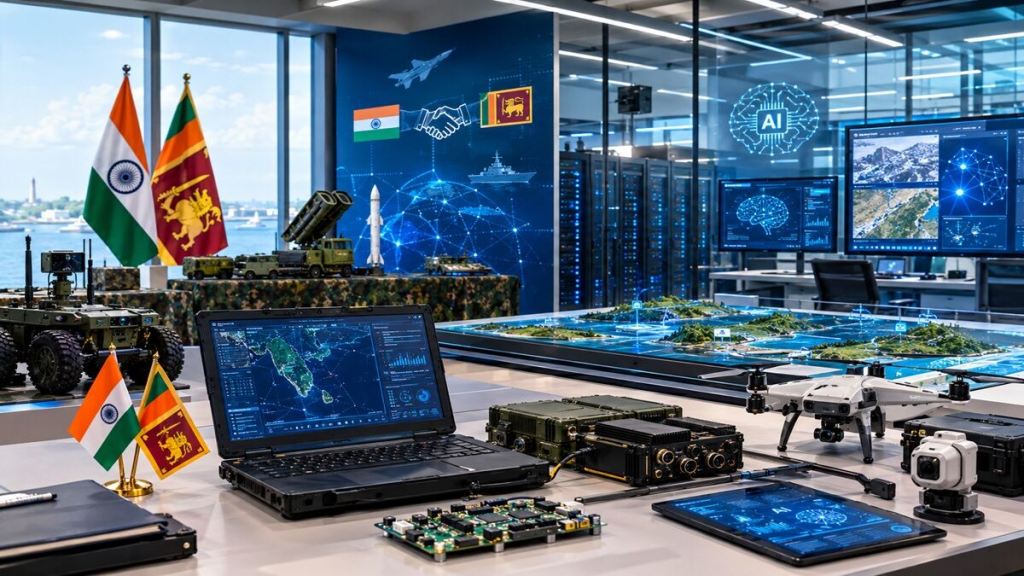

India will help Sri Lanka establish an Artificial Intelligence (AI) facility for its Army, Union Defence Minister Rajnath Singh announced during a visit to Colombo, underscoring Delhi’s push to deepen defence and maritime cooperation with its island neighbour. This move places AI and capacity-building at the centre of defence cooperation between the two countries.
Speaking at a deck reception aboard INS Udaygiri in Colombo, Rajnath Singh said India remains a committed partner for enhancing the capabilities of the Sri Lankan Armed Forces.
“Going ahead, we will also be working together for creation of an Artificial Intelligence Lab for Sri Lankan Army for its capability enhancements,” he said.
The proposed AI lab is expected to support the Sri Lankan Army in areas such as data analytics, surveillance, logistics and also decision-making — aligning with global trends where militaries are increasingly leveraging AI for operational efficiency.
While specific technical details were not disclosed, the initiative signals India’s willingness to share advanced technology with friendly neighbours as part of its “Neighbourhood First” policy.
#WATCH | Colombo, Sri Lanka: Defence Minister Rajnath Singh says, "After our discussions, we concluded three memoranda of understanding in the defence domain… We also virtually inaugurated three Bailey bridges built by the Indian Army Engineering Team in close cooperation with… pic.twitter.com/VQglxD4HZN
— ANI (@ANI) September 9, 2026
By assisting Sri Lanka in building an AI-enabled defence infrastructure, India is not only boosting its neighbour’s military capabilities but also reinforcing its own role as a net security provider in the region. The initiative could serve as a model for similar partnerships with other Indian Ocean littoral states, especially as AI becomes increasingly critical in modern warfare and border management.
For Sri Lanka, which has been rebuilding its defence posture after decades of civil conflict and recent economic turmoil, the AI lab will work as a strategic upgrade — one that could enhance situational awareness, resource allocation, and operational planning without heavy dependence on external powers.
Three key defence MoUs signed
Rajnath Singh held discussions with Sri Lankan President Anura Kumara Dissanayake, following which the two countries signed three Memorandum of Understanding (MoUs) in the defence domain.
These agreements cover the following:
- Upgradation of L-70 guns for the Sri Lankan Air Force
- Cooperation between the National Cadet Corps (NCC) of India and Sri Lanka
- Collaboration between the National Defence College (NDC) of India and NDC Sri Lanka
The MoUs formalise ongoing defence engagement and create structured pathways for training, institutional exchange and equipment modernisation.
Maritime cooperation takes centre stage
Defence Minister also highlighted the growing importance of maritime security in India–Sri Lanka relations. “Given the salience of maritime cooperation, it is undoubtedly an area where we foresee a closer and deeper engagement,” he said.
The visit of ‘INS Udaygiri’ — which carried defence equipment and components as part of India’s Defence Diplomacy initiative — symbolises this commitment. The assistance package includes spares for the Indra MK 2 radar for the Sri Lankan Air Force, components for the Sri Lankan Navy ship SAYURA and inflatable targets for naval exercises.
Sri Lanka values India’s defence support
Sri Lankan Minister of Labour and Foreign Employment Anil Jayantha Fernando has underscored Colombo’s deep appreciation for India’s sustained support in building the capacity and professional capabilities of the Sri Lankan Armed Forces.
“We greatly value India’s continued support for capacity building and human resource development of the Sri Lankan armed forces,” Fernando said. “The opportunities provided to our armed forces and personnel to pursue training and professional development in India have been an important investment in the future of our defence cooperation.”
The minister emphasised that Sri Lanka is keen to further strengthen maritime security collaboration between the two countries’ navies. “We hope to strengthen the maritime security cooperation between the two navies, including joint operations, training, and capacity building,” he said, highlighting joint patrols, interoperability exercises, and shared domain awareness as priority areas.
Fernando also formally acknowledged India’s timely assistance during multiple national crises. “We gratefully acknowledge India’s strong support, extended and solidarity maintained during recent challenges such as the COVID pandemic, the economic crisis in 2022, Cyclone Ditwa and this year’s energy crisis due to the situation in the Middle East,” he said.
Capacity building as a core pillar
“Capacity building has always been a strong pillar of our bilateral defence cooperation,” Rajnath Singh said, adding that India’s efforts are guided by Sri Lanka’s own requirements and priorities. “It has been our constant endeavour to respond to Sri Lanka Armed Forces’ requirements and keeping in mind your interests and priorities,” he added.
It reflects India’s strategy of offering tailored defence support — from training and equipment to technology transfer — rather than one-size-fits-all solutions. The AI lab initiative fits squarely within this framework, offering Sri Lanka access to cutting-edge capabilities while reinforcing strategic trust.
Deepening bilateral ties
Rajnath Singh’s three-day visit, which began on September 8, comes at a time when both countries are seeking to strengthen traditionally close ties amid evolving regional dynamics. Defence and maritime cooperation have emerged as key focus areas, with India positioning itself as a reliable security partner in the Indian Ocean Region.
The Defence Minister’s emphasis on AI, capacity enhancement and joint institutional cooperation also shows a shift toward future-ready defence collaboration — one that goes beyond hardware to include knowledge sharing, digital infrastructure and human resource development.