


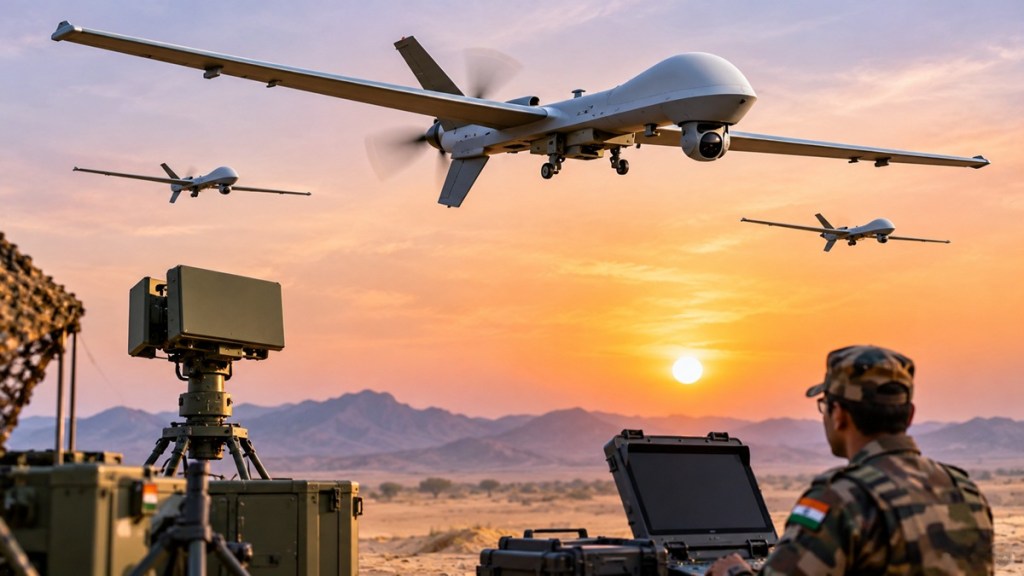

From indigenous drone engines and autonomous surveillance platforms to counter-drone systems, Indian defence technology companies are witnessing huge opportunities in the Indian Air Force‘s unmanned systems roadmap. But converting technological alignment into contracts will depend on trials, specifications and procurement decisions.
India’s push to build a domestic unmanned warfare ecosystem is opening up a larger question for defence technology companies: can a clearer picture of the armed forces’ requirements translate into a sustainable pipeline of business?
For companies developing unmanned aerial vehicles (UAVs), propulsion systems, autonomous software and counter-drone technologies, the Indian Air Force’s unmanned systems roadmap offers a direction for future capability development. The opportunity, however, extends beyond manufacturing a drone. It involves building the engines, navigation systems, communications, sensors and production capabilities required to make these platforms operationally viable.
Three defence technology companies – AKSI Aerospace Group, NextLeap Aeronautics and Paras Anti-Drone Technologies – outlined how their respective capabilities align with this emerging focus. Their responses point to different parts of the unmanned systems ecosystem, from indigenous manufacturing and long-range platforms to electronic warfare and counter-unmanned aerial systems.
The companies also illustrate the distinction between developing technology for a potential requirement and securing an order against it.

The IAF’s outreach to industry, held alongside Dronathon 2026 at Pokhran on September 14, was attended by around 100 industry representatives. The roadmap identifies areas including indigenous propulsion, autonomous software, resilient navigation and standardised interfaces as priorities for developing unmanned capabilities. According to the companies, these areas are relevant to technologies they are already developing, although alignment with the roadmap does not, by itself, establish a procurement commitment.
AKSI Aerospace’s push for indigenous propulsion
For AKSI Aerospace Group, the opportunity lies in developing more of the technology stack within India rather than relying on individual components or imported systems.
Pankaj Akula, founder and managing director of AKSI Aerospace Group, told The Financial Express digital that the roadmap could help companies plan their technology development and manufacturing investments around a clearer understanding of future requirements.
“The significance of the roadmap lies not merely in identifying potential demand for individual drones, but in providing industry with a clearer direction for long-term technology development, production readiness and indigenous manufacturing,” Akula said.
AKSI is developing its Agni Kalash unmanned platform, with the company working on key elements including the autopilot, power system and aerostructures through its subsidiaries. Its engine is also under development, making propulsion an important part of its effort to build an increasingly indigenous platform.
The company is targeting more than 80% indigenisation. However, that remains a target rather than a confirmed level of localisation across a completed, production-ready system.
AKSI has also reported a range of 300 km for Agni Kalash, but the platform remains under system trials. The company expects to release specifications in the next two months.
The propulsion milestone also has commercial implications. AKSI said it has received letters of intent from Europe and the Middle East, with deliveries expected after the engine milestone is achieved.
The company’s stated pipeline exceeds Rs 225 crore. It is also considering a phased expansion of manufacturing capacity over the next 24 to 48 months, depending on demand, technology maturity and funding.
AKSI was invited to the IAF’s October 21 industry outreach and is evaluating the requirements emerging from the exercise. The company has not indicated that participation guarantees a procurement pathway.
For the business, the immediate challenge is to move from development to a platform that can meet operational requirements and be manufactured at scale. Indigenous propulsion is particularly significant in this context as a domestically developed airframe alone does not establish control over the complete system or its production chain.
NextLeap Aeronautics: Building around autonomy and range
NextLeap Aeronautics is approaching the opportunity through unmanned platforms, autonomous surveillance and technologies designed to function in demanding operational environments.
Alvin Anthony, founder and chief executive officer of NextLeap Aeronautics, told The Financial Express that greater clarity on requirements could help companies prioritise the technologies they need to develop in India.
“The most important aspect of the IAF’s roadmap is that it provides greater clarity on the technologies India needs to develop domestically,” Anthony said.
“Indigenous propulsion, autonomous software, resilient navigation and communications are particularly important because they determine how effectively a UAV can perform its mission in demanding operational environments,” he added.
The company’s Stryker platform is among the systems it is developing. NextLeap describes Stryker as a UAV with a 20-kg payload capacity, a range of up to 300 km and a speed of 450 kmph. These are company-stated specifications, and should not be read as confirmation of IAF acceptance or procurement.
NextLeap is also developing Sentinel, an autonomous docking station intended to support round-the-clock surveillance. The concept combines a UAV with a docking and operating setup, allowing surveillance to continue without depending on a conventional arrangement in which personnel must manually prepare and launch the aircraft for every sortie.
Another focus is communications and navigation in environments where electronic warfare can disrupt conventional systems. NextLeap said its relevant technologies have undergone trials against powerful jammers. The company’s response does not, however, establish that these systems have been accepted for a specific IAF requirement.
The company is pursuing multiple variants of the Stryker platform. These include the Stryker-120E, an electric fixed-wing system with a stated range of 120 km, and the jet-powered Stryker-JP300, which has a stated range of 300 km.
NextLeap is also planning additional Stryker platforms over the next two to four years, with proposed ranges of up to 1,500 km and payload capacities of 50-100 kg. These are development ambitions rather than confirmed IAF specifications or procurement commitments.
The company’s immediate commercial priorities are linked to trials and engagement with end users. NextLeap said the Stryker-120E is being jointly developed with an end user and is expected to complete trials before the end of the year. It has projected a pipeline of more than 300 units for the platform.
For its aerial-target variant, the company said airframes have been delivered to a defence agency. A flight-test campaign for the Stryker-JP300 is expected to begin or progress towards completion by the end of December 2026, followed by end-user trials, according to the company’s stated schedule. NextLeap has projected a pipeline of at least 100 units for the next financial year.
These projections are not equivalent to confirmed orders. Their conversion into revenue will depend on the outcome of testing, user requirements and subsequent procurement decisions.
NextLeap also said several SkyHammer systems have been inducted by the Indian Army. The company plans to increase research and development activity in the next financial year.
Paras Anti-Drone Technologies: Countering the threat from drones
While AKSI and NextLeap are focused on developing unmanned platforms and related technologies, Paras Anti-Drone Technologies is addressing the other side of the equation: detecting, tracking and mitigating hostile drones.
Ashutosh Baheti, chief executive officer of Paras Anti-Drone Technologies, told The Financial Express that the company sees its strongest alignment with the roadmap in counter-unmanned aerial systems, electronic warfare and sensor integration.
“For us, the most relevant areas of alignment are counter-unmanned aerial systems (C-UAS), electronic warfare, RF-based detection, multimodal sensing and the integration of detection and mitigation capabilities,” Baheti said.
The company’s portfolio includes Hydra for radio-frequency-based drone and pilot detection, Skysense for detection and direction-of-arrival capabilities, and Skysense Lite, a portable detection system. Its mitigation portfolio includes Terminator, Aeroblast and Dexter, which are designed for jamming applications. Dexter 20 combines detection and jamming capabilities in an integrated system.
The commercial opportunity for counter-drone systems is linked to the growing need to protect military infrastructure and operational assets. Airbases, military installations and logistics hubs are among the potential applications identified in the company’s response. The prospect of drone swarms also increases the importance of integrating detection with mitigation, rather than relying on a single sensor or countermeasure.
According to Paras, the company’s approach is not limited to identifying a drone. It encompasses different detection technologies and systems intended to respond to the threat. In an operational setting, the usefulness of such a system depends on how effectively its components work together and meet the requirements of the intended user.
Paras also has a record of government orders disclosed by its parent company, Paras Defence and Space Technologies. In November 2025, the company disclosed a Ministry of Defence order worth Rs 35.68 crore for portable counter-drone systems. A separate order worth Rs 3.95 crore was disclosed for radio-frequency jammers through Paras Anti-Drone Technologies.
From technological alignment to contracts
Taken together, these companies show why India’s unmanned systems opportunity cannot be measured only by the number of platforms being developed. Propulsion, autonomous software, navigation, communications, sensors and counter-drone capabilities form interconnected parts of the ecosystem.
For manufacturers, the immediate priorities include completing development milestones, validating performance through trials and establishing production readiness. For companies with existing systems, the challenge is to demonstrate that their products meet specific user requirements and can be supplied reliably at the required scale.