


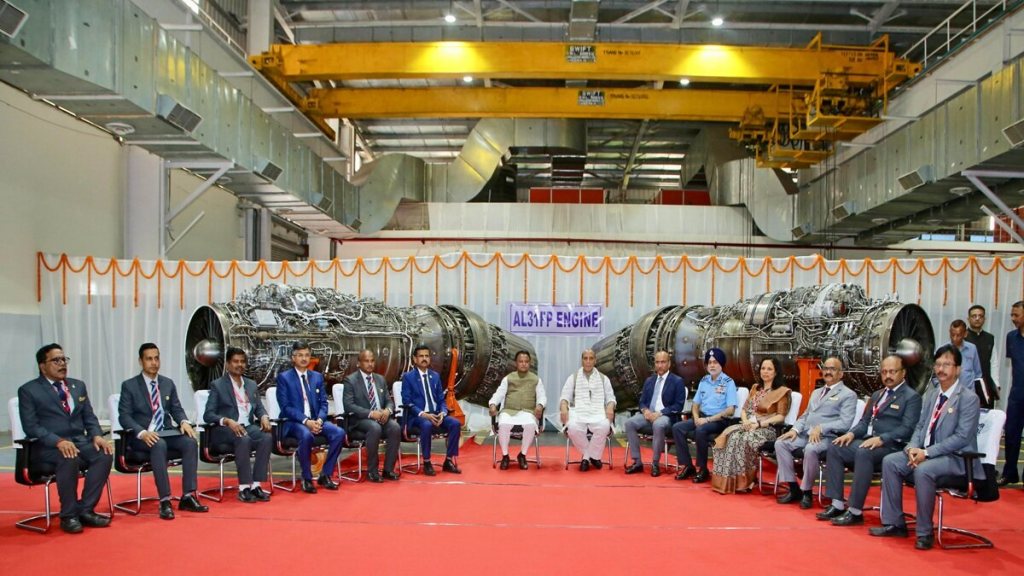

Union Defence Minister Rajnath Singh announced a Rs 218-crore investment for a second production line for Shakti engines at Hindustan Aeronautics Limited’s (HAL) Koraput Division in Odisha on Tuesday (October 6). The announcement came as the facility delivered its 2,000th aero-engine.
The new line, to be fully operational by 2028–29, will manufacture up to 100 Shakti engines a year for India’s indigenous helicopters, including the Dhruv Advanced Light Helicopter (ALH) and the Prachand Light Combat Helicopter (LCH).
Today is a historic day for HAL Koraput. The Division has today delivered its 2000th engine.
This is more than a production milestone. It is a symbol of six decades of engineering capability, skilled manpower and commitment to strengthening India’s defence preparedness. I am extremely pleased to be part of this remarkable journey.HAL Koraput has also crossed another significant milestone. It has overhauled more than 9,000 engines. Behind these numbers is the skill and dedication of the engineers and technicians who keep India’s critical platforms mission-ready.
The production of AL-31FP engines for the Su-30MKI is an important step in strengthening India’s indigenous engine manufacturing capability.
Despite global supply-chain disruptions and raw-material challenges, the Koraput team delivered its first engine ahead of schedule. 63 engines have now been delivered. I would like to acknowledge the commitment demonstrated by the team here in its production.
HAL is also enhancing annual production capacity from 30 to 50 engines. These capabilities directly contribute to the sustained operational readiness of the IAF’s Su-30MKI fleet.
India’s growing fleet of indigenous helicopters requires a strong and reliable indigenous engine ecosystem. HAL is establishing a second production line for Shakti engines at Koraput, adding to the existing capability at Engine Division, Bengaluru.
Together, these facilities will strengthen our capacity to support platforms such as the ALH and LCH and meet the evolving requirements of the Armed Forces.
A stronger engine ecosystem is essential to a stronger self-reliant defence capability.Aatmanirbharta in aerospace begins with the materials and technologies that go into an engine. I am pleased to note the progress made in indigenising raw materials for high-thrust engines. 264 lines of raw material have been developed by MIDHANI and received by HAL Koraput. This is an important contribution towards building a domestic ecosystem for advanced aero-engine manufacturing.
Our objective remains clear, that is to develop critical capabilities within India, build the industrial ecosystem around them and progressively reduce dependence on external sources.
— Rajnath Singh (@rajnathsingh) October 6, 2026
HAL Koraput delivers 2,000th aero-engine
The delivery of the 2,000th aero-engine was described by Rajnath Singh as a “historic milestone” in India’s aerospace journey, marking six decades of propulsion manufacturing since the Koraput Division was set up in 1964. He said each engine represented a direct contribution to the operational capability of the armed forces, noting that the division has also overhauled more than 9,000 engines, extending the service life of critical aircraft.
Over the years, Koraput’s engines have powered frontline fighters such as the MiG-21, MiG-27, MiG-29 and Su-30MKI, making the facility a backbone of India’s military aviation. Rajnath Singh called the aero-engine the “heart” of an aircraft, stressing that advanced airframes, radars and weapons can only be fully effective if backed by reliable, high-performance propulsion.
Rs 218 crore for a 2nd ‘Shakti line’
At the same event, the Defence Minister also announced the second Shakti engine production line at Sunabeda. Once fully established, the line will have an annual capacity of up to 100 engines, strengthening supply for India’s indigenous helicopter fleet.
Currently, HAL produces Shakti engines at its Bengaluru facility; the new Odisha line will raise total annual capacity to about 180 engines, officials said. The Shakti engine, co-developed with France’s Safran, powers both the Dhruv ALH and the Prachand LCH, platforms that are central to the Army and Air Force’s rotary-wing capabilities.
Rajnath Singh said the Defence Forces need engines that are “available when needed, supported throughout their lifecycle and upgraded with evolving technology”, underlining the strategic importance of a stable, indigenous supply chain for helicopter propulsion.
Su-30MKI engines: Capacity hike and delivery record
Alongside the Shakti announcement, Rajnath Singh highlighted progress on engines for the Su-30MKI fighter fleet. In 2024, the government placed an order for 240 AL-31FP engines with HAL for the Su-30MKI, and despite global supply-chain and raw-material challenges, the first engine was delivered ahead of schedule. By the end of the second year, HAL had delivered 63 engines against a target of 60, he said.
To further strengthen this supply, Singh announced that HAL is raising annual AL-31FP production capacity from 30 to 50 engines with an additional investment of Rs 335 crore. This expansion is aimed at reducing dependence on imports and ensuring steady engine availability for one of the Air Force’s mainstay fighters.
Pushing for full aerospace sovereignty
Singh tied these announcements to a larger goal, i.e., self-reliance in aero-engines as the foundation of India’s complete aerospace sovereignty. He said work is already underway on indigenous high-thrust engines, testing infrastructure, raw materials and robust maintenance, repair and overhaul (MRO) capabilities to build a strong “engine ecosystem”.
He pointed to a proposed investment of around Rs 5,000 crore for indigenous high-thrust engine development, collaboration with Mishra Dhatu Nigam Limited (MIDHANI) for critical materials, and plans for India’s first indigenous high-thrust engine testing facility. Such capabilities are seen as vital for future programmes like the Advanced Medium Combat Aircraft (AMCA), which will require powerful, reliable engines designed and supported in India.
Rajnath Singh also stressed that aero-engine technology sits at the cutting edge of industrial capability, involving superalloys, thermal-barrier coatings and sophisticated cooling systems that must work under extreme conditions. Mastery over these areas, he said, is a marker of advanced manufacturing strength.
Odisha’s emerging defence and aerospace role
The event also spotlighted Odisha’s growing place in India’s defence and aerospace map. Singh noted the state’s strategic location, long coastline, ports, mineral resources, industrial infrastructure and skilled manpower as key advantages for defence manufacturing. He cited DRDO’s Integrated Test Range at Chandipur and recent state initiatives, including an approved Aerospace and Defence Equipment Manufacturing Complex at Gajamara in Dhenkanal, as foundations for further growth.
Odisha Chief Minister Mohan Charan Majhi, who shared the stage with Singh, said the state was undergoing an “industrial revolution”, with large investment proposals across sectors from metals to semiconductors. He said projects worth more than Rs 3 lakh crore have already been grounded and are expected to create around 2.5 lakh jobs, while initiatives like the proposed “Odisha Silicon Valley” near Cuttack aim to boost semiconductor manufacturing.
CM Majhi described HAL Koraput’s contribution over six decades as “unparalleled” and said the inauguration of the second Shakti line and the 2,000th engine handover reflected India’s rising defence capabilities. He urged the Centre to set up another defence manufacturing unit in Odisha, arguing that the state’s expanding industrial ecosystem can help India move closer to self-reliance in defence production.
Six decades of engineering excellence. 2,000 aero engines. 9,000+ engine overhauls. And a growing indigenous capability in high-thrust engines. HAL Koraput today delivered its 2,000th engine (AL31 FP) in the presence of Hon’ble Raksha Mantri Shri Rajnath Singh, Shri Mohan Charan Mahji, Chief Minister of Odisha, Shri Sanjeev Kumar, Secy (DP),
— HAL (@HALHQBLR) October 6, 2026
Building an ecosystem, not just a factory
Defence Minister asked HAL to think of Koraput not merely as an engine factory but as the nucleus of a broader aerospace propulsion ecosystem. He called for deeper integration of MSMEs, start-ups, private industry, academia and research institutions into engine design, materials development, testing and production.
He urged the Koraput team to raise standards in quality, productivity, indigenisation, innovation and delivery timelines, using the 2,000th engine as a launching pad for an Indian aerospace industry capable of designing, developing, manufacturing and supporting advanced propulsion systems end-to-end.
Rajnath Singh also congratulated HAL’s engineers, technicians, scientists, the Indian Air Force, industry partners, MSMEs and the people of Odisha, framing the milestone as a collective achievement in India’s long journey towards aerospace self-reliance.
.