


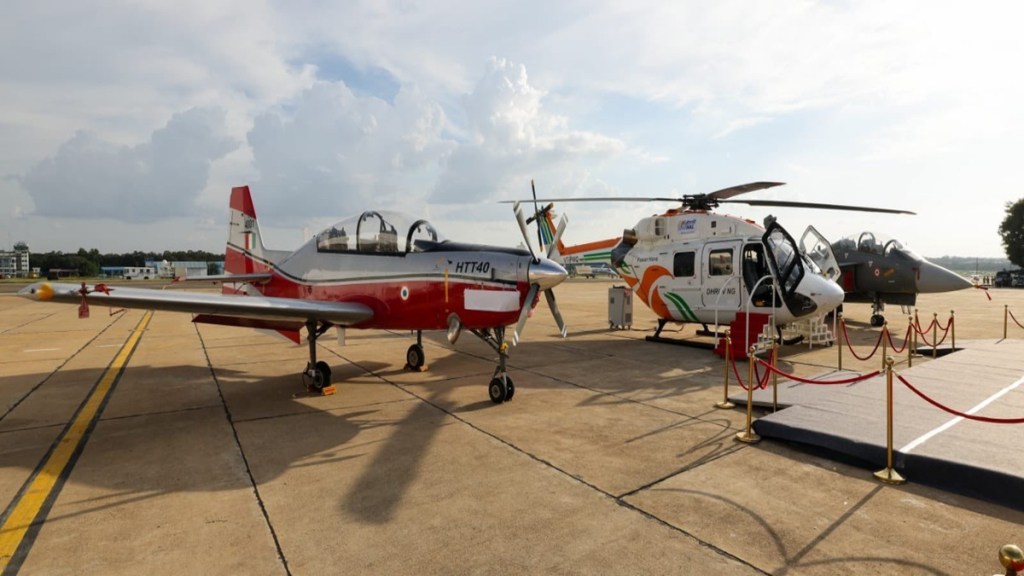

Hindustan Aeronautics Limited (HAL) handed over two LCA Tejas Final Operational Clearance (FOC) twin-seater trainer aircraft and three HTT-40 basic trainer aircraft to the Indian Air Force (IAF). It also delivered four Dhruv Next Generation (NG) helicopters to Pawan Hans Limited (PHL).
On Friday (September 18), the handover of Tejas trainer aircraft, in the presence of Union Defence Minister Rajnath Singh and Civil Aviation Minister Kinjarapu Ram Mohan Naidu, highlights India’s growing ability to design, manufacture and certify advanced aircraft.
According to the Defence Ministry, this move is another step towards producing more defence aircraft in India, reducing dependence on foreign suppliers and strengthening the country’s aerospace ecosystem.
In a milestone towards promoting indigenous design, development and manufacturing in the aerospace and defence sectors, Hindustan Aeronautics Limited (HAL) handed over two Light Combat Aircraft (LCA) Tejas Final Operational Clearance (FOC) Twin Seater Trainers & three HTT 40… pic.twitter.com/5K1pTRv3SD
— Defence Production India (@DefProdnIndia) September 19, 2026
Tejas trainer deliveries completed
HAL has delivered the last two LCA Tejas Final Operational Clearance twin-seater trainer aircraft to the Indian Air Force, completing the supply of all four twin-seaters ordered under the FOC contract. The twin-seater Tejas is designed primarily for training fighter pilots.
However, it retains the core systems and operational capabilities of the single-seat fighter, allowing pilots to train on the same platform they are expected to fly in frontline service.
The aircraft features a modern glass cockpit, digital avionics, a quadruplex fly-by-wire flight-control system, relaxed static stability and advanced composite materials. These systems are expected to help pilots transition from training aircraft to high-performance fighter operations.
The latest two aircraft include several improvements, including enhanced radar performance, improved autopilot handling, fuel-system upgrades, secure software-defined radio communication and an air-to-air refuelling probe.
The Tejas twin-seaters are also expected to support the IAF’s wider training requirements as the service expands the use of indigenously developed fighter aircraft. HAL is developing additional twin-seater aircraft under subsequent Tejas contracts, with future Mk1A trainers expected to incorporate Active Electronically Scanned Array (AESA) radar, electronic-warfare systems and expanded weapons capabilities.
Witnessed the Handing Over ceremony of LCA Tejas FOC Twin Seater Trainers & HTT 40 Basic Trainer Aircraft to IAF and Dhruv NG helicopters to PHL in Bengaluru.
India has the talent and technology to deliver world-class aircraft and today is a landmark achievement in this… pic.twitter.com/KxuUw081Tc
— Rajnath Singh (@rajnathsingh) September 18, 2026
HTT-40 deliveries begin
HAL also delivered the first three HTT-40 basic trainer aircraft to the IAF. The handover reflects the start of deliveries under the contract for 70 aircraft. Designed and developed by HAL’s Aircraft Research and Design Centre, the HTT-40 is intended to meet the basic training requirements of India’s armed forces.
The aircraft will be used for initial pilot training before trainees move on to more advanced trainer aircraft and fighter platforms.
The turboprop aircraft is equipped for basic handling, aerobatics, instrument flying, navigation, night flying and close-formation training. It has a modern cockpit and avionics suite and is designed to provide stable low-speed handling for trainee pilots.
IAF welcomes HTT-40 — ‘Ankur’
A new chapter in India’s journey towards Aatmanirbharta in aerospace takes flight as the HTT-40 Basic Trainer Aircraft, christened ‘Ankur’, joins the Indian Air Force.
Handed over by HAL to Hon’ble Raksha Mantri Shri Rajnath Singh, the induction of…
— Indian Air Force (@IAF_MCC) September 18, 2026
The HTT-40 first flew on May 31, 2016, and subsequently underwent handling, systems, hot-weather and crosswind trials. It has received a Restricted Military Type Certificate from the Centre for Military Airworthiness and Certification. The aircraft has an indigenous content of approximately 57 per cent.
The aircraft is powered by a 1,100-shaft-horsepower turboprop engine. It has a maximum speed of about 300 knots and a service ceiling of 6,000 metres.
For many years, India relied on imported aircraft for basic pilot training. As per MoD, the induction of the HTT-40 is therefore intended to provide the IAF with a domestic alternative while supporting the development of local manufacturing, maintenance and training capabilities.
Dhruv NG enters civil aviation
4 Dhruv NG helicopters were handed over to Pawan Hans Limited, bringing the civil-certified variant into India’s civil aviation segment. The Dhruv NG is a 5.5-tonne, twin-engine, multi-role helicopter developed and manufactured by HAL. It is powered by two Shakti 1H1C engines and has been configured for a range of civil operations.
The helicopter can be used for passenger and VIP transport, air ambulance services, offshore operations, utility missions, law enforcement and disaster-relief work. Its cabin can be adapted for different missions and can carry up to 14 passengers.
The aircraft has a maximum take-off weight of 5,500 kilograms, a top speed of approximately 285 kilometres per hour and a range of around 630 kilometres with a 20-minute reserve.
Does India manufacture civilian helicopters?
Yes! Our own Hindustan Aeronautics Limited, has built state-of-art twin-engine, multi-role masterpiece – Dhruv NG!
In the august presence of Hon’ble Raksha Mantri Shri @rajnathsingh Ji, HAL today handed over 4 Dhruv civil helicopters… pic.twitter.com/ZH1ZxKAC40
— Ram Mohan Naidu Kinjarapu (@RamMNK) September 18, 2026
The induction of the Dhruv NG gives Pawan Hans an indigenously manufactured platform for civil helicopter operations. It also represents HAL’s expansion from defence production into the commercial and civil rotary-wing market.
Civil Aviation Minister K Rammohan Naidu described the certification and induction of the Dhruv NG as an important development for India’s civil aviation industry. “The helicopter’s entry into civil service shows the ability of Indian companies to develop, certify and support advanced aerospace platforms for commercial use,” he said.
Rajnath Singh calls for integrated ecosystem
Addressing the gathering, Defence Minister Rajnath Singh said India must build an aerospace ecosystem capable of meeting both military and civil aviation requirements. “Our aim is to make India capable, self-reliant, and globally competitive in meeting its aerospace requirements,” Singh said.
“LCA FOC Trainer and HTT-40 are symbols of India’s indigenous military aerospace capability and the growing maturity of its self-reliant fighter aircraft ecosystem. By developing capabilities such as aircraft design, avionics, propulsion, training, and certification within an integrated aerospace ecosystem, India is rapidly advancing toward self-reliance,” Rajnath Singh added.
Speaking at the Handing Over ceremony of LCA Tejas FOC Twin Seater Trainers & HTT 40 Basic Trainer Aircraft to IAF and Dhruv NG helicopters to PHL. https://t.co/EkQymg49VP
— Rajnath Singh (@rajnathsingh) September 18, 2026
He also described the handover as a key step in India’s effort to build indigenous aerospace capabilities and achieve technological self-reliance. Defence Minister said the country was progressing towards self-reliance through the domestic manufacture of advanced defence equipment.
Singh stressed that the development of aerospace systems would be gradual and could not be achieved through a sudden transformation. “There can be no sudden ‘big bang’ in the development of aerospace systems. It is a vast and gradual process involving a wide range of components,” he said.
According to the minister, every aircraft, system and component represents one step on a much larger path. He said India would need to continue moving forward steadily while treating challenges as part of the development process.
Warning over project delays in defence programmes
Rajnath Singh also raised concerns about delays in defence technology and production programmes. He said delays could create gaps in critical defence requirements, increase costs and make equipment outdated by the time it entered service.
“We will have to take these delays seriously,” he said, adding that project timelines needed to be realistic.
The minister noted that rapid advances in technology meant that a system under development could become less relevant if its production was delayed for too long. He called for stronger project management, faster decision-making and closer coordination between the armed forces, public-sector companies, private industry and research organisations.
Public-private cooperation
Singh said public-sector defence companies and private firms should not be treated as competitors. Instead, he called for greater cooperation between them to develop the next generation of aerospace technologies.
“There is a need for enhanced public-private synergy to build next-gen indigenous aerospace capabilities. By working together, we can accelerate the growth of India’s aerospace sector,” he said.
He identified artificial intelligence (AI), autonomous systems, unmanned aerial systems, electronic warfare, cyber technologies and next-generation propulsion as key areas for future development.
The minister also urged young scientists, engineers, designers, test pilots and technicians to work on technologies that do not yet exist. He said research and development would be essential if India wanted to become a leading player in global aerospace technology over the next decade.
Importance for India’s aerospace sector
Defence Ministry said the three platforms handed over during the ceremony show different parts of India’s aviation ambitions. The Tejas twin-seater is expected to strengthen the country’s indigenous fighter-aircraft ecosystem and provide the IAF with a domestic platform for advanced pilot training.
The HTT-40 supports basic training and reduces dependence on imported aircraft. The Dhruv NG expands HAL’s presence in civil aviation and opens opportunities in passenger transport, emergency services and offshore operations.
In the presence of Hon’ble Raksha Mantri Shri Rajnath Singh, Hon’ble Minister of Civil Aviation Shri K. Rammohan Naidu, Chief of the Air Staff, Air Chief Marshal A. P. Singh and Shri Sanjeev Kumar, Secretary (Defence Production), MoD, pic.twitter.com/9oBMCqj8Mo
— HAL (@HALHQBLR) September 18, 2026
Rajnath Singh said capabilities developed for one part of the aerospace sector could benefit the entire industry. “When capabilities such as aircraft design, avionics, propulsion, composite materials, flight control systems, manufacturing, and certification are developed within the country, they benefit the entire aerospace sector,” he said.
HAL Chairman and Managing Director Ravi said the deliveries demonstrated the company’s ability to develop and supply platforms for diverse defence and civil requirements. He also highlighted the contribution of Indian industry partners supporting the three programmes.
The ceremony was attended by Chief of the Air Staff Air Chief Marshal AP Singh, Defence Production Secretary Sanjeev Kumar, Civil Aviation Ministry Secretary Samir Kumar Sinha and other senior officials from the defence, civil aviation and aerospace sectors.