


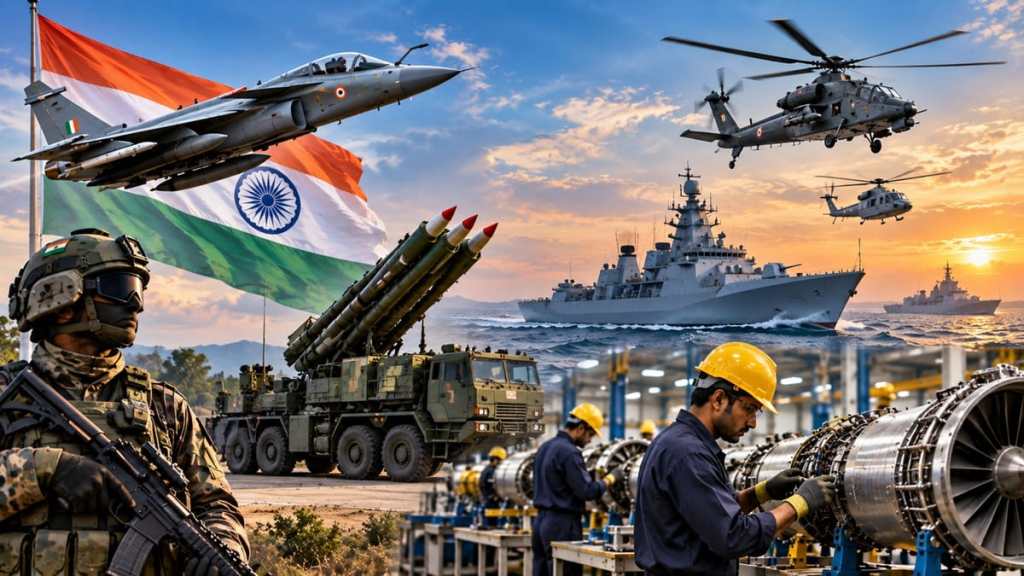

India is expanding its domestic defence manufacturing base through a combination of larger indigenous procurement, technology-development programmes, indigenisation initiatives, defence corridors and measures aimed at increasing private-sector participation.
In a factsheet released on August 14, the Ministry of Defence said that defence production reached a record Rs 1.78 lakh crore in FY2025-26, with the private sector accounting for 24% and public-sector entities contributing the remaining 76%. The government has set a target of Rs 3 lakh crore in annual defence production and Rs 50,000 crore in exports by 2029.
The policy framework supporting that expansion spans procurement, innovation, technology transfer, domestic sourcing and defence trade. For companies, the initiatives create potential entry points across the defence manufacturing and supply chain ecosystem.
Indigenous procurement creates a large order base
One of the biggest channels for domestic industry is defence procurement. The Defence Acquisition Council (DAC) has accorded Acceptance of Necessity (AoN) for more than Rs 6 lakh crore of systems designed by DRDO and manufactured by Indian industry, according to the factsheet.
The government also noted major indigenous acquisition programmes, including approvals for 97 Tejas Mk-1A fighter jets worth Rs 62,000 crore and 156 LCH Prachand helicopters worth Rs 62,700 crore.
The Defence Acquisition Procedure (DAP) 2020 was introduced to strengthen indigenous procurement and expand opportunities for Indian companies in defence design, development and production.
Meanwhile, the Defence Procurement Manual 2025 streamlined nearly Rs 1 lakh crore in revenue procurement, with measures including faster approvals, relaxed penalties for indigenous projects and long-term orders.
The draft DAP 2026 proposes simpler acquisition categories and stronger support for indigenous design and development, including indigenous content requirements of up to 60%.
iDEX and ADITI open the door to startups
The government’s innovation programmes provide another route for smaller companies and technology developers to enter defence manufacturing.
The Innovations for Defence Excellence (iDEX) scheme has an outlay of Rs 498.78 crore. As of March 2026, it had engaged 676 startups, MSMEs and innovators and resulted in 551 design and development contracts.
The ADITI Scheme, with an outlay of Rs 750 crore for 2023-24 to 2025-26, provides financial support through the Defence Innovation Organisation to accelerate development of innovative defence technologies.
The Technology Development Fund (TDF) provides grants of up to Rs 50 crore for critical defence technology development. As of June 2026, 80 projects worth Rs 334 crore were under implementation, while an additional Rs 500 crore corpus had been sanctioned for deep and emerging technologies.
These programmes create a pathway for startups, MSMEs and technology companies working on defence technologies to participate in development programmes.
Technology transfer creates another route into manufacturing
The government’s technology-transfer framework is designed to move defence technologies developed by DRDO into industry. The DRDO Development cum Production Partner framework has transferred technologies to 134 partner companies, while 2,180 technology transfer agreements have been signed.
More than 2,780 intellectual property rights had also been opened for industry use as of March 2026.
For industry, this creates a route to participate in manufacturing using technologies developed within the defence R&D ecosystem.
5,521 items placed on indigenisation lists
The government’s Positive Indigenisation Lists are another mechanism aimed at expanding domestic manufacturing. According to the factsheet, 10 Positive Indigenisation Lists, five each from the Department of Military Affairs and Department of Defence Production, had covered 5,521 items by May 2026.
The lists are intended to increase self-reliance in defence production by identifying equipment and items for domestic sourcing. This also creates opportunities for companies that can manufacture products previously sourced from outside the domestic industrial base.
Srijan platform connects suppliers to demand
The Srijan Defence Equipment Empowerment Platform (DEEP) provides another window into the size of India’s domestic defence supply chain. The platform is a digital repository aimed at promoting indigenous defence sourcing. As of May 2026, it listed more than 41,000 vendors and 2.7 lakh products, according to the Ministry.
The scale of listings points to a broad supplier ecosystem extending beyond the companies that manufacture complete defence platforms.
Defence corridors bring manufacturing investment
Infrastructure is another part of the government’s strategy. The Uttar Pradesh Defence Industrial Corridor had attracted Rs 42,057 crore in investment commitments by April 2026, of which Rs 4,409 crore had been grounded.
The Tamil Nadu Defence Industrial Corridor had attracted Rs 32,699 crore, with Rs 6,446 crore realised, according to the factsheet.
The government has also highlighted the BrahMos Integration & Testing Facility in Lucknow, which has begun manufacturing missiles.
Defence exports expand the addressable market
The domestic manufacturing push is accompanied by an expanding export market. Defence exports rose to Rs 38,424 crore in FY2025-26, from Rs 686 crore in FY2013-14, according to the Ministry. Indian defence equipment is now being exported to more than 80 countries.
The private sector accounted for Rs 17,353 crore, or 45.16%, of defence exports, while Defence Public Sector Undertakings accounted for Rs 21,071 crore, or 54.84%. The government is targeting Rs 50,000 crore in annual defence exports by 2029, alongside the Rs 3 lakh crore production target.
Easier defence trade and higher FDI
The government has also sought to make it easier for companies to operate in the defence sector.
Industrial licence validity has been extended from seven years, with a possible three-year extension, to 15 years with a possible three-year extension, while lifetime validity has been granted under the Arms Act, according to the factsheet.
The revamped Defence Exim Portal provides end-to-end application processing, automated company verification, simplified registration, real-time tracking and payment integration.
The defence-sector FDI limit has also been increased to 74% under the automatic route and up to 100% through the government route. Defence-sector FDI inflows stood at Rs 6,670.59 crore by March 2026, the Ministry said.
Where the opportunities are emerging
Taken together, the initiatives cover several stages of the defence manufacturing chain – from technology development and startups to technology transfer, indigenisation, procurement, manufacturing infrastructure and exports.
The government’s stated production target of Rs 3 lakh crore by 2029 provides the broader backdrop. Within that expansion, the PIB factsheet identifies mechanisms through which startups, MSMEs, private manufacturers, technology companies, suppliers and larger defence manufacturers can participate.
The factsheet does not identify individual private companies as beneficiaries of these initiatives. Instead, it lays out the institutional and policy framework through which the government is seeking to expand India’s domestic defence industrial base.