


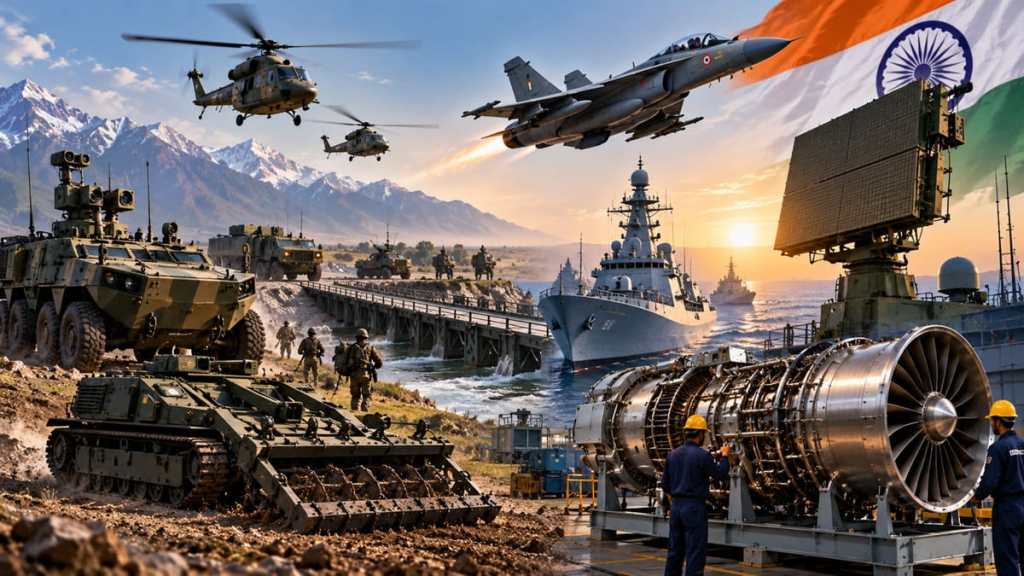

The Ministry of Defence has cleared a fresh tranche of defence acquisition proposals worth approximately Rs 1.1 lakh crore, covering everything from battlefield mobility and CBRN reconnaissance to naval radars, marine propulsion systems and electronic warfare equipment.
The Defence Acquisition Council (DAC), chaired by Defence Minister Rajnath Singh, accorded Acceptance of Necessity (AoN) for a series of proposals across the Indian Army, Navy and Air Force.
The defence ministry said approximately 98% of the total procurements will be made from Indian industry, showing Centre’s push to reduce dependence on foreign suppliers while expanding domestic defence manufacturing and technology capabilities.
However, the approvals do not mean that contracts have been signed or that the equipment will immediately enter service. AoN marks an important step in the acquisition process, with subsequent stages including procurement procedures and evaluations.
Army: Mobility, mine-laying and CBRN protection
For the Indian Army, the DAC cleared proposals for Chemical Biological Radiological and Nuclear (CBRN) Recce Vehicles, High Mobility Vehicles (HMVs), Self-Propelled Mechanical Mine Layers (MMLs), Advanced Light Helicopters (ALHs), Trawl Tanks and the Sarvatra Bridge System.
According to the defence ministry, the CBRN reconnaissance vehicles will be equipped to detect, identify, monitor and mark areas contaminated with chemical, biological, radiological or nuclear agents. Such capabilities are intended to allow forces to operate and assess contaminated areas while improving battlefield situational awareness.
The High Mobility Vehicles will strengthen operational capabilities, logistics support and mobility, particularly across challenging terrain.
The Army’s requirement for Self-Propelled Mechanical Mine Layers is aimed at enabling fast and responsive mine-laying in difficult terrain. The capability can help formations rapidly create obstacles and defensive barriers during military operations.
Helicopters and battlefield crossings
The approval for Advanced Light Helicopters is to enhance the Army and IAF’s ability to undertake complicated missions across different terrains and operational situations.
To military mobility, helicopters remain critical, particularly in areas where conventional ground movement is difficult or infrastructure is limited.
The ministry also said that the Army will receive Trawl Tanks and the Sarvatra Bridge System, which will be used to provide composite crossings to fighting formations during operations across varied terrain.
The combination of mobility vehicles, helicopters and bridging equipment points to an emphasis on keeping formations mobile even when natural or man-made obstacles restrict movement.
Navy: Arudhra radars and indigenous marine engines
For the Indian Navy, the DAC cleared procurement of Arudhra Radars, along with the design and development and subsequent procurement of Marine Gas Turbines (MGTs).
The Arudhra Radar is intended to replace existing Air Route Surveillance Radars at various Naval Air Stations.
The more strategically significant approval could be the Marine Gas Turbine programme. MGTs are used as propulsion systems on warships, making indigenous development important for India’s efforts to strengthen its naval industrial base.
The Defence Ministry said the design, development and subsequent procurement of MGTs will help reduce dependence on foreign vendors.
Developing critical propulsion technology within India could have wider implications for naval self-reliance, particularly in the construction, maintenance and long-term sustainment of warships.
IAF: Jammers to strengthen electronic warfare
For the Indian Air Force, the DAC approved proposals aimed at enhancing the war-fighting capabilities of fighter aircraft, transport platforms and helicopters.
The council also cleared procurement of a Ground-Based Multi-Purpose Jammer (GBMPJ).
According to the defence ministry, the GBMPJ will provide effective jamming against adversary radars. The capability is part of the growing importance of electronic warfare in modern military operations, where disrupting an adversary’s ability to detect and track platforms can be as important as physical destruction.
The IAF will also get the Defence Forces Secure Access Card (DEFSAC) System. The system is designed to replace paper-based identity cards, passes and permits with an interoperable Radio Frequency Identification (RFID)-based smart-card system.
The bigger signal: 98% Indian sourcing
Beyond the individual platforms and systems, the biggest takeaway from the latest approvals is the extent of domestic sourcing.
With around 98% of the procurements planned from Indian industry, the latest pipeline reinforces India’s effort to build a defence ecosystem capable of supplying increasingly sophisticated military equipment.
The proposals span several technology areas – radar, electronic warfare, helicopters, specialised vehicles, bridging systems and marine propulsion.
For the private sector and defence public-sector companies, the AoNs could therefore translate into opportunities across multiple segments of the supply chain as individual programmes move through subsequent stages of acquisition.
The Marine Gas Turbine programme is particularly significant because it targets a critical technology traditionally dependent on overseas suppliers.