


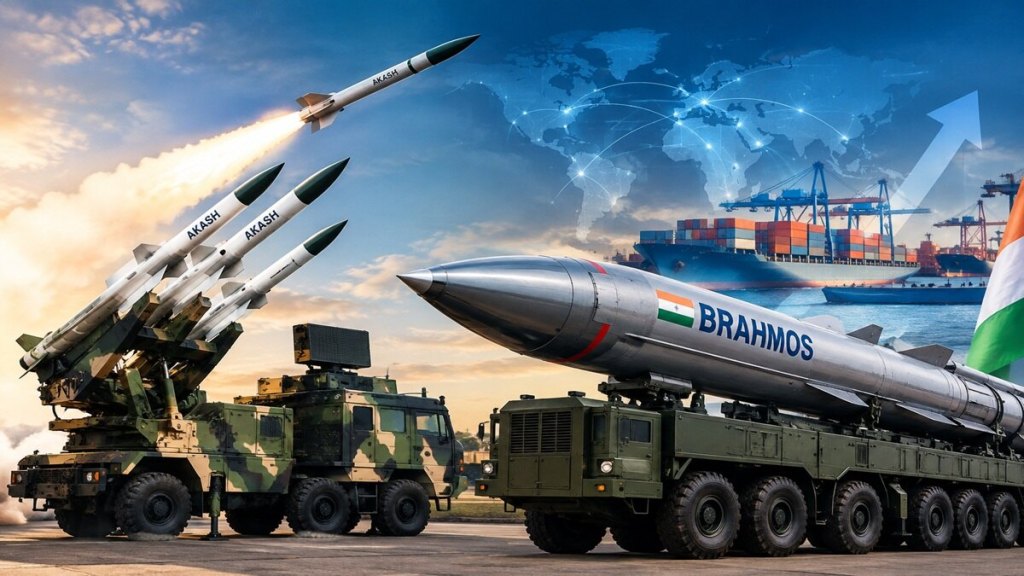

India’s defence export story has moved beyond small arms and spare parts because high-end indigenous missile systems like Akash and BrahMos are now at the forefront. Defence Secretary Rajesh Kumar Singh confirmed to ANI that BrahMos exports alone are set to cross USD 600 million.
At the same time, the Akash surface-to-air missile (SAM) system, once developed for India’s own air defence, has become a ‘success story’ with stabilised production and confirmed sales to Armenia, Tajikistan and Turkmenistan. Together, these two programmes show how India’s domestic design, testing and production ecosystem is maturing into a globally competitive defence industry.
#WATCH | Delhi | On BrahMos exports, Defence Secretary Rajesh Kumar Singh says, "BrahMos is a kind of benchmark for our emerging export story. This is one of the high-end strategic systems that we've been able to export. We've got contracts or agreements to sell it to three… pic.twitter.com/yCt8Bjbh9C
— ANI (@ANI) October 1, 2026
BrahMos as the ‘benchmark’: USD 600 million export pipeline
If Akash represents India’s growing competence in air defence, BrahMos exemplifies its emergence in high-end strategic strike systems. Defence Secretary Singh described BrahMos as “a kind of benchmark for our emerging export story,” adding that it is “one of the high-end strategic systems that we’ve been able to export.”
He confirmed that BrahMos exports are expected to cross USD 600 million, driven by contracts or agreements with three Southeast Asian countries: the Philippines, Indonesia and Vietnam. Around USD 330 million worth of BrahMos systems have already been delivered to the Philippines. For Vietnam, exports are expected to start at about USD 100 million, while Indonesia’s deal is projected at around USD 200 million, taking the combined total well above the USD 600 million mark.
#WATCH | Delhi | On BrahMos exports, Defence Secretary Rajesh Kumar Singh says, "BrahMos is a kind of benchmark for our emerging export story. This is one of the high-end strategic systems that we've been able to export. We've got contracts or agreements to sell it to three… pic.twitter.com/yCt8Bjbh9C
— ANI (@ANI) October 1, 2026
Singh also highlighted the missile’s combat credibility and versatility: “The system has been proven in battle during Operation Sindoor… This missile also has an air-launched version, which exists and is a great success on Sukhois.” The air-launched variant, successfully tested and integrated with Su-30MKI fighters, expands BrahMos’ appeal to air forces looking for long-range, supersonic strike options.
Union Defence Minister Rajnath Singh has previously described BrahMos as “not just a missile, but a symbol of the growing indigenous capabilities of the nation,” reflecting its strategic and diplomatic weight in India’s defence partnerships.
Why Akash is ‘one of India’s success stories
Defence Secretary Rajesh Singh explicitly called Akash a milestone in India’s journey toward self-reliance in military technology. Speaking to ANI on India’s defence export trajectory, he said, “Akash, I would say that it is one of our success stories. It shows the maturing of our indigenous missile design and production system. It is effective in dealing with high-velocity aerial targets.”
According to Singh, production for the Akash missile system has now stabilised, with active procurement continuing for the Indian Armed Forces even as foreign orders grow. He added, “The first customer was Armenia, which has taken multiple batteries. Thereafter, we’ve also exported it to Tajikistan and Turkmenistan. Production has stabilised. We have additional orders for our own services, and I’m sure there will be many more from various parts of the world.”
Armenia signed a deal in 2022 to acquire multiple Akash-1S batteries, with initial deliveries starting in late 2024, DRDO and the Ministry of Defence have confirmed. The entry of Central Asian nations Tajikistan and Turkmenistan into the buyer list is particularly significant, as these countries have traditionally relied on Russian-supplied air defence systems.
Why Akash matters for exports
Akash is a short-range surface-to-air missile system developed by the Defence Research and Development Organisation (DRDO) and manufactured by Bharat Dynamics Limited (BDL) and Bharat Electronics Limited (BEL). It is designed to engage supersonic targets at ranges up to 25–30 km, with newer variants like Akash-NG extending reach to around 50 km, using ramjet propulsion and command guidance.
The system’s operational value lies in its ability to counter fast-moving, manoeuvring aerial threats, including fighter jets, drones and cruise missiles. For countries seeking an affordable, proven, and indigenously supported air defence solution, Akash offers a credible alternative to older Soviet-era systems, while integrating more easily with modern command and control networks.
Singh underlined this point when he noted that Akash “is effective in dealing with high-velocity aerial targets,” signalling that the missile has moved from experimental trials to a reliable, export-ready platform.
Record defence exports: Rs 38,424 crore in 2025–26
The success of Akash and BrahMos sits within a much larger surge in Indian defence exports. As per the data presented by the defence ministry in April 2026, India’s defence exports touched an all-time high of Rs 38,424 crore, a 62.66% increase over the previous year’s Rs 23,622 crore in the financial year 2025–26.
Both public and private sectors have contributed significantly:
- Defence Public Sector Undertakings (DPSUs) accounted for 54.84% of exports, contributing Rs 21,071 crore.
- The private sector contributed 45.16%, or Rs 17,353 crore.
DPSU exports surged by 151% compared to the previous year, while private firms recorded a 14% increase, showing robust growth across the board. Indian defence equipment now reaches more than 80 countries, underlining the widening acceptance of ‘Made in India’ platforms in global markets.
Earlier in September, Defence Secretary Rajesh Singh emphasised cost advantage as one of India’s unique selling points in defence exports, and said the ministry expects exports to reach Rs 50,000 crore in the next two years.
At the 13th PAFI Annual Forum 2026, he noted, “The most well-known product is the BrahMos, which is fairly coveted and which we are selling to or in the process of selling to, several Southeast Asian countries… Possibly also Akash surface-to-air missiles where there is a lot of interest.”
From concept to cornerstone: The long road behind Akash
The Akash missile’s current export success rests on decades of development. The system was first conceptualised in 1983, when scientist Ramarao was a young researcher at the Defence Research and Development Laboratory (DRDL) in Hyderabad, working under Dr APJ Abdul Kalam, then Director of the lab.
In 1984, the missile system was officially named “Akash,” and Ramarao was appointed Project Director. Recalling that phase, he said, “In 1984, the name of the missile was given as AKASH. To my pleasant surprise, I was given the title of Project Director. I was young at that time and scared about handling such a massive responsibility. The project was taking longer than anticipated, with over 15 years of work, and I was concerned about whether I could manage it.”
The programme faced major technical challenges. The missile, its radar systems and ground infrastructure had to function in perfect harmony to counter fast-moving, manoeuvring aircraft equipped with electronic warfare technology. Through persistent testing and iterative improvements, Akash eventually became a cornerstone of India’s air defence, playing a key role in safeguarding the country against external threats before evolving into an export product.
A new defence export identity: Missiles as anchors
The twin narratives of Akash and BrahMos reveal a shift in how India is perceived in the global defence market. Instead of being seen only as a buyer or a supplier of low-cost components, India is now exporting complex, battle-proven missile systems that integrate advanced guidance, propulsion and networked operations.
For partner countries, these systems offer:
- Proven performance against modern aerial and surface threats.
- Competitive pricing and life-cycle support from an emerging but rapidly scaling industrial base.
- Strategic autonomy, as they diversify away from traditional single-supplier dependencies.
Defence Secretary Singh said BrahMos could play a key role in India’s growing defence exports. With Akash now in steady production and BrahMos exports crossing $600 million, missiles are emerging as an important part of India’s defence export growth.