


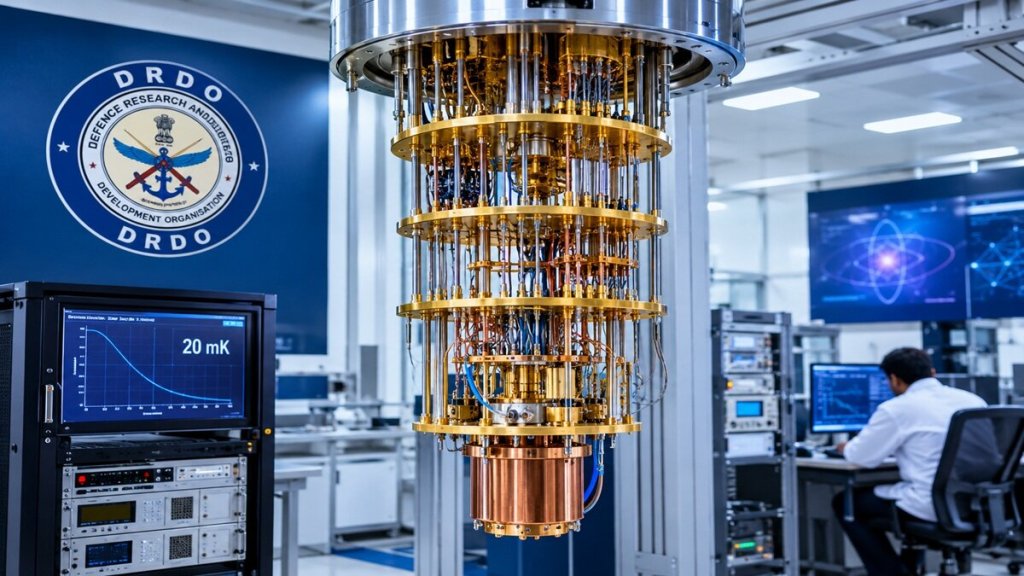

India’s defence research establishment has moved from funding small prototypes to backing a full-scale, high-value deep-tech project with a start-up. Under the Technology Development Fund (TDF) scheme, the Defence Research and Development Organisation (DRDO) has signed its first major agreement from a Rs 500 crore corpus which Union Defence Minister Rajnath Singh earlier approved for cutting-edge technologies.
The deal is with Zero mK India Private Limited, a start-up based in Rajasthan‘s Alwar, for the indigenous development of a 20 millikelvin (mK) dilution refrigerator for quantum applications.
Why the defence sector is putting money behind quantum cooling
The defence ministry has been pushing to reduce reliance on imported critical technologies, especially in areas that will shape future warfare and strategic capabilities. Quantum computing, secure communications and advanced sensing are seen as key domains where India cannot afford to be dependent on foreign suppliers.
Dilution refrigerators are the ‘cold rooms’ of the quantum world. They are specialised cryogenic systems that can cool devices to temperatures just above absolute zero, in the millikelvin range. Such ultra-low temperatures are essential to operate and test many types of quantum processors and related quantum hardware.
Until now, much of this cryogenic infrastructure has been imported. According to the defence ministry‘s report, the new project is expected to build a 20 mK-class dilution refrigerator in India, aligning with the National Quantum Mission and strengthening domestic capabilities in quantum technology and advanced cryogenics.
DRDO has signed its first high-value deep-tech project agreement under the Technology Development Fund (TDF) scheme with Zero mK India Pvt Ltd for indigenous development of a 20 mK-class Dilution Refrigerator for Quantum Applications. The project, supported by the Rs 500 crore… pic.twitter.com/SUyWjWe6BT
\— Ministry of Defence, Government of India (@SpokespersonMoD) September 24, 2026
Rs 500 crore TDF push for deep tech
The Technology Development Fund (TDF) is a DRDO scheme that supports industry, including Micro, Small, and Medium Enterprises (MSMEs) and start-ups, to develop defence-related technologies. In November 2025, Rajnath Singh approved an additional corpus of Rs 500 crore specifically for deep-tech and cutting-edge projects as a separate vertical under TDF.
The agreement with Zero mK India is the first high-value project to be taken up from this Rs 500 crore deep-tech fund. The signing took place in the national capital between the Director of TDF and representatives of Zero mK India. The project will be monitored, mentored and technically supported by the Solid State Physics Laboratory (SSPL), a DRDO lab that works on advanced materials and low-temperature physics.
Senior officials present included the Defence Secretary and DRDO Chairman Rajesh Kumar Singh, along with directors from DRDO’s microelectronics, technology management and SSPL divisions.
What the project will actually build
The core deliverable is an indigenous 20 mK dilution refrigerator for quantum applications which is a machine that can cool quantum devices down to about 20 thousandths of a degree above absolute zero—a regime where delicate quantum states can be maintained and measured.
Such systems are needed for:
- Operating superconducting and other types of quantum processors
- Testing quantum sensors and communication hardware
- Supporting research and development in quantum technologies for both civilian and strategic uses
Zero mK India already works on advanced cryogenic systems and has stated that it is developing dilution refrigerators capable of reaching below 20 mK in line with the India Quantum Mission.
How this fits into India’s quantum ambitions
The project is closely aligned with the National Quantum Mission, which seeks to build a self-reliant quantum technology ecosystem in India. Developing critical infrastructure such as dilution refrigerators within the country could reduce dependence on imported cryogenic systems, lower costs and improve access for Indian researchers and companies.
It could also help create a domestic supply chain for quantum hardware, supporting applications across both the defence and commercial sectors.
A defence ministry report said the initiative “strengthens India’s capabilities in quantum technology, advanced cryogenics and strategic technologies, contributing towards a self-reliant, quantum-ready ecosystem.”
Defence Minister Rajnath Singh has publicly welcomed the project, complimenting DRDO, industry partners and other stakeholders. He expressed confidence that this partnership would “set an important precedent for future DRDO–industry collaborations in emerging technology domains.” Defence Secretary and DRDO Chairman Rajesh Kumar Singh congratulated the teams and wished them success in meeting the project’s technical objectives.