


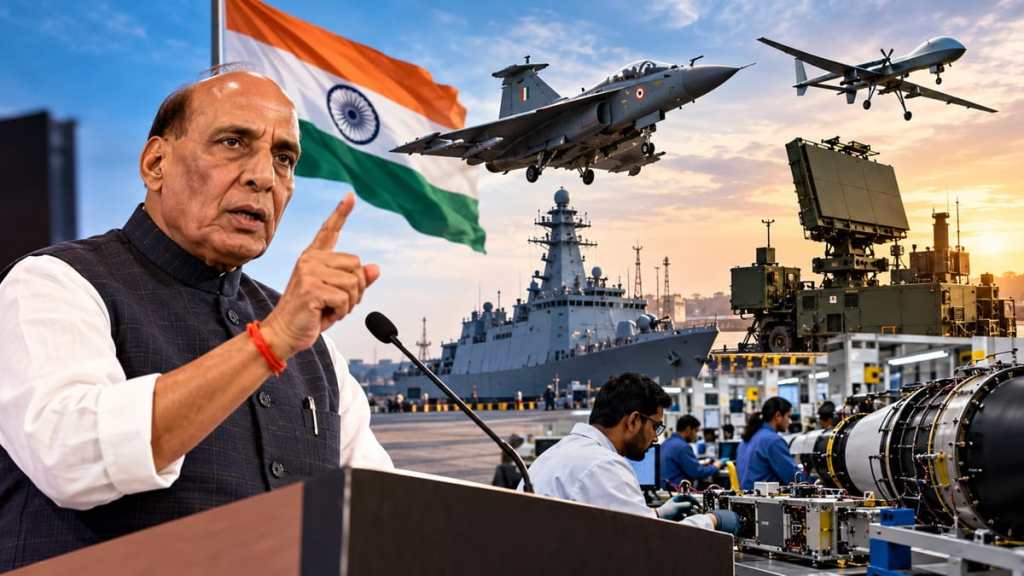

Defence Minister Rajnath Singh has outlined the government’s expanding push to strengthen India’s domestic defence technology and manufacturing ecosystem. The outline has come with higher research funding, greater industry participation and a growing list of military equipment earmarked for indigenisation.
Addressing a defence conclave in New Delhi, Singh said the allocation for defence research and development has risen to Rs 29,100 crore in 2026-27, compared with Rs 15,283 crore in 2014-15. The government has also opened a quarter of the defence R&D budget to industry, startups and academia as part of efforts to broaden participation in military technology development.
The latest push comes alongside record defence production, rising exports and a policy focus on reducing dependence on imported military equipment.
R&D allocation nearly doubles over the decade
According to the defence minister, the Rs 29,100.25 crore allocation for the Defence Research and Development Organisation (DRDO) in 2026-27 is up from Rs 26,816.82 crore in 2025-26. Of the latest allocation, Rs 17,250.25 crore has been earmarked for capital expenditure.
The government has showcased the increase as part of its longer-term effort to develop critical defence technologies domestically.
According to government data, the R&D allocation has risen from Rs 13,716.14 crore in 2014-15 to Rs 29,100.25 crore in 2026-27, an increase of more than 112%. However, the government has separately compared the current allocation with Rs 15,283 crore in 2014-15 when discussing the broader R&D spending figure.
25% of R&D budget opened to private sector, academia
A major component of the strategy is to move defence research beyond government laboratories and bring private companies, startups and academic institutions into the development pipeline.
Since 2022-23, around 25% of the defence R&D budget has been opened to industry, startups and academia, according to the government.
The Ministry of Defence has also established 15 DRDO-Industry-Academia Centres of Excellence, covering 82 identified research areas. The DRDO has additionally built a network of around 2,000 industries involved in manufacturing equipment, with technologies transferred to Indian partners without a transfer-of-technology fee in several cases, according to government data.
5,521 defence items identified for indigenisation
Alongside R&D, the government is using Positive Indigenisation Lists (PILs) to create a pipeline of equipment and components that are to be manufactured domestically.
As of May 2026, 10 Positive Indigenisation Lists covering 5,521 items had been notified, according to government data. Five lists were issued by the Department of Military Affairs and five by the Department of Defence Production.
The lists are intended to provide Indian manufacturers with a defined set of products for which domestic sourcing and production can progressively replace imports.
The government has also established the Srijan Defence Equipment Empowerment Platform, which connects defence users and public-sector entities with Indian industry, MSMEs and startups looking for indigenisation opportunities.
AI, drones and advanced technologies in focus
Artificial intelligence is emerging as another major area of focus within India’s defence technology strategy.
In March 2026, Singh released an AI Maturity Assessment Model at the National Defence Industries Conclave in New Delhi. The framework is intended to help defence organisations assess their adoption and use of artificial intelligence.
The government has also established an AI Centre of Excellence at Bharat Electronics Ltd (BEL) in Pune. Singh inaugurated the centre in February and was briefed on AI-based solutions being developed by Indian startups.
Beyond AI, the defence technology ecosystem is increasingly focused on areas such as drones, counter-drone systems, robotics, additive manufacturing and smart materials.
Singh has also emphasised the need for an indigenous drone ecosystem that extends beyond complete platforms to critical components such as software, engines and batteries.
iDEX expands startup participation
The government’s Innovations for Defence Excellence (iDEX) initiative is another part of the effort to bring startups and smaller companies into defence technology development. According to government data, as many as 676 startups, MSMEs and innovators had joined the defence innovation ecosystem under iDEX by March 2026.
Of these, 58 prototypes worth Rs 3,853 crore had received procurement clearance, while 45 procurement contracts worth Rs 2,326 crore had been signed.
The Development-cum-Production Partner framework and the Technology Development Fund are among the other mechanisms being used to take technologies from development to production.
Defence production hits record Rs 1.78 lakh crore
The R&D and indigenisation initiatives come as India’s overall defence production reaches a record level. India’s defence production stood at Rs 1.78 lakh crore in FY2025-26, up 15.6% from Rs 1.54 lakh crore in the previous fiscal year, according to the Ministry of Defence. The figure is also more than double the Rs 84,643 crore recorded in FY2020-21.
Public-sector entities accounted for about 76% of production, while the private sector contributed 24%, with private-sector production reaching around Rs 42,000 crore. The government has set a target of Rs 3 lakh crore in annual defence production by 2029.
Defence exports cross Rs 38,000 crore
India’s defence exports have also expanded alongside domestic production. Exports reached a record Rs 38,424 crore in FY2025-26, an increase of 62.66% from Rs 23,622 crore in the previous fiscal year.
Indian defence products are now being exported to more than 80 countries. In FY2025-26, the private sector accounted for 45.16% of defence exports, while defence public-sector undertakings contributed 54.84%. The government has set a target of Rs 50,000 crore in annual defence exports by 2029.