


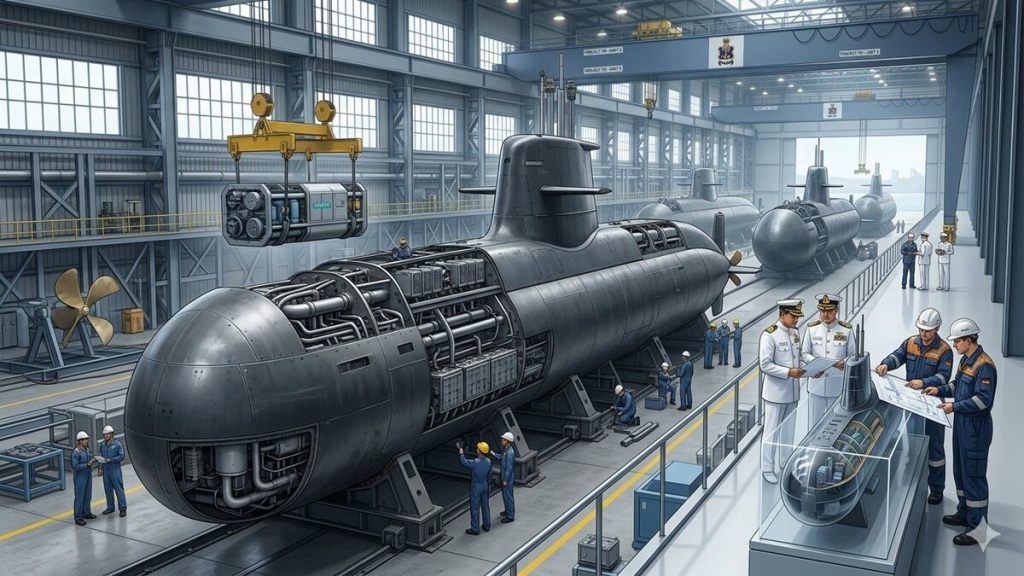

India is almost in the final stages of clearing an over Rs 80,000 crore deal to build six advanced conventional submarines domestically with German partnership, while also weighing a separate proposal for three additional Scorpene (Kalvari-class) boats at Mazagon Dock Limited (MDL) in Mumbai, Defence Secretary Rajesh Kumar Singh told ANI. The move comes as India monitors growing Pakistan–China naval cooperation, including Islamabad’s plans to induct Hangor-class submarines.
The six new submarines are part of the long-pending Project-75(I) programme, under which Indian shipyard MDL and German defence firm TKMS (ThyssenKrupp Marine Systems) are expected to build the boats in India with substantial participation from Indian private-sector firms.
When asked about India’s response to Pakistan’s underwater fleet upgrades, Singh said, “Both Project-75(I) and additional Scorpene submarines are being considered. Project-75(I) is at the final stage. It has been submitted and is pending a final decision by the competent authority.”
#WATCH | Delhi | On being asked about the status of our submarine programme, including Project-75(I), and others, Defence Secretary Rajesh Kumar Singh says, "Both Project-75(I) and additional Scorpene submarines are being considered. Project-75(I) is at the final stage. It has… pic.twitter.com/58aZJIrtOX
— ANI (@ANI) October 1, 2026
“Additional Scorpene submarines are also being considered. It is not as advanced as the other one, but that is also under consideration.”
Project-75(I) is designed to deliver diesel-electric attack submarines with advanced sensors, weapons and stealth features, while the additional Scorpene order would extend the existing Kalvari-class line already under construction at MDL.
Indigenous AIP and combat systems to upgrade existing fleet
Beyond new builds, the Indian Navy is working to upgrade its existing submarine fleet. The main focus is fitting an indigenous Air Independent Propulsion (AIP) system, developed by the Defence Research and Development Organisation (DRDO), onto Scorpene-class boats during mid-life refits.
“We are trying to put our indigenous, DRDO-developed AIP system into one of our submarines when it comes in for a refit towards the middle of next year. We have multiple lines of effort going on to strengthen our underwater capabilities. Submarines will be entirely built in India, no doubt about it,” Singh said.
AIP allows conventional submarines to stay submerged for longer periods without surfacing, improving stealth and endurance.
Alongside propulsion upgrades, the Navy is also overhauling its combat architecture. Rajesh Singh said the Naval Physical and Oceanographic Laboratory (NPOL) has developed an indigenous integrated combat system for submarines, which will be phased in during refits.
“Besides the indigenous Air Independent Propulsion (AIP), the two additional Scorpenes, and the strategic partnership model for the Project-75(I) programme with the Germans, the Naval Physical & Oceanographic Laboratory (NPOL), our laboratory, has recently developed a very advanced indigenous integrated combat system for our submarines. We are going to start putting that in all of our submarines over time, as they come in for refits. That will again be a major game changer when it comes to improving the combat capabilities of our submarines.”
Project-75(I): India’s plan for 6 advanced submarines built at home
Project-75(I) is the Indian Navy’s long-pending programme to acquire six advanced diesel-electric attack submarines with Air-Independent Propulsion and modern combat systems, to be built in India through a strategic partnership between an Indian shipyard and a foreign original equipment manufacturer.
The project traces its origins to the early 2000s, when the Navy identified the need to replace its ageing conventional submarine fleet and close the gap with regional adversaries; it was formally approved in principle by the Defence Acquisition Council and later structured under the Strategic Partnership (SP) model introduced in India’s Defence Procurement Procedure to bring in global submarine builders while mandating domestic construction and high indigenous content.
Over the years, official documents and statements from the Ministry of Defence, Indian Navy, and Defence Acquisition Council have described Project-75(I) as a critical element of India’s undersea warfare capability, envisaging submarines with enhanced stealth, sensor suites, weapon systems and endurance, and with substantial participation from Indian private-sector defence firms alongside a public-sector shipyard (primarily Mazagon Dock Limited).
Why the push now
The push to finalise Project-75(I) and expand the Scorpene line reflects India’s effort to close capability gaps in its underwater arm as regional rivals modernise. Pakistan’s ongoing induction of Hangor-class submarines, based on Chinese design and built with Chinese assistance, has heightened concerns about the balance of undersea power in the Arabian Sea and Indian Ocean.
By combining new-build submarines, AIP retrofits and an indigenous combat system, the Navy aims to:
- Increase the number of operational submarines
- Extend underwater endurance and stealth
- Reduce dependence on foreign combat systems over time
The final approval for the Rs 80,000 crore-plus Project-75(I) deal will determine how quickly the six new boats move from contract to keel-laying, while the decision on three extra Scorpenes could provide a near-term boost to fleet strength as the larger programme ramps up.