


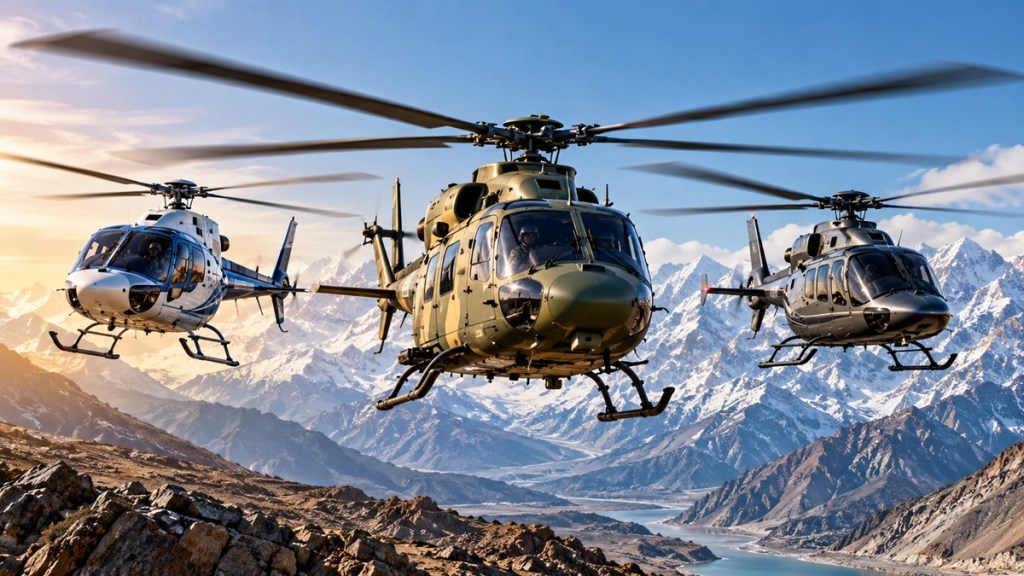

India’s plan to replace the Army’s ageing Chetak and Cheetah helicopter fleet could create a major opportunity for the country’s rotary-wing industry, with around 200 light multi-role helicopters expected to be procured for the Army and the Indian Air Force (IAF).
The programme features prominently in a defence procurement outlook outlined by 360 ONE Capital Research report, which identifies Hindustan Aeronautics (HAL), Tata-Airbus and Adani-Leonardo as potential beneficiaries of the proposed requirement.
The competition brings as many as three different industrial models into focus: HAL’s indigenous helicopter manufacturing capabilities and two private-sector partnerships involving foreign aerospace manufacturers. The final specifications of the programme will be important in looking at which platforms can meet the armed forces’ requirements.
The report identifies HAL’s Light Utility Helicopter (LUH), in the three-tonne class, and Advanced Light Helicopter (ALH), a multi-role platform in the 5.5-tonne class, as potential offerings. Airbus H125, associated with the Tata-Airbus partnership, and Leonardo’s AW109, associated with Adani-Leonardo, are also identified as potential contenders.
However, the report does not establish that a tender has been issued or that the three companies have formally entered a bidding process.
HAL, Tata-Airbus and Adani-Leonardo in focus
According to the brokerage report, HAL could be a key beneficiary of the proposed Light Multi Role Helicopter (LMRH) requirement, depending on the final specifications.
The company’s LUH belongs to the three-tonne class, while its ALH offers a multi-role configuration in the 5.5-tonne class. The report identifies both platforms in its assessment of the potential helicopter requirement.
For Tata-Airbus, the report identifies the H125 as a possible contender. Adani-Leonardo could compete with the AW109, according to the research note.
The eventual platform selection will depend on the requirements defined by the armed forces. The report does not provide a final technical specification, a confirmed list of bidders or a procurement schedule for the 200-unit programme.
The expected fleet replacement is intended to support reconnaissance and surveillance, combat operations, search and rescue, and humanitarian assistance and disaster relief. These roles make the programme relevant to the Army’s operational requirements as well as the IAF’s bigger helicopter fleet needs.
A wider defence acquisition push
The helicopter requirement is part of a much larger defence modernisation push. On October 26, the Defence Acquisition Council (DAC), chaired by Union Defence Minister Rajnath Singh, granted Acceptance of Necessity (AoN) for capital acquisition proposals worth approximately Rs 2.12 lakh crore. This was nearly double the Rs 1.1 lakh crore cleared in the previous cycle in September 2026.
The latest tranche spans high-mobility vehicles, artillery systems, helicopters, unmanned aerial systems, counter-drone capabilities, air defence and naval platforms.
Within the Army’s requirements, the report identifies LMRH procurement as a programme intended to replace the Chetak and Cheetah fleet. Separately, the IAF’s list includes special utility helicopters to meet air transport requirements.
For the IAF, the report identifies HAL as a potential beneficiary of the special utility helicopter requirement, depending on the final specifications. It notes that HAL’s Indian Multi Role Helicopter (IMRH) remains under development. Airbus H-725 and Lockheed Martin are also listed as potential contenders, with 24 units likely to be procured.
The Army and IAF helicopter requirements are distinct procurement streams in the report and should not be conflated into a single confirmed contract.
Domestic sourcing and the order pipeline
The latest approvals reinforce the government’s emphasis on domestic sourcing and the development of indigenous defence capabilities. The report estimates domestic sourcing at around 82% across the latest tranche.
For the defence industry, the scale of AoN approvals over recent years could support order inflows over the medium term, according to 360 ONE Capital Research. The report lists AoN approvals of Rs 3.8 lakh crore in FY24, Rs 2.2 lakh crore in FY25 and Rs 9.28 lakh crore in FY26.
It also notes that defence capital expenditure in the FY27 Budget Estimate stands at Rs 2.193 lakh crore, 22% higher than the FY26 Budget Estimate of Rs 1.8 lakh crore. Capital outlay accounts for 27.9% of the overall defence budget, the highest share since FY15, according to the report.
These figures provide the financial context for the helicopter programme, although they do not represent funds specifically allocated to the 200-unit LMRH requirement.
What comes next for the helicopter programme?
The next important milestone will be greater clarity on the helicopter requirement, including the specifications against which potential platforms will be evaluated.
The report identifies 200 expected LMRH units and names HAL, Tata-Airbus and Adani-Leonardo as potential beneficiaries. It does not disclose a programme-specific acquisition value, a final tender structure or a confirmed division of quantities between the Army and IAF.
The grant of AoN is also not the same as the placement of a contract. Procurement decisions, final specifications and subsequent ordering will determine when the potential requirement translates into business for manufacturers.