



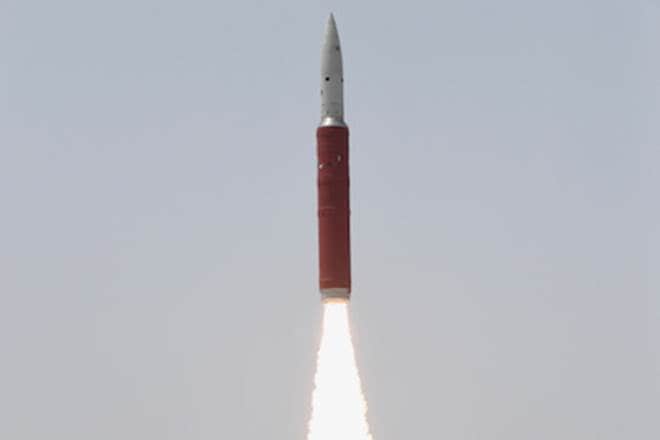
Amidst growing tensions with Pakistan, and China’s growing space programme, India joined a select group of countries that includes only US, Russia and China, when it successfully conducted an Anti-Satellite (A-SAT) missile test ‘Mission Shakti’ from the Dr A P J Abdul Kalam Island in Odisha.
A Ballistic Missile Defence (BMD) Interceptor Missile developed by the Defence Research and Development Organisation (DRDO) successfully engaged an Indian orbiting target satellite in Low Earth Orbit (LEO) in a ‘Hit to Kill’ mode.
The test which demonstrated country’s capability to defend its assets in outer space, fired interceptor missile which was a three-stage missile with two solid rocket boosters. Tracking data from range sensors has confirmed that the mission met all its objectives.
WATCH video of A-SAT missile
Dr VK Saraswat, former chief of DRDO and member of NITI AYOG said, “With this test India has a special capability to protect its space assets, so that no one can harm them. Also, it is a major technological achievement – as a satellite which travels at 5,000 meters per second speed, every parameter has to be precision matched and engaged. This has proved that India has great rocketry and missile technology which is world-class.”
“With this test, India joins the exclusive club with US, Russia and China. We had the capabilities since 2012 when the Agni V was being tested. Another programme was the Ballistic Missile Programme on which DRDO has been working since 2001 until recently. What were missing were two critical technologies including the IR Seeker and Kill Vehicle. Today, we have demonstrated these two,” the former DRDO chief added.
Defence experts have hailed Mission as an important milestone in for India’s preparedness for future warfares. The test sends out stern messages to India’s neighbours, Pakistan and China, about India’s enhanced and high-tech defence capabilities which are indigenously developed