



In August, Data Patterns disclosed a ₹585.76-crore order from Bharat Electronics Limited (BEL) for radar electronics. The transaction offers a glimpse of the business inside India’s defence manufacturing push: a government integrator buying specialist technology from a private supplier.
For companies seeking to enter the sector, that relationship deserves attention. Supplying the electronics inside military equipment can create a substantial business. But the distance between developing a component and earning a dependable return runs through testing, customer acceptance and repeat orders.
Why the ₹3,070-Crore Target Is Not a Guaranteed Order Book
The Department of Defence Production’s (DDP) sixth Positive Indigenisation List (PIL) offers a map of potential demand. Announced on August 18, 2026, it covers 405 items with estimated domestic business potential of ₹3,070 crore. Of these, 389 relate to Defence Public Sector Undertakings (DPSUs) and 16 to the Indian Coast Guard (ICG). The ministry links domestic procurement to successful indigenous development. That business estimate covers the entire list, including mechanical items and materials; it does not measure the electronics opportunity alone.
The announcement provides no guaranteed order book, annual quantities, or item-level prices. Its indicative indigenisation timelines run from December 2026 to December 2032. A manufacturer therefore has to establish how much a buyer will purchase, when it will purchase it, and what qualification will cost. Those answers determine whether an import-substitution target can support a factory.
BEL accounts for 227 entries, roughly 56% of the list by item count. That makes it a particularly important customer for electronics suppliers; the percentage says nothing about its share of the list’s rupee value. The requirements reach into radar, electronic warfare, satellite communications, thermal imaging and sonar. The opportunities will suit different kinds of manufacturers. The published requirements identify what buyers want; the routes into production depend on each supplier’s capabilities.
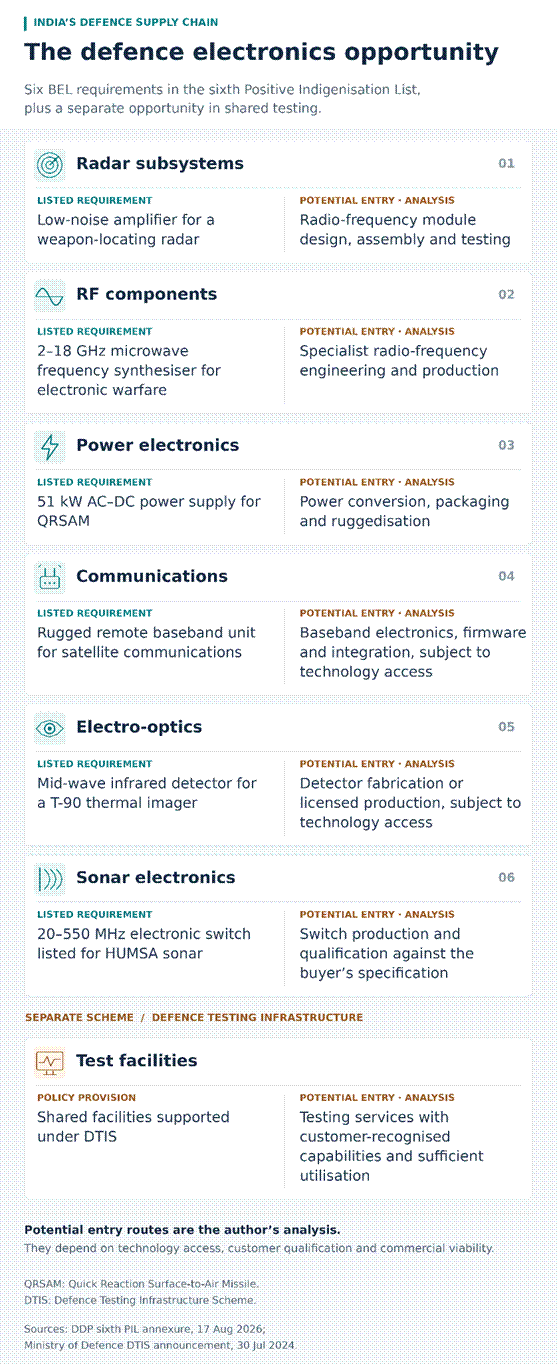
The six component examples come from there. Testing facilities are an adjacent opportunity under the Defence Testing Infrastructure Scheme (DTIS). QRSAM is the Quick Reaction Surface-to-Air Missile system.
For an established power-electronics manufacturer, a military power supply may be a logical extension of its engineering capabilities. The additional work lies in meeting the customer’s operating conditions and proving consistent performance. Manufacturing an infrared detector requires a different investment assessment, centered on semiconductor processes, equipment, and the proportion of devices that meet specification.
For companies targeting secure communications, the assessment must also cover firmware access, interface control, and the security approvals required for the intended application. Building rugged communications hardware and controlling the technology that protects its traffic are separate capabilities.
The Hidden Costs of Component Qualification
Qualification is where the commercial proposition becomes demanding. A buyer needs evidence that a replacement works in the intended equipment and that subsequent batches will perform consistently. Engineering and qualification costs have to be funded, and the supplier’s share must be recovered through the business it eventually wins.
Acceptance can create a valuable customer relationship. It can also leave development expenditure spread across too few orders. A high selling price for a difficult component does not automatically produce a high return on the capital committed.
Why High EBITDA Margins Don’t Guarantee Net Profit Growth
Data Patterns shows that attractive margins are possible: it reported an earnings before interest, tax, depreciation and amortisation, or EBITDA, margin of 40% for FY2025–26. Yet in the June 2026 quarter, revenue from operations rose about 17% year-on-year while net profit fell about 13.5%. These company-wide results show why investors must examine profitability alongside growth. They cannot establish the margins available on an individual component.
Access to technology determines how much of this business a supplier can undertake. DRDO released a design kit for gallium-nitride microwave chips operating up to X-band in December 2021, with devices manufacturable at GAETEC. That gives manufacturers a domestic technology base to investigate. Commercial production still requires access to the process, dependable fabrication capacity, and an acceptable proportion of usable chips.
How Foreign Partnerships Restrict Future Upgrades and Exports
Foreign partnerships can provide a route into technologies a manufacturer cannot develop economically on its own. India Optel’s December 2025 agreement with Safran covers transfer of production for the SIGMA 30N navigation system and CM3-MR firing sight. The announced responsibilities include manufacturing, assembly, testing, quality assurance, and lifecycle support.
SIGMA 30N also appears in the sixth PIL. The public documents do not establish whether the India Optel–Safran agreement covers BEL’s specific requirement. The overlap nevertheless illustrates why prospective suppliers need to examine existing localisation arrangements before assuming that a listed item represents an open market.
For private capital, the partnership’s terms matter as much as its announcement. Access to design data, permission to modify the product, export rights and continued dependence on imported inputs all influence the business that can be built. A company may manufacture locally while retaining limited control over future upgrades or overseas sales.
Testing creates a further opportunity because several manufacturers can share facilities that would be costly to build individually. DTIS supports this model with government grants of up to 75% of project cost. Announced facilities include electronic warfare, electro-optics and communications testing.
The investment case still depends on utilisation, recognised test capabilities and the alternatives already available to customers. The announced DTIS model also provides for reinvesting revenue in testing capabilities. Investors must assess the economics on those terms, including the time needed to attract enough work to keep equipment and staff productive.
Capital Allocation: Funding the Operating Cycle Over Physical Equipment
The cash needed to develop products and execute orders can be substantial. By June 30, 2026, Data Patterns had used ₹168 crore from its 2023 institutional share placement for working capital, ₹142.59 crore for product development, and ₹13.63 crore for a facility to test electromagnetic interference and compatibility. These are cumulative uses of those proceeds, rather than expenditure in a single quarter.
Those allocations show why funding a defence electronics business extends well beyond buying assembly equipment. Capital must support development and the operating cycle, as well as physical capacity. Payment milestones and the time between spending on a batch and collecting from the customer belong in the investment calculation.
How the ₹1 Lakh Crore RDI Scheme Plugs Funding Gaps
The ₹1 lakh crore Research, Development and Innovation (RDI) scheme provides a possible funding route across several sectors. Its published framework offers eligible projects long-term loans and equity through designated fund managers. Financing can generally cover up to 50% of assessed project cost at technology readiness level four and above, subject to exceptions. Grants and short-term loans are excluded. Companies still need to finance the uncovered requirement and establish how production will generate cash.
Procurement reform addresses another part of that problem. The Ministry of Defence’s (MoD) February 2026 summary of the draft Defence Acquisition Procedure (DAP) proposed raising indigenous content in the preferred Indian-designed procurement category from 50% to 60%, alongside five years of assured orders for Make/Innovations in Defence Excellence (iDEX) projects. The significance for component makers depends on the procurement route under which they win work. An entry on the PIL does not, by itself, confer five years of orders.
Why Defence Orders Alone Won’t Sustain Low-Volume Niche Components
Even with financing and qualification in place, some components may face a volume problem. A technically successful product serving a small defence requirement can struggle to recover its development costs. Exports or civilian applications could improve utilisation, particularly where RF engineering, power conversion or optical capabilities can serve additional customers.
That expansion needs its own commercial case. A military design may require changes for a civilian price point; an export customer may demand different specifications and approvals. The useful advantage is engineering and equipment that can be reused across paying customers. A broad claim of dual-use potential provides little evidence of that demand.
The BEL order illustrates how substantial the business can become for a specialist supplier. For the next entrant, success will depend on financing development, securing acceptance, and delivering reliably. The sixth list identifies problems to solve. A customer returning for the next batch will show which companies have built a lasting business.
Aritra Banerjee is a senior journalist with Financial Express specialising in the intersection of defence, space, emerging technologies, industrial policy and the global energy transition.
Disclaimer: The views expressed are the author’s own and do not reflect the official policy or position of Financial Express.