




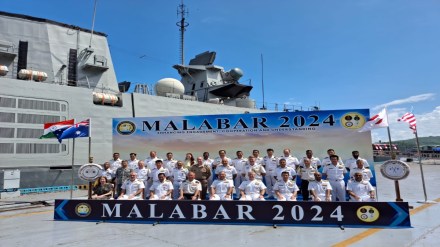
The latest iteration of the Malabar maritime exercise series, Malabar 2024, launched at Visakhapatnam, India, on October 8, 2024. This significant military event, co-hosted by India and the Eastern Naval Command (ENC), brings together the navies of the Quad—Australia, Japan, the United States, and India—for 10 days of advanced maritime training and strategic dialogue. As India steps up as the host this year, the exercise reflects the evolving security dynamics of the Indo-Pacific region, emphasising India’s crucial role in counterbalancing China’s growing influence.
From Bilateral to Multilateral: The Malabar Exercise’s Evolution
Since its inception in 1992 as a bilateral exercise between the Indian and U.S. navies, Malabar has grown into one of the most important multilateral military events in the Indo-Pacific. The inclusion of Japan in 2015, followed by Australia’s formal participation in 2020, has transformed Malabar into a robust coalition exercise aimed at enhancing interoperability among the Quad nations. This year’s exercise highlights the expanded scope of Malabar, focusing on countering evolving regional threats through strategic and operational coordination.
Malabar 2024 is divided into two primary segments. The Harbour Phase, taking place from October 8 at the Eastern Naval Command, precedes the Sea Phase, where ships and aircraft will engage in joint tactical manoeuvres off Visakhapatnam’s coast until October 18. Vice Admiral Rajesh Pendharkar, Flag Officer Commanding-in-Chief of ENC, is hosting a Distinguished Visitors’ Day on October 9, offering top defence officials from all four nations a firsthand view of the operation’s scope and capabilities. During this phase, senior leaders will participate in strategic discussions and a joint press conference, underscoring the significance of the Quad’s expanding maritime partnership.
Showcasing Naval Might and Specialised Warfare
Malabar 2024 showcases a formidable array of naval assets from each Quad nation, symbolising the coalition’s commitment to safeguarding freedom of navigation in the Indo-Pacific. India has deployed an extensive fleet comprising guided-missile destroyers, multi-role frigates, submarines, and a diverse array of aircraft, including fixed-wing maritime reconnaissance aircraft, fighter jets, and helicopters. Australia’s contribution includes HMAS Stuart, an Anzac-class frigate with an MH-60R Seahawk helicopter and a P-8 maritime patrol aircraft. The U.S. Navy is fielding USS Dewey, an Arleigh Burke-class destroyer with a Seahawk helicopter and P-8 aircraft, while Japan has sent the Murasame-class destroyer JS Ariake.
In addition to advanced vessels, Special Forces from all four nations are participating, focusing on complex manoeuvres in surface, air, and anti-submarine warfare (ASW). The exercise will include Subject Matter Expert Exchanges (SMEEs), where military personnel will collaborate on key operational techniques, enhancing each nation’s skill set through shared knowledge and expertise. This level of cooperation enables the Quad to conduct high-level maritime operations with precision and cohesion, reflecting a united front in the face of shared regional challenges.
Strategic Significance: Countering China’s Expanding Influence
The timing of Malabar 2024 is significant. Over the last decade, China’s maritime strategy has extended its footprint in the Indian Ocean Region (IOR) through strategic port developments and bolstered alliances with regional states. Notably, China’s People’s Liberation Army Navy (PLAN) is now the world’s largest by fleet size, projecting to expand its submarine fleet to over 65 vessels by 2025. The recent development of a Chinese-supplied submarine base in Bangladesh raises concerns among Quad nations, reinforcing the need for exercises like Malabar to counterbalance Beijing’s expanding influence in the Indo-Pacific.
The anti-submarine warfare focus of Malabar 2024 underscores the Quad’s collective response to the rising underwater threat posed by China. India’s P-8I Poseidon aircraft, regarded among the world’s most advanced maritime surveillance and ASW platforms, will play a prominent role in this year’s exercise. This reflects India’s commitment to reinforcing its own ASW capabilities and providing regional stability. Yet, trust concerns linger, especially around data-sharing agreements for sonobuoy operations with the U.S., although negotiations to sell advanced sonobuoys to India indicate positive movement toward stronger operational cohesion.
Fostering Trust and Operational Synergy Among Quad Navies
While the Malabar exercise now symbolises a cohesive Quad response to Indo-Pacific security, this was not always the case. India’s historically cautious approach to defence partnerships and its strategic autonomy stance presented initial challenges in engaging with the Quad. Regular participation in Malabar has helped foster trust and operational synergy between the navies, particularly between India and the United States. The exercise has evolved to not only hone tactical coordination but also build a shared strategic framework to address the region’s complex security environment.
As India leads Malabar 2024, it is setting a precedent for future Quad initiatives, moving beyond bilateral partnerships toward a more integrated regional security structure. The ongoing exchanges between commanders and subject matter experts will solidify shared protocols, joint manoeuvres, and a comprehensive understanding of each nation’s operational strengths, aligning Quad strategies for faster response times and more effective deterrence.
Addressing “Grey Zone” Tactics and Maritime Threats
Malabar 2024 is more than just a show of strength; it represents the Quad’s proactive stance against grey zone tactics, a favoured strategy of China that employs indirect aggression to avoid conventional military confrontation. By holding joint exercises, the Quad nations send a clear message of deterrence, demonstrating their readiness to counter unconventional threats and maintain maritime order. As regional geopolitics intensify, these drills serve as a platform for strategic dialogue and foster a unified approach to countering non-traditional threats, including cyber and hybrid warfare.
Charting a Course for an Open and Balanced Indo-Pacific
As the exercise progresses, Malabar 2024 will stand as a testament to India’s growing leadership in securing the Indo-Pacific alongside its Quad allies. Hosting such a high-profile exercise on its eastern coast reinforces India’s pivotal role in maintaining stability in the region’s seas. Beyond the tactical drills, the Quad’s operational coordination signifies a renewed commitment to a rules-based maritime order, where regional sovereignty and peaceful trade are safeguarded.
In hosting Malabar 2024, India is both asserting its influence as a naval leader and marking a pivotal point for the Quad’s role in the Indo-Pacific. As this exercise draws to a close on October 18, it will leave an indelible mark on regional security cooperation, setting a high standard for future collaborations aimed at ensuring a secure and open Indo-Pacific for all.


