




By Maj Gen (Dr) Ashok Kumar, VSM (Retd)
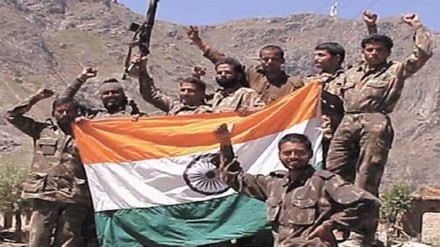
26th July 2023 marked the celebration of the 24th anniversary of Operation Vijay – India’s victory over Pakistani forces in the Kargil war. The day of the event was preceded by activities to honour the bravehearts who made the supreme sacrifice to defend the country’s territorial integrity and sovereignty. One of the major ways this was done across the country was the laying of wreaths at various war memorials that dot the military stations and cantonments. Obviously, these are justifiable celebrations and stand as testimony to the valour, grit and determination of India’s soldiers who fought against unforgiving odds. The names and actions of so many are permanently etched into the national imagination and continue to motivate thousands of young men and women to don the olive greens, blues and whites and become part of the select few. The war, in the way it was fought, is still known for the overwhelming predominance of the youth. Never has the aphorism – “never in the field of human conflict was so much owed by so many to so few” – held truer than this conflict.
The job – invaders thrown out – once done, the Kargil Review Committee (KRC) and other investigations were conducted in the aftermath to find out the lacunae in planning, intelligence and analysis failure that led to the undetected infiltration on such a massive scale. Even if a part of it was detected, as some accounts claim, it was not acted upon. However, some suggestions of the KRC were heeded, and corrective measures taken, more still needs to be done. The aim of this piece is to understand and analyze some of the recommendations of these committees and, combined with the author’s real time experience of the conflict, propose some measures that will help the country be more prepared in case of future conflicts. Three broad issues have been raised in the article: politico-military directions, preserving the sanctity of the Line of Control (LC) and significantly higher casualties during the conflict.
Politico- Military Directions
This is the most important facet in the prosecution of any war. It entails the communication of the political direction to the defence forces with respect to the desired military end state which will play a major part in the attainment of the political end-state. One of the major presumptions of this interaction between the political and military class is that the political class will avoid intervening in the operational and tactical level of warfighting. In a democratic country where the defence forces are apolitical, it assumes greater importance especially in the absence of a declared national security strategy.
The prosecution of the 1971 war with Pakistan is a great example of an ideal politico-military interaction which needs to be emulated in our context for times to come. It is understood that the political leadership wanted the prosecution of this war sometime in April-June 71 due to enormity of the situation, however, the military leadership recommended that the operations be conducted in December 1971 to prevent Chinese support to Pakistan as the mountain passes would be closed. Additionally, the geographic area of the erstwhile region of East Pakistan will be more conducive for operations in December as multiple rivers crisscrossing Bangladesh would have receded. General (later Field Marshal) SHFJ Manekshaw, the Chief of the Army Staff at the time, wanted sufficient time to train and equip his forces, as well as create a logistics chain. The political leadership accepted these recommendations, displaying great strategic acuity. This resulted in a Lightning Campaign, where in just two weeks of war in December 71, Pakistan was dismembered and reduced to a rump state, East Pakistan separated from West Pakistan to be renamed Bangladesh as a separate nation and more than 93,000 Pakistani prisoners of war were captured, a feat unparalleled in the world history since the Second World War.
Though it may not be too appropriate to analyse the issue in hindsight, the prosecution of the Kargil war limited options for the defence forces as crossing the LC was not permitted by the political leadership. This resulted in most Indian Army’s attacks being frontal for removing the Pakistani intrusion. On the other hand, the Pakistani soldiers occupied the commanding heights providing them an unrestricted field of vision and fire. Indian soldiers had to conduct daylight frontal assaults on reinforced Pakistani positions with hardly any cover from murderous interlocking fields of fire. In some cases, near vertical assaults were conducted against enemy positions. Such restrictions resulted in initial setbacks, increased casualties and Pakistan not being adequately punished for its misadventure. The contention of this author is that even if a decision was made to sanctify the LC, it would have been better if the Indian forces (both the Army and the Indian Air Force, IAF) were allowed to cross the LC to repel the Pakistani intrusion. Once the war was concluded, then negotiations could have been undertaken about the alleged sanctity of the LC as part of a unilateral withdrawal by India, symbolizing magnanimity. It therefore clearly emerges that while the political leadership must decide and lay down the desired end state in a democratic set up, the methods for conduct of operations must be left to the Armed forces, something which appears to have been missed out during the Kargil war.
Sanctity of LC
During the Kargil war, the sanctity of the LC was considered a ‘Lakshman Rekha’ by India’s political leadership, and it was made inviolable by the Indian forces despite Pakistani intrusions. It is essential to have a quick chronological look towards the real situation of the LC between India and Pakistan as making it an inviolable did not adequately serve the national interest during the Kargil war. The Cease Fire Line (CFL) came into existence between India and Pakistan after the 1947-48 war even though the entire state of Jammu and Kashmir (J&K) was acceded to India when Maharaja Hari Singh signed the Instrument of Accession in Oct 1947. Despite having sizable wins both across the International Border (IB) and CFL sectors, including the famous Haji Pir Pass, India and Pakistan both reverted to pre-conflict positions as decided in the Tashkent agreement concluded in 1966. The fresh alignment of the LC after the 1965 war was somewhat the same as it existed after the 1947-48 war.
The 1971 war was, however, different on many counts. While the creation of Bangladesh out of East Pakistan is well documented, India also made some gains across the IB and CFL sectors in the Western theatre, even though this was not the focal area of conflict for India. During the 1972 Shimla agreement, when CFL was redesignated as the LC, while all areas gained in the IB sector were returned by both the countries a number of areas across LC were retained by India including Turtuk, the gateway to the Siachen glacier. Retaining certain areas across the LC after the war created a paradigm where gains across the LC could be made during peace and war time. The renewed connotation of LC as being dynamic and prone to being changed was a new strategic direction which opened a future possibility of Pakistan Occupied Kashmir (PoK) becoming part of India at a later stage.
This stance was negated during the Kargil conflict during which not only the LC was made inviolable but even operations were not permitted by going across. This changed thought process came to the fore even during future negotiations between both nations wherein the LC is being considered as part of a future deal which may be seen to be as part of a settled and negotiated border. In other words, the LC at the time of the Kargil war was not fixed but its embedding into the national mindset and especially in the minds of the Armed Forces as a fixed and inviolable line robbed India of a strategic disbalancing option for future conflicts and crises. It is encouraging that India carried out surgical strikes through commando raids and Balakot air strikes by IAF wherein these operations were conducted across the LC. Although these actions signalled a changed stance towards the sanctity of LC, these were primarily responses to terrorist activities perpetrated by Pakistan and did not result in occupation of areas across the LC. The current signalling from the political establishment, in this context, is encouraging. While peace and tranquility with the neighbours is desirable, the profile of the LC with Pakistan needs to be in line with what was done during the 1971 operations. The military leaders must make it a planning parameter for all the future conflicts/ conflict like situations.
Higher Casualties
During the 1947-48 war, India suffered over close to one thousand fatal casualties while Pakistan suffered close to 6000 fatal casualties, that is, close to six times more. During the 1965 war as well, the Pakistani casualties were higher than the Indian casualties. While India lost close to three thousand of its gallant soldiers, Pakistani fatalities were close to 4000, almost 33 percent higher. During the 1971 war, India lost close to 2500 of its soldiers but it inflicted four times more fatal casualties on the Pakistanis. A sustained outcome of all wars with Pakistan always resulted in much higher casualties on the Pakistani side as compared to those suffered by Indian soldiers. The Kargil war was fought close to three decades after the 1971 war. Having conducted the 1971 war in an outstanding manner and converting East Pakistan into Bangladesh, it was a golden opportunity for India to take the war into Pakistani territory. As against this, Kargil was different wherein our losses were much higher. Though Pakistan cannot be believed for its data but as per India, we suffered 527 fatal casualties wherein Pakistan as per them suffered little over 450 fatal casualties. Even if Pakistani figures are not to be believed, one thing is certain and that we could not maintain our superiority of having much lesser casualties as compared to Pakistan as happened in previous three Indo-Pak wars. This aspect needs a serious introspection to chalk out a better strategy for the future. A new warfighting strategy based on this analysis will be a real tribute to our soldiers.
Though Kargil war has multiple lessons, these three major aspects have been highlighted. The stakeholders must take note of the above for crafting the future military strategy.
Author is a Kargil war veteran and Senior Fellow of CLAWS, an Army Think Tank.
Disclaimer: Views expressed are personal and do not reflect the official position or policy of Financial Express Online. Reproducing this content without permission is prohibited.


