


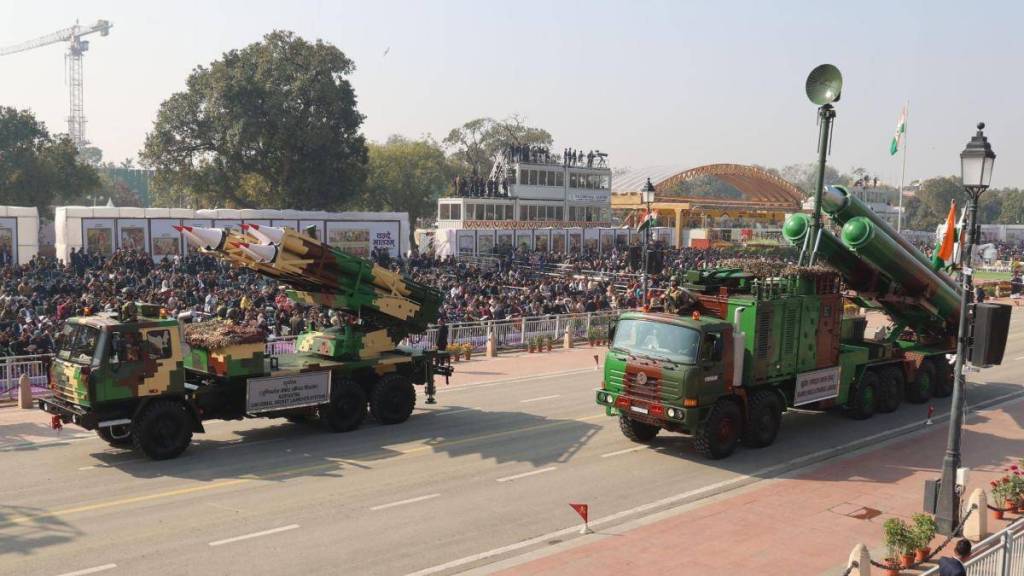

India has emerged as a growing global defense exporter in recent years — eyeing a target of ₹50,000 crore by 2029. Systems now reach more than 18 nations amid an increase of over 5,500% since FY14. The country has also emerged as the third-largest arms exporter to Europe due to the ‘re-arm’ initiative.
“Our exports have reached an all-time high of ₹38,424 crore (which is about €3.6 billion)… India became the third-largest exporter of arms to Europe mainly because of the Rearm Europe initiative. As a result a lot of standard ammunition of different types, artillery shells, and large- and small-caliber ammunition started getting exported to the continent in significant numbers,” Defence Secretary Rajesh Kumar Singh said last week.
He also flagged a Bloomberg report that said Indian arms makers have sent at least $872 million worth of ammunition to European countries since the Russian invasion of Ukraine four years ago. The figure represents a 1,600% increase from the $49.2 million in arms exported to Europe during the 4 years prior to the war. The publication cited data sourced by Trade Data Monitor from the Commerce Ministry to outline the explosive increase in Indian defense exports.
Third-largest arms exporter to Europe
The Indian government is targeting ₹3 lakh crore in annual defense production and ₹50,000 crore in exports by 2029. According to a recent PIB release, there has been 56x growth in defense imports from the ₹686 crore reported in FY14. The private sector contributed ₹17,353 crore, or 45.16%, in FY26 while defense public sector undertakings (DPSUs) contributed the remaining ₹2,071 crore, or 54.84%, of defense exports.
The country saw its annual defense production surging to an all-time high of ₹1.78 lakh crore in FY26. The figure represented a 15.6% growth over the previous fiscal and a staggering 110% increase since FY21. Data shared by the government in August also indicates a corresponding surge in defense exports — reaching ₹38,424 crore in FY26.
According to the defense secretary, the ‘ReArm Europe’ initiative has significantly boosted Indian arms exports to the continent. Singh added that India also planned to expand its participation in European defense procurement through joint ventures with European partners as well as encouraging foreign companies to manufacture in India.
The India-EU Security and Defense Partnership was signed in January this year — moving ties into direct operational and industrial defense cooperation. The inaugural session of the India-EU Security and Defense Dialogue was held in March 2026 to manage joint military logistics and supply chain integrations. Both sides have also entered negotiations to share classified intelligence for sensitive hardware. Successful deals have also been struck at the bilateral level — a key example being ties between India and France that allow co-development of advanced military technology, joint defense manufacturing, and deep maritime security cooperation.
According to the Bloomberg report, three quarters of the arm shipments sent by India have gone to nations within Eastern and Central Europe. The 13-country block has been a major arm supplier for Ukraine and saw demand surge after the Russian invasion. According to Trade Data Monitor, India is now the overall second-biggest supplier of arms, including shells, mortars, propellants, and explosives, to these countries — up from 28th four years ago.
Why is Europe rushing to buy Indian arms?
The ReArm Europe plan was presented by the European Commission in March last year and provides financial levers for member states to quickly and significantly increase defense investments and capabilities. It aims to mobilize over €800 billion in defense investments across the continent over five main financial pillars. A key component is a national escape clause that allows member states to increase their annual defense spending by up to 1.5% of GDP for a four-year period without triggering EU deficit penalties. The European Commission estimated in a 2025 briefing that this could translate to approximately €650 billion in additional defense expenditure across the region over the next four years.
According to the official World Bank database, India saw overall global exports for arms and ammunition reach $816.80 million in 2025. Romania was listed as the top buyer with an export value of $157.62 million while Slovenia ranked third at $105.23 million. Official data also shows India steadily embedding itself into Western and global supply chains — with a sizable components and munitions pipeline opening up with France and Belgium.
| Country | Export Value in 2025 |
| Romania | $157,619,050 |
| Slovenia | $105,228,640 |
| Czech Republic | $25,800,000 |
| Turkey | $20,831,490 |
| Bulgaria | $9,935,650 |
| Serbia | $8,312,380 |
| Russian Federation | $7,702,230 |
| France | $6,060,590 |
| Belgium | $5,645,000 |
| Italy | $4,123,040 |
| Sweden | $3,958,580 |
| Germany | $1,494,700 |
| Poland | $414,990 |
| Belarus | $323,260 |
European military stockpiles have been critically depleted over the past four years as they sent a steady supply of weapons, ammunition, and military hardware to Ukraine. Decades of post-Cold War defense cuts meant these nations had held very lean stockpiles even before Russia launched its invasion of Ukraine in 2022. The continent also faces a severe bottleneck in replacing what has been sent — with a desperate race to scale up industrial manufacturing and exports.
According to a recent Euro News report, the EU intends to accelerate the disbursement of its €90 billion support loan to Ukraine as the country faces a financial crunch amid Russia’s all-out escalation and blockade in the Black Sea. The bloc will provide Kiev with €32 billion in military aid and €13 billion in budget support during 2027. The loan includes €45 billion in payments for 2026, with the credit initially meant to last until the end of next year.
How is India balancing close ties with Russia against its role as European arm supplier?
India has long maintained a policy of diplomatic neutrality and non-alignment, repeatedly calling for an end to the Ukraine conflict through dialogue and diplomacy. The country does not directly supply weapons or ammunition to war-hit Kiev. New Delhi also maintains close military ties with Russia and the other country remains India’s largest supplier of military industry hardware as well as a critical partner in energy and strategic technological cooperation.
But multiple reports claim European customers have been transferring Indian munitions to Ukraine over the past four years. The Indian government had also issued a clarification after news agency Reuters reported that artillery shells sold by Indian arms makers had been diverted by European customers to Ukraine. The publication added that New Delhi had not intervened to stop the trade despite protests from Moscow. It is also pertinent to note that Indian arms export regulations limit the use of weaponry to the declared purchaser — who risks future sales being terminated if unauthorized transfers occur. European states can, however, use Indian ammunition to replenish their own stocks while transferring their weapons to Kiev
At the same time India has continued to maintain strong ties with Russia. Moscow has been its primary supplier of weapons since the Cold War. Prime Minister Narendra Modi has met with President Vladimir Putin twice in 2026 and more than 50% of India’s combat aircraft are of Russian origin. The country has also been one of the single largest buyers of Russian oil since 2022 — despite facing strong pushback from the United States.