


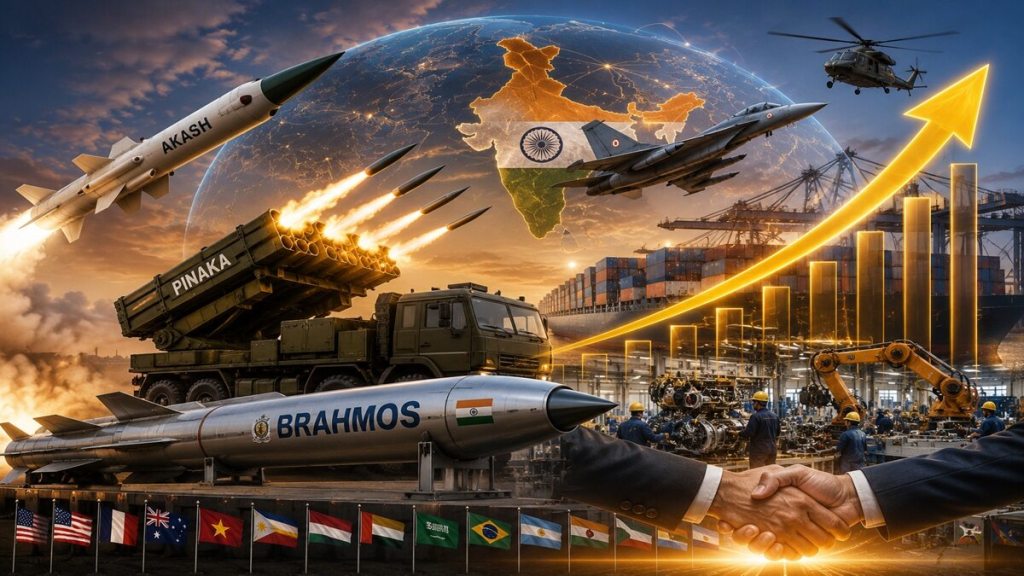

India took a major step to reduce its reliance on foreign defence hardware on Tuesday — signing a Rs 661 crore contract to procure BrahMos fire control system and launchers. The agreement outlines a significant 68% domestic sourcing threshold and kickstarts a new three-year deployment and production window. The system has been fitted onto various frontline Navy warships and acts as the primary Surface to Surface missile for maritime strike operations.
“With a minimum 68% indigenous content, the project encourages active participation of various Indian industries including MSMEs. The project will generate employment over a period of three years. It also bolsters India’s maritime security architecture and defence capabilities and marks a critical milestone in the ongoing efforts to indigenise advanced military technology,” a PIB press note adds.
The update came even as Defence Minister Rajnath Singh launched the Navy’s first indigenous Fleet Support Ship from Hindustan Shipyard in Visakhapatnam. He stressed the need for strong maritime capabilities while addressing the event — contending that the goal was to “go beyond self reliance and become a global maritime power”.
Growing Brahmos arsenal
The BrahMos joint venture was formed in 1998 — with the first successful missile launch taking place in 2001. India became the first country to operationally deploy the BrahMos supersonic cruise missile in 2007. The inter-governemental agreement has now endured for more than 25 years and played a key role as India launched Operation Sindoor last year.
“The missile features a traditional warhead and an advanced guided system and possesses the capability to strike long distances at supersonic speeds. This combination of speed, accuracy, and power makes BrahMos one of the best systems in the world. It has become the backbone of our Armed Forces,” Singh noted in October last year.
The Defence Minister added that “every inch of Pakistani territory was now within the reach of BrahMos” as he highlighted its role in the 2025 conflict. Singh said it had “become the greatest practical proof of national security” while flagging off the first batch of missiles manufactured at the BrahMos Integration and Testing Facility Centre in Lucknow.
Why does BrahMos procurement require 68% indigenous content ?
According to the PIB press note, the procurement is classified under the Buy (Indian-IDDM) category. The acronym stands for “Indigenously Designed, Developed, and Manufactured” — a new category introduced in 2016 and “accorded topmost priority for procurement of capital equipment”. The Defence Acquisition Procedure outlined by the government indicates that the percentage of indigenous content is decided using the base contract price and the total value of foreign components.
Stipulations for use of “68% indigenous content” also reflect a broader structural shift in the defence procurement strategy of India. The missiles are manufactured by BrahMos Aerospace — a joint venture between India (50.5%) and Russia (49.5%) that combines technology and contributions from both nations.
According to the official website, the Defence Research and Development Organisation had “developed crucial systems like inertial navigation systems, mission software, mobile launchers for Prithvi and Agni missiles”. Meanwhile, Russia’s NPO Mashinostroyenia brings expertise in the area of ramjet engines and technologies for space systems, launch vehicles and cruise missiles. It is pertinent to note that internal overheads and imported Russian components will likely count toward the 32% maximum foreign allowance in the latest deal.
How will the latest BrahMos deal boost Indian MSMEs?
The deal would “encourage active participation” of MSMEs — with BrahMos Aerospace expected to subcontract mechanical fabrication, printed circuit boards, cable harnesses, and the like to smaller domestic suppliers.
The result would be a direct revenue surge for MSMEs, possible technology transfer to selected Indian sub-vendors and significant short term capital expenditures to set up localised supply chains, testing rigs, and quality assurance processes. The government has not publicly announced details of this process or shared a cost breakdown.
How is India ramping up BrahMos production with new facilities in Hyderabad, Thiruvananthapuram & Lucknow?
Integration and manufacturing facilities have now been set up in Hyderabad, Thiruvananthapuram, and Lucknow — with the latter set to produce “approximately 100 missile systems” every year and ramp up in the coming years. A government press release from October 2025 added that the 200-acre facility had been built at a cost of Rs 380 crore. It was projected to generate a turnover of Rs 3,000 crore and contribute around ₹500 crore in GST from the current financial year.
Hyderabad hosts the core integration hub for the weapon system, while a dedicated component production facility has been set up in Thiruvananthapuram.
Unofficial estimates based on purchase history suggest the country has an inventory between 1,000 and 2,000 missiles across all three branches of the armed forces. According to a social media post by the DRDO in April this year, BrahMos Aerospace had seen its revenue cross Rs 5200 crore in FY26. It also said that Brahmos Aerospace was steadily growing its footprint in the world market, with two export orders worth Rs 4000 crore signed in 2025-26.
Will the new Rs 661 crore BrahMos deal accelerate India’s defence exports?
The Rs 661.50 crore contract also comes less than two years after the Defence Ministry signed a landmark deal worth nearly Rs 20,000 crore with BrahMos Aerospace for more than 200 supersonic cruise missiles and associated ship-borne systems for the Navy. According to the latest data from the Stockholm International Peace Research Institute, New Delhi is the world’s fifth-largest military spender and the second-largest arms importer after Ukraine.
But India has also established itself as a seller in recent years — with The Philippines becoming the first to strike a deal for BrahMos missiles in 2022. Since then, the country has signed deals to sell the missile system to Vietnam and Indonesia. According to a source-based Reuters report earlier this year, New Delhi has also received interest from Thailand, South Africa, Brazil and Chile. The publication also reported that the government was in talks with the UAE to sell some of its flagship defence systems, including the supersonic cruise missile BrahMos.
Data released by the government in early April also highlights a massive surge in defence exports — surging 62.66% year on year to a record Rs 38,424 crore in FY26. The country has pushed to manufacture everything from guns and drones to fighter jets and submarines at home over the past few years, often working in collaboration with foreign partners. Defence Public Sector Undertakings contributed 54.84% while the private sector contributed 45.16% as the country marked a massive rise of Rs 14,802 crore.