


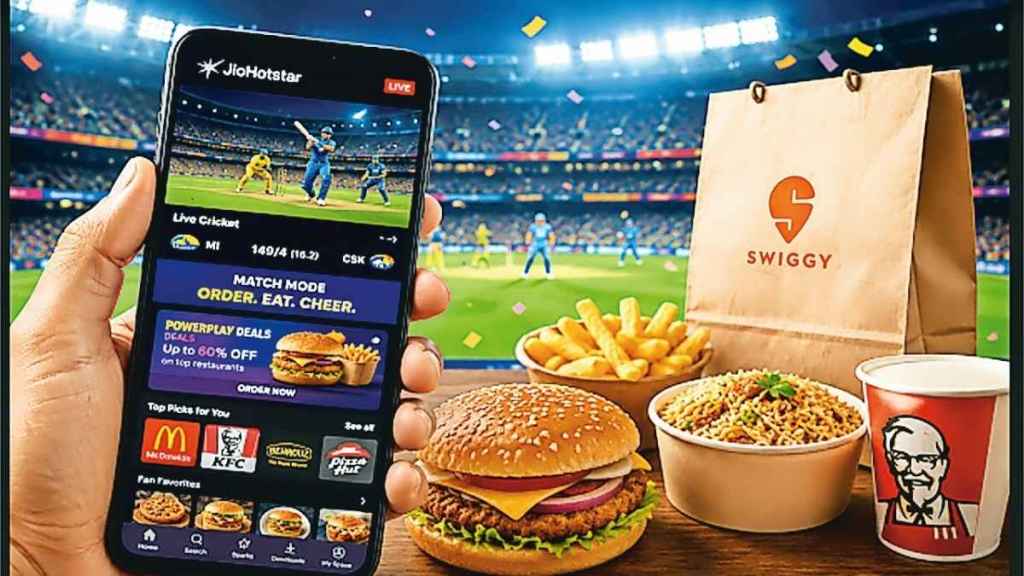

Earlier this year, JioHotstar partnered with food delivery platform Swiggy to introduce an in-app food ordering feature integrated into live cricket streaming on its platform. Designed for mobile users, the feature enabled 37 million users in over 690 cities to order food without moving away from the live cricket action. Though such live shopping partnerships are still uncommon in India, experts say that the response from consumers demonstrates the potential they hold for growth.
While live sports can create immediate and high-intent moments, the opportunity is much broader, opines Bharath Ram, chief product officer, JioHotstar. “Consumers expect to participate, interact and act on their interests without stepping away from the content. In-app commerce is part of this shift, and its value lies in making the experience more convenient for the consumer,” he says. The opportunity extends beyond metro and tier-I markets, since Swiggy and JioHotstar saw a good response across tier-II and III markets too.
The live commerce opportunity in India is unquestionably large, but Aditya Aima, MD, growth markets and co-MD, India & MENA, AnyMind Group, says it is best described as “formative rather than fully developed”. The market is yet to move past experimentation towards everyday consumer behaviour.
India has all the makings of a formidable live commerce market, say experts. As per a report by Boston Consulting Group, there are 2 to 2.5 million creators that are influencing $350-400 billion in annual spending in India. The country’s e-retail shopper base is an estimated 280-300 million, second only to China’s 920 million. In 2024, the country’s live commerce market generated around $4.82 billion in revenue and is projected to grow at a CAGR of 46% through the early 2030s to cross $140 billion by 2033, says a Grand View Research report.
“The driver isn’t the livestream format itself, but rather India’s fast-growing creator economy and a shopper who still trusts a person demonstrating a product more than a page of reviews,” observes Rajnish Rawat, CEO & co-founder, Social Pill. For consumers, especially in categories like fashion and beauty, it adds something that e-commerce has never done well. A real person demonstrating how a product behaves. “That combination of entertainment, urgency and demonstration is a big part of why fashion and apparel remain the largest live commerce category in India,” he adds.
Live commerce also shortens the path from discovery to purchase, observes Viren Vesuwala, lead, strategic partnerships & alliances, White Rivers Media. “It also makes content spends easier to link with sales. Growth will come from formats built around how Indians shop, with a focus on convenience and price,” he adds, noting that the target audience is largely mobile-first. Brands can, therefore, target shoppers at both ends of the market across geographies.
Miles to go
In the last couple of years, e-commerce players such as Flipkart and Myntra have experimented with live commerce initiatives where creators and brands have hosted live sessions. However, experts say that the challenge has been in converting engagement into consistent revenue streams. The biggest hurdle is the country’s fragmented ecosystem, says Tanvi Bosmia, vice-president, business, SoCheers. India deals with lower average order values, distinct regional languages, and split platform behaviours.
This is different from a market like China, which has platforms like Douyin that offer centralised content, creator networks and checkout in one seamless app. “When we seamlessly integrate quick commerce into a live event, we eliminate app-switching friction, capture impulse demand, and deliver advertising dollars into measurable, real-time ROI,” she remarks.
The other major challenge is scalability. “A market as multilingual and diverse as India will require stronger creator-brand matching, better measurement and a combination of human-led livestreams with AI-enabled content that can extend reach across languages and time zones,” suggests Aima, adding that platforms like AnyLive are already doing this in some Asian markets.