


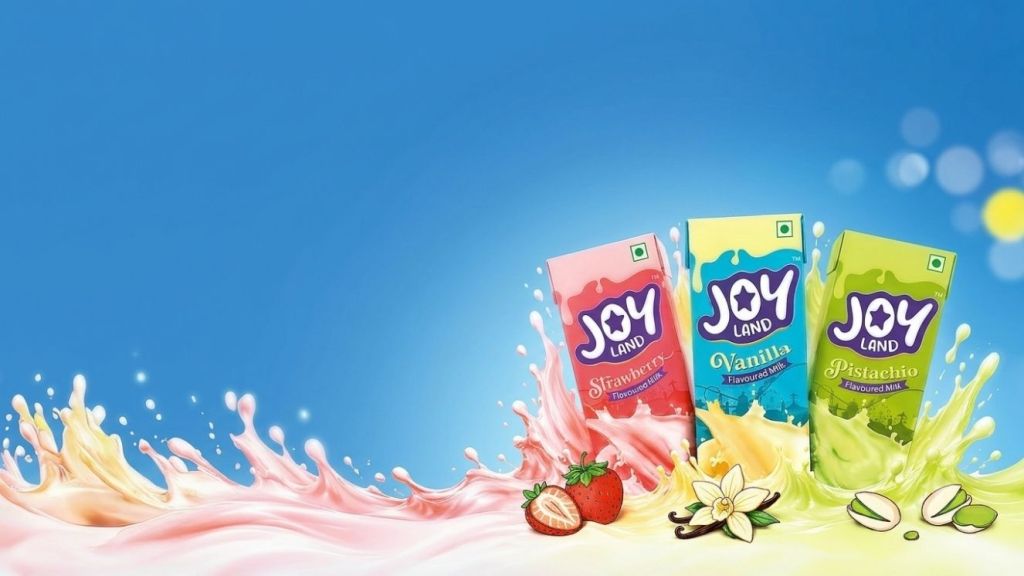

Reliance Consumer Products’ entry into the Rs 8,000-crore ready-to-drink (RTD) dairy beverage market via Tamil Nadu is interesting for at least two reasons.
Together, Tamil Nadu and Karnataka account for nearly a quarter of India’s national market for milk-based RTD beverages. The state already has a strong dairy ecosystem, including regional players such as Cavin’s and national ones such as ITC with Sunfeast Wonderz Milk. Entering this market puts Reliance’s Joyland in direct confrontation with established brands, and before consumers who are familiar with the category and would have developed clear preferences already. Which essentially means Joyland — currently available in strawberry, vanilla, and pistachio flavours in a single-serve format — must work that much harder to earn both shelf space and consumer trust.
On the other hand, by going to market with a processed dairy-based offering rather than staple milk, Reliance Consumer Products has actively sidestepped regional sensitivities regarding milk-shed procurement and local co-operative systems like that of Aavin.
But that doesn’t make the job any easier for Joyland
India’s RTD dairy market is highly competitive. Because Joyland entered the segment at an aggressive price point of ₹20 per pack, it directly challenges powerhouse regional players such as Cavin’s and Milky Mist, besides national players like Amul, Mother Dairy and ITC. That apart, the market is moving rapidly toward functional value-added products with brands like Epigamia, Country Delight and Sid’s Farm focussing on high-protein, organic or lactose-free alternatives and following aggressive expansion plans.
To say Joyland has its task cut out would be an underestimation, says an expert. To start with, “the company will need to understand regional taste preferences, build relationships with local retailers, maintain consistent product quality and ensure that the product is available where target consumers shop”, says strategy consultant Karthik Srinivasan, “The key test is whether trial converts into repeat purchase. The Rs 20 price point could induce a lot of trials but Joyland needs to offer something more than price to make the product a habit,” he adds.
What’s in store
While Reliance Consumer Products’ Campa was able to give global giants like PepsiCo and Coca-Cola a run for their money on the back of its disruptive Rs 10 pricing, experts believe the same playbook will not work for the RTD dairy market. High margins allowed Reliance to deeply undercut competitors (for instance, Rs10 for Campa versus Rs 20 for 250 ml for others). But national players in the dairy-based drinks market like Amul Kool and Parle Agro’s Smoodh already retail around the Rs 20-25 price band.
Nisha Sampath, managing partner, Bright Angles Consulting, says while Joyland could become a meaningful player in the dairy beverage market, especially if positioned as a kids’ treat, it will have a slower, harder-earned growth graph compared with Campa. “It is pertinent to note that Campa already had residual brand awareness, and the added edge of an Indian brand fighting big multinationals. In the case of Joyland, there is no nostalgia, and it is taking on swadeshi co-operatives like Amul and Aavin, which enjoy strong familiarity, trust and perception of value,” she points out.
Reliance is far more likely to succeed in leveraging its distribution muscle and high trade margins, the formula that helped Campa quickly get on to the shelves and keep trade partners interested.
That said, regional and national players in the category have an advantage that Reliance cannot build overnight – decades of consumer trust, brand value and established dairy supply chains. “Amul, Nandini and Aavin already deliver milk to neighbourhood stores every morning, giving them a powerful distribution advantage they can extend to flavoured milk,” says Shekhar Suman, co-founder, Brandshark. He says regional players would do well to not outspend Joyland but outperform in areas like taste, innovation and local flavours.
He adds that new players in a category like dairy need to focus on building consumer trust since it is a category that sells nutrition and health benefits, quite unlike a cola brand. “Reliance has deep pockets and a distribution network that can help it scale quickly, but unlike Campa, Joyland will have to earn loyalty first rather than simply out-manoeuvre competition,” sums up Suman.