



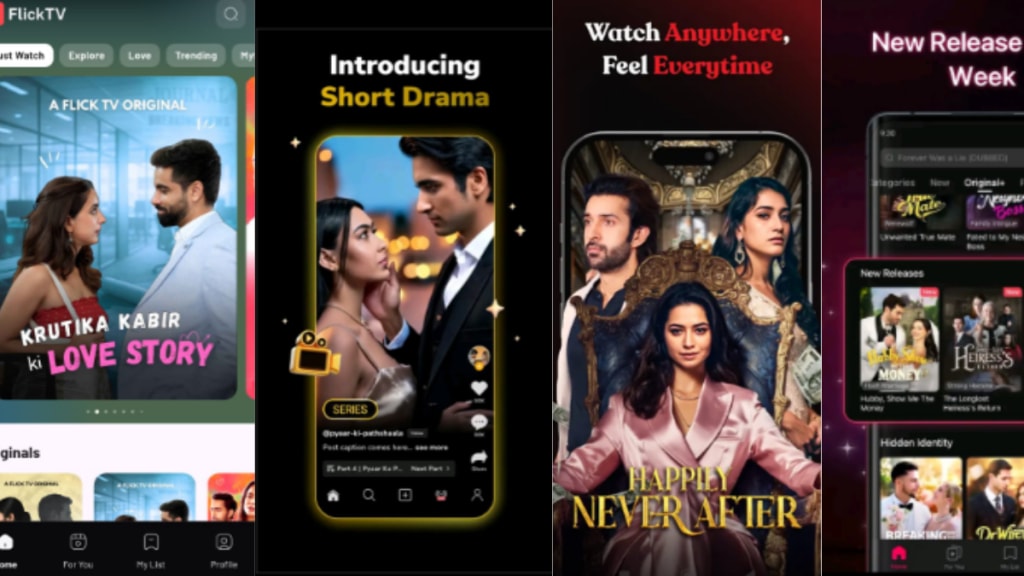
With attention spans shrinking and smartphone usage rising, microdramas have become India’s novelty. Inspired by TikTok, these compact, emotionally charged episodes, typically 90 seconds to two minutes long, emotional potboilers, began as a response to fleeting viewer attention and have grown into a billion-dollar industry riding on regional narratives, mobile-first behaviour, and vernacular storytelling.
In cities like Kanpur, Patna, and Bhubaneswar, microdramas are no longer a novelty. They are now a daily habit for millions, watched in transit, during tea breaks, or late into the night, often in binge-worthy stretches. India’s domestic market for microdramas is expected to touch $5 billion in the next five years. This surge is backed by hard numbers: over 68% of short video platform users now come from smaller cities such as Jaipur, Kanpur, Kota, and Lucknow.
These platforms are further seeing varied levels of user traction. Kuku TV leads with 4.5 million active paying users while ShareChat’s subscription-only app QuickTV has raked up over 5 million downloads. It’s also distributing micro drama through the short video app Moj, which boasts 100 million+ downloads on the Play Store alone. Amazon miniTV follows with over 1 crore downloads, and newer entrant Reelsaga has crossed the 1 lakh mark on app stores.
Cultural realism over cinematic gloss
The success of this format hinges on one crucial factor: relatability. “We are seeing a surge of content being tailored around the everyday lives of people in smaller cities,” Manohar Singh Charan, Co-Founder and CFO of ShareChat & Moj, told financialexpress.com. “This reflects a momentous shift in storytelling to more grounding and humbling. Tier 2 and Tier 3 India is demanding more authentic stories.”
According to recent data, internet users in Tier 2 and Tier 3 locations consume an average of 38–42 GB of data per month, compared to 30–34 GB in metro regions. This high level of digital consumption has created fertile ground for formats that are accessible, affordable, and aligned with local sensibilities.
Rising internet penetration and the proliferation of affordable smartphones have significantly expanded access to digital entertainment across India’s non-metro markets. Microdrama apps, with their low data consumption and flexible pricing, have capitalised on this shift, making screen-based storytelling both accessible and affordable for a wider audience.
Furthermore, these Indian microdrama platforms follow a range of monetisation models tailored to a price-sensitive market.
Kuku TV operates on a pure subscription model with plans priced at Rs 399 quarterly and Rs 899 annually, along with a Rs 2 refundable trial.
ReelSaga adopts a freemium approach, offering initial content for free with a 7-day trial for its premium tier, with a pricing set at Rs 133 for a month.
Sources reveal that the pricing will be based upon the production costs for the originals. Moj offers ad-supported content while Quick TV is subscription-based.
Bullet, housed within the ZEE5 ecosystem, seems to leverage ZEE5’s existing subscription pricing—Rs 320 monthly or Rs 1,949 annually for premium, with regional packs starting at Rs 120.
Amazon miniTV is entirely free, monetising through advertising alone.
Platforms like DramaBox rely on a coin-based system for episodic access, with in-app purchases ranging from Rs 99 to Rs 8,000, drawing user criticism over unclear pricing and poor value delivery.
Charan adds that it’s not just the ‘what’ but the ‘how’ that matters; content rooted in family life, aspirations, and social identity now drives deeper connections than high-concept narratives imported from global streaming playbooks. Shubh Bansal, Co-Founder of ReelSaga, echoed the sentiment: “We focus on relatable, day-to-day storytelling that mirrors real life in Bharat… Romance, family conflict, and socially-charged drama with a twist consistently outperform other genres.”
The format that fits
The microdrama model, short episodes, typically 1–2 minutes long, bundled into longer story arcs, dovetails perfectly with how audiences in smaller cities consume content: frequently, but in fragments. On Moj alone, 100 million microdrama episodes are watched daily by over 15 million users, often in “micro-binge” sessions of 5–10 episodes.
While Tier 1 audiences may flirt with experimental formats, Tier 2 and 3 viewers show a steadfast preference for what they know and feel. “Bharat audiences prioritise relatability… stories that reflect their own social context, values, and aspirations,” said Charan. And that connection is not fleeting; daily watch times range from 40 to 90 minutes across platforms, with completion rates reportedly exceeding 90%.
Built in Bharat, for Bharat
A major catalyst for this boom is the strategic focus on vernacular storytelling. Over 83% of India’s internet users now come from non-metro regions, many of whom are first-generation digital consumers more fluent in Hindi, Tamil, Telugu, or Bhojpuri than in English. More than 50% of microdrama audiences prefer content in their native languages.
“We noticed that when we re-produced the stories in regional languages with indigenous characters and talent, they turn out to be more relatable and perform a lot better. We found that the completion rate doubles for regionally contextualised variants,” Charan noted. ReelSaga’s approach reinforces this. “Localisation is not just language—it’s cultural intuition, and that’s key to deep engagement,” Bansal said.
Monetising micro-moments
Platforms have adopted a shrewd blend of monetisation models to suit these price-sensitive but highly engaged markets. While Moj has leaned heavily into ad-supported content, QuickTV has opted for an ad-free, subscription-based experience.
“In Tier 2 and 3 markets, we are observing a clear trend where audiences are more inclined to engage with ad-supported content,” Charan explained. “They do not mind higher ad loads… We pride ourselves on being the only platform in the country serving free-to-watch micro-drama content at scale.” Others are experimenting with hybrid models. The gamified nature of many platforms, daily check-ins, rewards, and premium unlocks further boosts user retention.
This strategy is already bearing fruit. Tier 2 and 3 audiences account for 70% of the user base on platforms like Moj and contribute nearly 50% of their revenue. For newer platforms like ReelSaga, the majority of both users and revenue are sourced from these cities, where digital literacy and mobile penetration are now on par with urban centres.
Beyond metro myopia
This shift is not just about new formats, it’s about a recalibration of India’s content economy. Infrastructure upgrades, affordable data, and increasing disposable income in smaller cities have created an ideal storm for platforms willing to look beyond the metro-first model.
“India’s next 500M entertainment users live outside metros, and they want stories that feel like theirs,” Bansal said. “From script development to casting, we design for these audiences.”
Yet, the long-term potential remains substantial. With India’s internet user base projected to cross one billion by 2030, and regional language consumption expected to comprise over half of OTT content by 2025, microdramas are well-positioned to define the next decade of digital entertainment.